
Last updated March 2026
When a child is arrested, confusion and fear set in immediately. Many parents are unsure what they are allowed to do — or what they should refuse to do — in the first critical hours.
For a broader overview of how juvenile arrests, detention hearings, diversion, and filing decisions work in Broward County, see our guide to Juvenile Crimes in Fort Lauderdale.
Understanding your rights as a parent can protect your child from making damaging statements, consenting to unlawful searches, or facing unnecessary escalation.
📞 Right to Be Notified of an Arrest
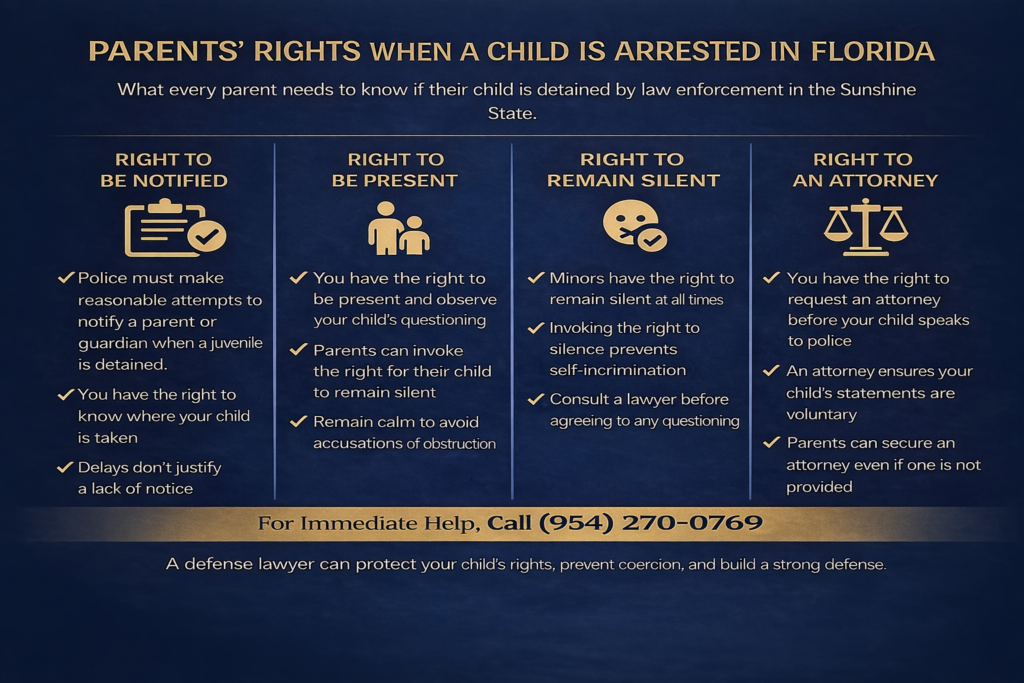
In most situations, law enforcement must make reasonable efforts to notify a parent or legal guardian when a juvenile is taken into custody.
This includes:
Notification of arrest
Location of detention
Information about upcoming hearings
However, notification does not always occur immediately — and questioning may begin before a parent arrives.
Prompt action matters.
🧑⚖️ Right to Attend the Detention Hearing
If a juvenile is held in custody, Florida law requires a detention hearing within 24 hours.
At this hearing, a judge decides whether the child will:
Be released
Be placed on home detention
Remain in secure detention
Parents have the right to attend and provide relevant information about school enrollment, home stability, and supervision.
Early preparation can influence release decisions significantly.
🗣️ Right to Protect a Child From Self-Incrimination
One of the most important rights parents must understand:
Your child does not have to answer police questions.
Police may question a minor without a parent present under certain circumstances. However, statements obtained improperly may later be challenged.
If your child has been questioned — especially without you present — see our detailed breakdown here: Can Police Interrogate a Minor Without a Parent Present in Florida?
The safest course is to clearly state that your child will not answer questions without an attorney.
📱 Right to Refuse Consent to Searches
Parents often unknowingly consent to searches of:
Phones
Bedrooms
Vehicles
Digital devices
Unless officers have a warrant or a valid exception to the warrant requirement, consent may be required.
Once consent is given, it can be difficult to undo.
If a device search has already occurred, suppression issues may still be available.
⚖️ Right to Seek Diversion Instead of Prosecution
Many first-time juvenile cases qualify for diversion programs instead of formal court processing.
Diversion can:
Prevent adjudication
Avoid probation
Preserve expungement eligibility
Reduce long-term record consequences
To understand how diversion works in Broward County, see our guide to Juvenile Diversion Programs in Broward County.
Early advocacy often determines whether diversion is offered.
🚨 Right to Challenge Adult Prosecution (Direct File)
In serious cases, prosecutors may consider transferring a juvenile to adult criminal court through direct file.
This dramatically increases exposure and long-term consequences.
Parents have the right to seek legal counsel immediately to prevent or challenge adult prosecution.
The window to intervene may be short.
🔒 Right to Protect Future Record Eligibility
Even if a juvenile case resolves favorably, records may remain unless properly addressed.
Parents have the right to pursue record-clearing options when eligible.
Protecting eligibility begins at the moment of arrest.
🛡 What Parents Should Do Immediately
If your child is arrested:
❌ Do not allow questioning without counsel
❌ Do not consent to phone searches
❌ Do not assume the case will “just go away”
❌ Do not rely on verbal promises
Instead:
✅ Contact a juvenile defense attorney immediately
✅ Gather school and background records
✅ Avoid discussing the case on social media
✅ Attend all hearings
The first 24–48 hours often shape the outcome.
📞 Arrested in Broward County?
When a child is arrested, the decisions made in the first hours can determine whether the case ends in diversion — or escalates into long-term consequences.
Contact Michael White, P.A. for a confidential consultation with a former prosecutor who defends juveniles across Broward County with one goal: protecting the future.
❓ Frequently Asked Questions
1) Can I be present when police question my child in Florida?
Not always. Police may question a minor without a parent physically present in some situations. However, parents can and should clearly state that the child will not answer questions without an attorney, and request that questioning stop until counsel is involved.
2) What happens at a juvenile detention hearing in Florida?
If a child is held in custody, a judge must hold a detention hearing within 24 hours. The judge decides whether the child is released, placed on home detention, or held in secure detention while the case continues.
3) Should I consent to a search of my child’s phone or give police passwords?
Usually no. Consenting to a phone or device search can create evidence that would not otherwise be available. If police believe they have legal authority to search, they can seek a warrant. Families should speak with an attorney before consenting to any search or providing passwords.