
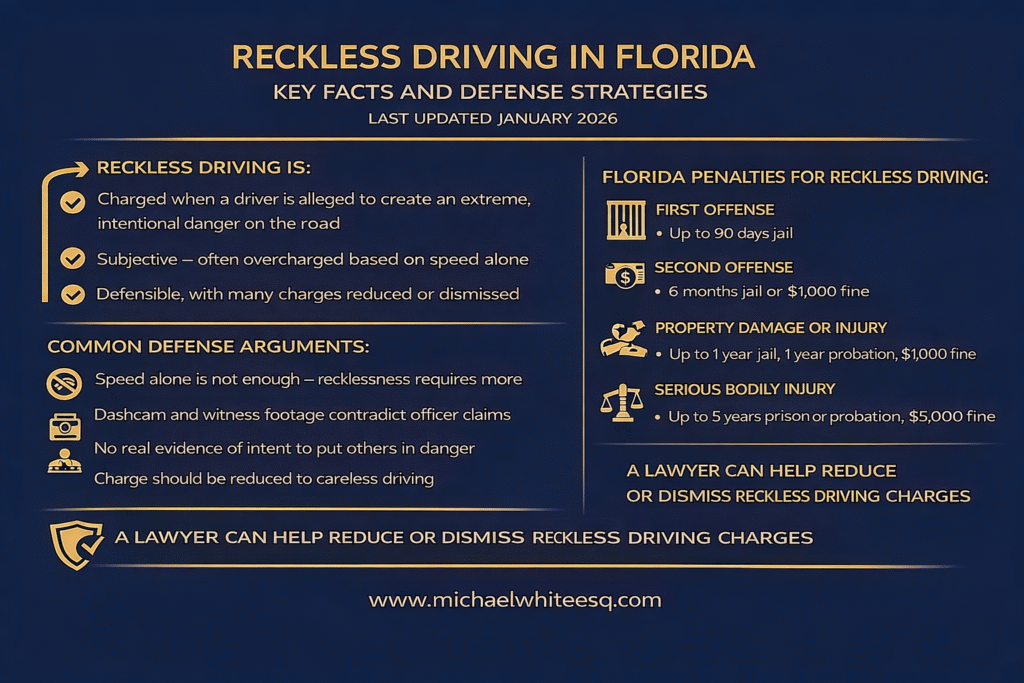
Last updated February 2026
🚗 Reckless Driving in Florida: What You Need to Know
Reckless driving is one of the most aggressively charged traffic crimes in Florida. What begins as speeding, aggressive driving, or a questionable traffic stop can quickly escalate into a criminal prosecution — even when the evidence does not support it.
Unlike careless driving, reckless driving is a criminal offense, not a traffic infraction. A conviction can lead to jail, probation, license consequences, increased insurance rates, and a permanent criminal record.
But reckless driving cases are also highly defensible when handled strategically.
This page explains:
What legally qualifies as reckless driving
How prosecutors attempt to prove it
Why it is often overcharged
How these cases are reduced or dismissed
How reckless driving fits within Florida’s broader traffic crime system
⚖️ What Counts as Reckless Driving in Florida?
Under Florida law, reckless driving requires more than bad driving or a mistake.
To convict someone, the State must prove beyond a reasonable doubt that:
You were driving a motor vehicle, and
You acted with willful or wanton disregard for the safety of persons or property.
That standard is significantly higher than negligence.
🧠 What “Willful or Wanton” Actually Means
Willful = intentional or purposeful conduct
Wanton = conscious disregard of a known risk likely to cause harm
Speed alone, momentary poor judgment, or a single traffic violation usually does not meet this threshold.
This is where many reckless driving prosecutions fail.
🚨 Why Reckless Driving Is Often Overcharged
Reckless driving is inherently subjective.
Officers often rely on:
Personal opinions about danger
Visual speed estimates
Assumptions about risk
Aggressive driving characterizations
But criminal charges require proof — not conclusions.
Common overcharging scenarios include:
High speed on an empty roadway
Lane changes without near-collisions
“Aggressive driving” with no dashcam evidence
Conduct more consistent with careless driving
In many cases, reckless driving is charged because it provides greater leverage for prosecutors.
🛡️ Common Defenses to Reckless Driving Charges
Reckless driving cases are often reduced or dismissed once the evidence is examined closely.
🔹 Speed Alone Is Not Enough
Excessive speed does not automatically equal recklessness. The State must prove conscious disregard for safety.
🔹 Lack of Actual Danger
If no one was endangered and no property was at risk, proving willful or wanton conduct becomes difficult.
🔹 Officer Opinion vs. Objective Evidence
Courts require specific, articulable facts — not generalized statements.
Dashcam footage frequently contradicts reckless allegations.
🔹 Reduction to Careless Driving
One of the most common outcomes is reduction to careless driving, a civil infraction.
🔹 Dismissal After Discovery
Weak or inconsistent evidence often leads to dismissal following depositions or motion practice.
🍺 What Is a “Wet Reckless” in Florida?
A “wet reckless” is not a separate statutory charge. It is a negotiated plea in which a DUI charge is reduced to reckless driving.
This typically occurs when:
Breath or blood results are borderline
There are evidentiary weaknesses in the DUI case
The State faces proof challenges
Although a wet reckless may carry reduced penalties compared to a DUI, it remains a criminal conviction.
Because wet reckless cases involve unique strategic considerations — including immigration consequences, professional licensing implications, and sealing eligibility — they are treated differently from standard reckless driving cases.
👉 Learn more about Wet Reckless in Florida.
📋 Florida Penalties for Reckless Driving
Penalties depend on circumstances and prior history.
🔸 First Offense (No Injury or Damage)
Second-degree misdemeanor
Up to 90 days jail
Up to 6 months probation
Up to $500 fine
🔸 Second Offense
Second-degree misdemeanor
Up to 6 months jail
Up to $1,000 fine
🔸 Reckless Driving With Property Damage or Injury
First-degree misdemeanor
Up to 1 year jail
Up to 1 year probation
Up to $1,000 fine
🔸 Reckless Driving With Serious Bodily Injury
Third-degree felony
Up to 5 years in prison or probation
Up to $5,000 fine
Felony reckless driving can dramatically change the trajectory of a case.
🚦 How Reckless Driving Fits Within Florida’s Criminal Traffic System
Reckless driving sits between civil infractions and more serious felony traffic offenses.
It frequently intersects with:
Driving With a Suspended License
Habitual Traffic Offender (HTO) consequences
Fleeing & Eluding charges
Leaving the Scene allegations
Repeated convictions may increase exposure to Habitual Traffic Offender designation.
👉 Learn more about Habitual Traffic Offender (HTO) in Florida.
👉 Explore our overview of Florida Traffic Crimes Defense.
Understanding this escalation structure is critical to long-term defense strategy.
🧑⚖️ Why Early Legal Intervention Matters
Because reckless driving is a criminal offense, early case strategy can influence:
Charging decisions
Diversion eligibility
Reduction opportunities
Immigration impact
Professional licensing consequences
Waiting limits options.
Early review expands them.
👨⚖️ Fort Lauderdale Reckless Driving Defense Lawyer
If you’ve been charged with reckless driving in Fort Lauderdale or anywhere in South Florida, do not assume the case will resolve itself.
As a former prosecutor, Michael White understands how reckless driving cases are built — and how they are dismantled.
Strategic early intervention often makes the difference between:
A criminal conviction
A reduced civil infraction
A dismissed charge
📞 Call (954) 270-0769 or schedule a free consultation to protect your record and your future.
❓ Reckless Driving in Florida – FAQs
What’s the difference between reckless and careless driving?
Reckless driving requires proof of willful or wanton disregard for safety. Careless driving is based on simple negligence and is a civil infraction.
Is reckless driving a felony in Florida?
Usually no, but it becomes a felony if serious bodily injury is involved.
Can reckless driving charges be reduced?
Yes. Many cases are reduced to careless driving or dismissed entirely when the evidence is challenged.
Will reckless driving show up on my criminal record?
Yes. Reckless driving is a criminal offense and appears on your record if convicted.
Can I go to jail for reckless driving?
Yes, particularly for repeat offenses or cases involving injury or damage — but jail is often avoidable with proper defense strategy.