
Last updated February 2026
If you are stopped for DUI in Florida and an officer asks you to submit to a breath test, you may wonder whether you can legally refuse. The answer is yes — but refusing now carries far more serious consequences than it once did.
Florida’s DUI refusal laws changed significantly on October 1, 2025, under legislation commonly referred to as Trenton’s Law. Refusal cases are no longer limited to license consequences and evidentiary arguments. In many situations, a first refusal can now expose a driver to a new criminal charge.
Because of these changes, refusal cases turn less on the act of refusing itself and more on whether law enforcement strictly followed the law before, during, and after the request for testing.
A breath test refusal does not exist in a vacuum. Refusal cases are part of Florida’s broader DUI testing framework, which also includes breath, blood, and urine testing — each governed by strict legal and procedural requirements. To understand how refusal fits into the larger testing picture, see our guide to Florida DUI testing.
📜 Florida’s Implied Consent Law
Florida drivers are subject to the state’s implied consent law. By operating a motor vehicle, a driver is deemed to have consented to submit to breath, blood, or urine testingafter a lawful DUI arrest.
Refusal is legally permitted, but consequences attach only if:
The stop was lawful
The arrest was lawful
The officer had legal authority to request testing
The implied consent warnings were correctly given
If any of these elements are missing, both the refusal and its penalties may be challenged.
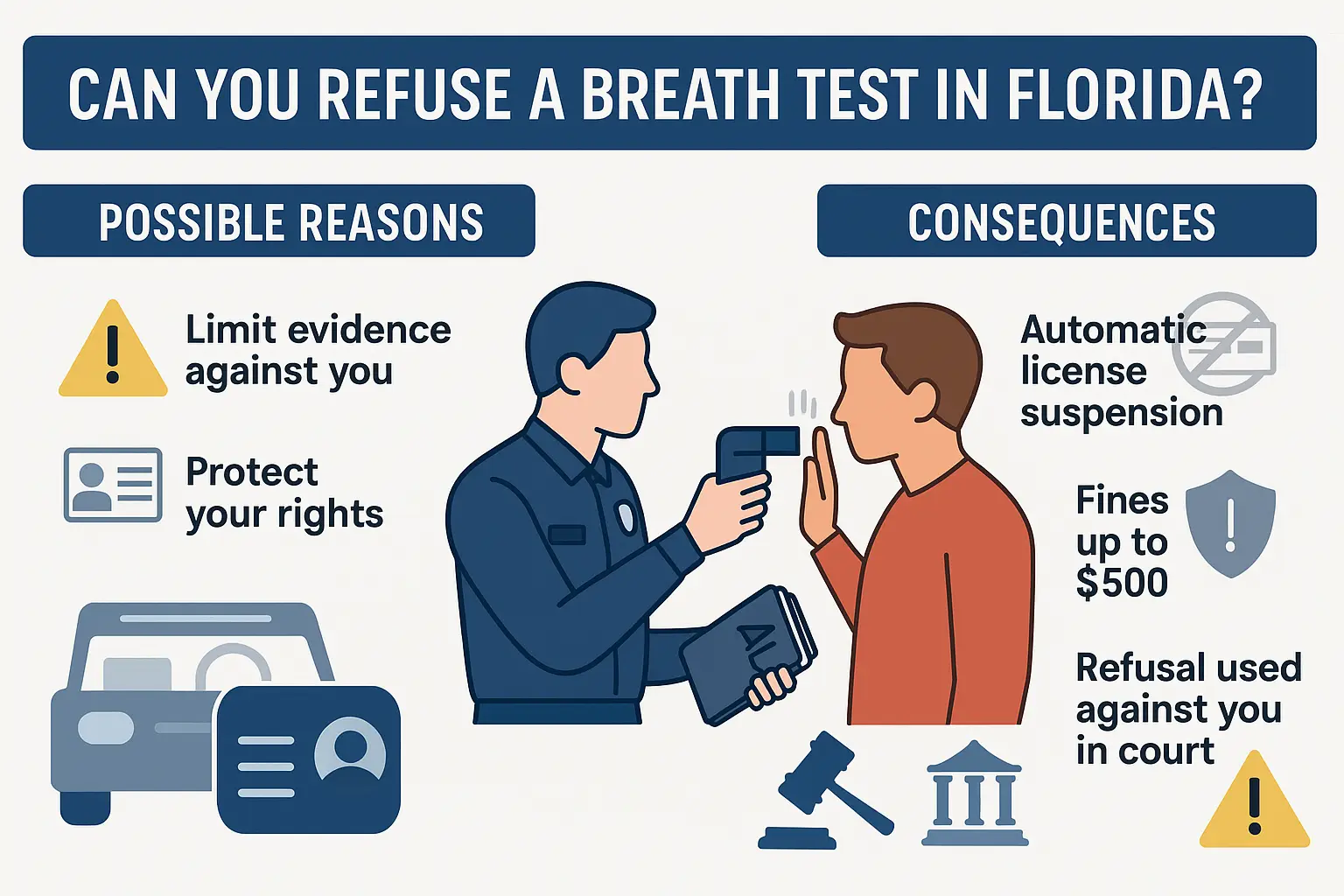
⚠️ Potential Consequences of Refusing a Breath Test in Florida
| Refusal History | License Consequences | Criminal Consequences |
|---|---|---|
| First refusal | 1-year administrative suspension | May be charged as a misdemeanor after 10/1/2025 |
| Second or subsequent refusal | 18-month suspension | Separate first-degree misdemeanor |
Administrative refusal penalties are separate from any DUI conviction penalties, meaning license suspensions and other consequences may overlap or “stack” depending on how the case resolves.
In fact, after October 1, 2025, a refusal is no longer merely an administrative or strategic issue. A first refusal may now expose a driver to criminal prosecution, depending on the facts of the stop, the warnings given, and the nature of the DUI investigation.
Refusing also does not prevent a DUI charge. Prosecutors may still rely on officer observations, field sobriety exercises, video footage, and witness testimony.
🩸Breath vs. Blood Test Refusals in Florida
Breath test refusals and blood test refusals are treated differently under Florida law. Breath testing is the most common request following a DUI arrest, while blood testing typically arises in cases involving crashes, injuries, or suspected drug impairment.
In some situations, officer may seek a warrant for a blood draw after a refusal. A refusal does not automatically prevent testing if a valid warrant is obtained, and the legal consequences may differ depending on how the State proceeds.
In crash or serious bodily injury cases, officers may obtain a warrant for a blood draw, meaning a breath refusal does not necessarily prevent chemical evidence from being introduced.
For this reason, refusal decisions made at the roadside versus in a medical setting can carry very different legal consequences.
⚖️ When Refusing a Breath Test May Help — or Hurt
Refusal is not inherently good or bad. It is a high-risk strategic decision whose impact depends on the specific facts of the case.
Refusal may help when:
A breath result would likely be extremely high
The legality of the stop or arrest is questionable
Field sobriety evidence is weak or poorly documented
Refusal may hurt when:
The driver has a prior refusal or DUI history
Driving privileges are essential for work or caregiving
The State has strong video, crash, or witness evidence
After Trenton’s Law, refusal also carries criminal exposure, which must be weighed alongside any perceived evidentiary benefit.
⏱️ The 10-Day Rule After a Breath Test Refusal
A driver who refuses testing has 10 days from the date of arrest to request a formal review hearing with the Florida DHSMV to challenge the license suspension.
Missing this deadline:
Triggers the suspension automatically
Permanently limits defenses to the suspension
Narrows or delays hardship license eligibility
Even if the DUI or refusal charge is later dismissed, failing to act within 10 days can have lasting license consequences.
🛡️ How DUI Refusal Cases Are Defended in Florida
Florida law allows prosecutors to argue that a refusal reflects “consciousness of guilt.” This argument can be powerful with juries unless the defense demonstrates alternative explanations, such as medical limitations, confusion during implied consent warnings, anxiety, or officer coercion.
Modern refusal cases are litigated as full criminal matters, not just license disputes. Defense strategy typically focuses on four core areas:
1️⃣ Unlawful Stop or Arrest
If officers lacked reasonable suspicion or probable cause, the breath request — and any refusal — may be invalid.
2️⃣ Defective Implied Consent Warnings
Officers must strictly comply with statutory warning requirements. Errors in wording, timing, or delivery can defeat both administrative and criminal refusal charges.
3️⃣ Was It a True Refusal?
Medical limitations, language barriers, confusion, panic, or equipment issues are often mischaracterized as refusal. Body-worn camera footage frequently tells a different story.
4️⃣ Criminal vs. Administrative Leverage
Weaknesses exposed at the DHSMV hearing often translate directly into leverage in the criminal case, especially under the post-2025 refusal framework.
When officers violate constitutional or statutory requirements, defense counsel may seek to exclude refusal evidence and other DUI evidence through suppression.
🆕 Trenton’s Law (Effective October 1, 2025): What Changed
Effective October 1, 2025, Florida enacted Trenton’s Law, which significantly expanded criminal liability for refusing DUI testing.
Whether a first refusal is criminally charged depends on the specific statutory predicates alleged by the State and remains highly fact-dependent, making early case analysis critical.
Before this change, criminal penalties were generally limited to second or subsequent refusals. Under Trenton’s Law, a first refusal may now be charged as a misdemeanor, depending on the circumstances of the arrest and investigation.
Key Impacts of Trenton’s Law
First-time refusals may now carry criminal exposure
Prosecutors scrutinize refusal cases more aggressively
Minor procedural defects now carry greater consequences
Early legal review is more important than ever
Post-October 2025 refusal cases require close examination of:
Whether officers had lawful authority to demand testing
Whether implied consent warnings were exact and complete
Whether the refusal was clear, voluntary, and unequivocal
Whether the refusal charge itself is legally sustainable
Drivers arrested after October 1, 2025 should not rely on outdated refusal advice. The risks — and the defense opportunities — have materially changed.
🚗 How Refusal Cases Interact With DUI Testing Issues
Refusal cases frequently overlap with broader DUI testing problems. If officers rushed procedures, skipped steps, or lacked legal grounds to request testing, those failures can undermine both the refusal charge and the underlying DUI case.
❓ FAQs
1) Can I legally refuse a breath test in Florida?
Yes, but refusal carries mandatory license suspension and can be used against you in court.
2) What happens after a first refusal?
You face a 1-year license suspension and, after October 1, 2025, may also face criminal charges depending on the facts of the case.
3) What if I’ve refused more than once?
A second refusal leads to an 18-month suspension and a separate misdemeanor.
4) Can refusal be challenged in court?
Yes. Defense often focuses on improper warnings, unlawful stops, or medical inability.
5) Can a lawyer help me get my license back?
Yes. Attorneys can request a DMV hearing within 10 days, seek a hardship license, and fight the suspension in court.
🚫 What Not To Do After a Breath Test Refusal
After a refusal, drivers often make decisions that unintentionally damage otherwise defensible cases. Common mistakes include:
Making statements about drinking patterns without legal advice
Assuming refusal alone prevents a DUI conviction
Missing the 10-day deadline to challenge the suspension
Relying on outdated advice that no longer applies after October 1, 2025
Refusal cases now carry criminal exposure. Early missteps can close off defenses that might otherwise succeed.
📞 Refused a Breath Test in Florida? Act Immediately.
Refusal cases now move fast and carry criminal exposure from the outset. Early mistakes by law enforcement can create powerful defenses — but only if they are identified and preserved quickly.