
Last updated March 2026
Florida’s sealing and expungement laws are strict.
Many people qualify — but many are disqualified for technical reasons that are not obvious.
If your petition was denied — or you’ve been told you’re ineligible — the reason usually falls into one of a few statutory categories.
👉 For a full overview of Florida’s record-clearing framework, start here: Sealing & Expungement in Florida
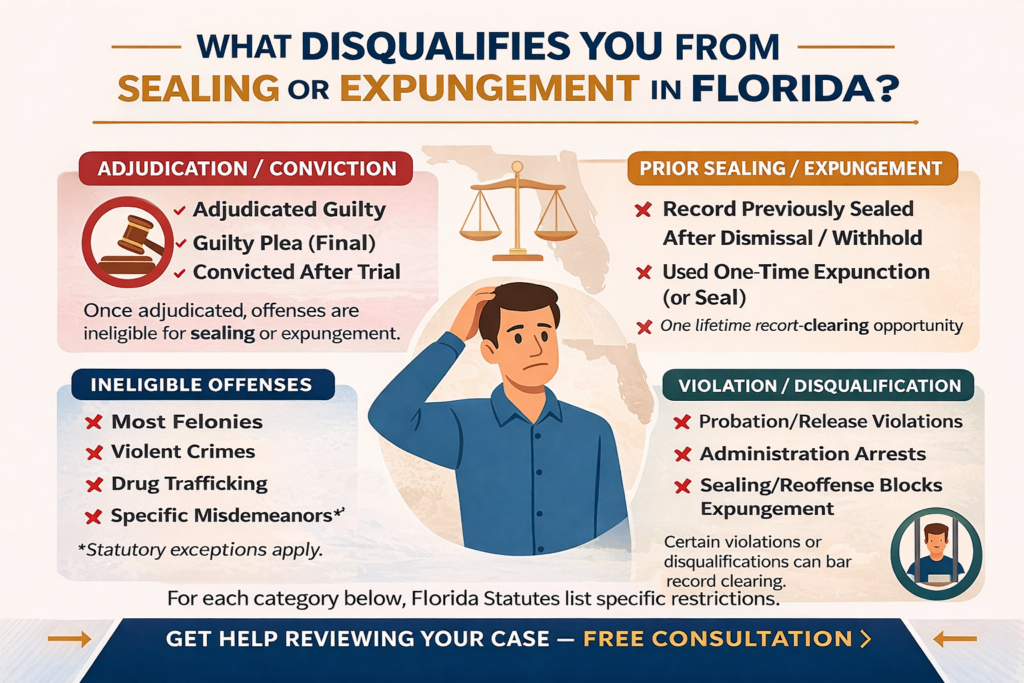
⚖️ 1. Any Prior Criminal Conviction
The most common disqualifier is a prior conviction.
Under Florida law:
If you have ever been adjudicated guilty of any criminal offense, you are generally not eligible for sealing or expungement.
This includes convictions in other states.
A withhold of adjudication is not a conviction — but an adjudication of guilt is.
Even one prior conviction can permanently bar record-clearing relief.
🛑 2. A Prior Sealing or Expungement
Florida generally allows only one sealing or expungement in a lifetime under:
Fla. Stat. § 943.0585 (expunction)
Fla. Stat. § 943.059 (sealing)
If you previously sealed or expunged a case from a separate criminal episode, you are usually barred from clearing another.
This rule applies even if:
The prior case was minor
It happened years ago
The new case was dismissed
Limited, technical exceptions exist — but they are rare and fact-specific.
📋 3. Disqualifying Offenses Listed by Statute
Certain offenses are statutorily ineligible, even if:
The case was dismissed
You received a withhold of adjudication
The arrest was years ago
Florida maintains a list of offenses that cannot be sealed, including many:
Violent crimes
Sexual offenses
Certain domestic violence–related offenses
Child abuse–related charges
Some repeat or serious felony offenses
The exact statutory language controls eligibility — not the common name of the offense.
⚖️ 4. Adjudication of Guilt in the Case You Want to Clear
Even if you have no prior convictions, you cannot seal or expunge a case where:
You were adjudicated guilty
The judge entered a conviction
You pled guilty and adjudication was entered
Expungement is generally limited to cases that ended in:
Dismissal
Nolle prosequi
No action
Not guilty verdict
Sealing is typically available only if adjudication was withheld.
👉 For a breakdown of that distinction, see: Sealing vs. Expunging Criminal Records in Florida
⏳ 5. Pending Charges or Open Cases
You are generally not eligible for sealing or expungement if:
You have any pending criminal charges
A case is still open
The court record incorrectly shows an active status
Even administrative errors can delay or defeat eligibility.
🔁 6. Multiple Separate Criminal Episodes
Florida’s one-time rule applies to separate criminal incidents.
If you are attempting to clear multiple cases from different dates or unrelated events, you may be barred — even if none resulted in conviction.
However, multiple charges from the same arrest may qualify as one record-clearing event.
👉 Learn more: Can You Seal or Expunge Multiple Arrests From the Same Incident?
🧠 7. Misinterpreted Case Outcomes
Many disqualifications are based on misunderstandings.
Common examples:
A withhold mistaken for a conviction
A dismissed charge recorded incorrectly
Separate case numbers treated as separate incidents
Out-of-state records misclassified
Background checks listing arrests without final disposition
Eligibility requires reviewing the actual court disposition — not just what appears online.
📌 Why “Close” Still Means Ineligible
Florida’s statutes do not allow courts to make exceptions based on:
Hardship
Employment needs
Time passed
Good behavior
Rehabilitation
Eligibility is determined strictly by statute.
If you fall into a disqualifying category, the court has no discretion to override it.
🛡️ What We Review Before Filing
Before submitting an FDLE application or petition, we evaluate:
✔ Every prior arrest and disposition
✔ Whether adjudication was entered
✔ Whether any offense appears on the statutory disqualifier list
✔ Prior sealing or expungement usage
✔ Whether multiple cases qualify as one incident
✔ Whether any pending charges exist
Many denials happen because these issues were not identified early.
📞 Unsure Whether You’re Disqualified?
Being told “you don’t qualify” is not always the final answer — but Florida law is technical.
If you are unsure whether a prior conviction, prior sealing, or specific offense bars you from relief, we can review your record and determine your eligibility with precision.
👉 Schedule a consultation today.
❓ FAQs — Disqualifications for Sealing & Expungement
What automatically disqualifies you from expungement in Florida?
A prior adjudication of guilt, a prior sealing or expungement, certain statutorily disqualified offenses, or pending charges can all bar eligibility.
Can I seal a record if I was convicted of a different offense years ago?
Generally no. Any prior adjudication of guilt typically prevents sealing or expungement.
Does a withhold of adjudication disqualify me?
No. A withhold is not a conviction — but the offense itself must still be eligible for sealing.
What if my background check says I was convicted but I wasn’t?
Clerical errors and database inaccuracies are common. Eligibility should be confirmed using certified court records.
Can a judge make an exception if I’m close to qualifying?
No. Florida’s sealing and expungement statutes are strictly applied.