
Last updated February 2026
Being threatened or confronted doesn’t automatically make you a criminal.
But in Florida, the line between lawful self-defense and criminal assault is often misunderstood — by police, alleged victims, and sometimes even prosecutors.
Understanding where that line is drawn can mean the difference between dismissal and charges moving forward.
This page explains how Florida distinguishes assault from self-defense, and when Stand Your Ground protections may apply.
⚖️ The Core Difference: Assault vs. Self-Defense
Florida law treats these concepts very differently:
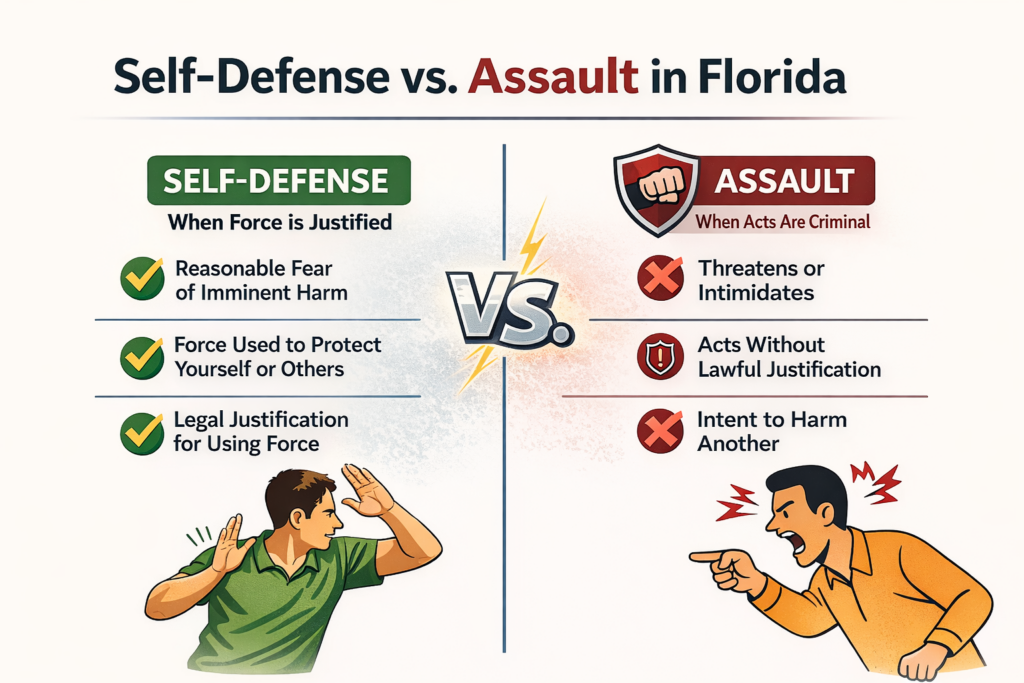
Assault is a crime — based on an unlawful threat that causes fear of imminent violence.
Self-defense is a legal justification — raised when force or threats were used to prevent imminent harm.
The same conduct can be viewed either way depending on intent, timing, and context.
That’s why these cases often hinge on how events are framed in the earliest police reports.
⚔️ How Florida Defines Assault
Under Florida law, assault requires proof of three elements:
An intentional threat by word or act
An apparent ability to carry out the threat
A well-founded fear that violence was imminent
Physical contact is not required.
If prosecutors can prove all three elements — and no legal justification applies — an assault charge may stand.
For a full breakdown of how assault charges work statewide, see our guide to assault charges in Florida.
🛡️ Where Self-Defense and Stand Your Ground Come In
Florida law allows people to use or threaten force when they reasonably believe it is necessary to prevent imminent harm.
Under the Stand Your Ground framework, there is no duty to retreat if you are lawfully present and not engaged in criminal activity.
In practical terms, this means:
A threat that might otherwise look like assault
can be legally justified if it was made to stop an immediate danger.
This distinction is critical — and frequently contested.
For a complete explanation of how self-defense and Stand Your Ground immunity work in Florida, see
self-defense and Stand Your Ground in Florida.
🚫 When Stand Your Ground Usually Does Not Apply
Stand Your Ground protections may fail when:
You were the initial aggressor
You provoked the confrontation
The threat was retaliatory rather than preventative
There was no reasonable fear of imminent harm
These are the pressure points prosecutors rely on to reframe self-defense as assault.
🧠 How These Cases Are Actually Defended
Successful defenses often focus on:
Intent — were the words or actions meant to threaten, or to deter harm?
Immediacy — was danger truly imminent, or exaggerated after the fact?
Context — what happened before and after the alleged threat?
Evidence — video, 911 audio, injuries, witness credibility
Many assault cases collapse once the defense reframes the conduct as lawful self-defense rather than unlawful aggression.
📍 Facing Assault Charges After Defending Yourself?
Being arrested does not mean the law was applied correctly.
If police or prosecutors misinterpret self-defense conduct as assault, early legal intervention matters. These cases are often won before trial, when evidence is preserved and the narrative is corrected.
📞 Call Michael White, P.A. to discuss whether self-defense or Stand Your Ground protections apply in your case.
❓FAQs
What’s the difference between assault and self-defense in Florida?
Assault is an unlawful threat; self-defense is a lawful justification when force or threats are used to prevent imminent harm.
Can Stand Your Ground apply outside the home?
Yes. It applies anywhere you are lawfully present, including public places.
Can I still be arrested even if I acted in self-defense?
Yes. The legality of self-defense is often litigated after arrest.
Who decides if Stand Your Ground applies?
Ultimately, a judge decides immunity issues before trial if properly raised.