
Last updated February 2026
Being accused of domestic violence can be devastating — especially when you were acting in self-defense. Florida’s Stand Your Ground law can provide powerful protection for people who used force because they reasonably believed they were in imminent danger.
In domestic violence cases, Stand Your Ground can sometimes result in immunity from prosecution, meaning the charges are dismissed before trial.
This page explains how Stand Your Ground works in Florida domestic violence cases, when it applies, and how these claims are evaluated by judges. It focuses specifically on self-defense immunity.
For a broader overview of domestic violence charges and defense strategy, see our Domestic Violence Defense guide.
⚖️ What Is Florida's Stand Your Ground Law?
Florida’s Stand Your Ground law is primarily found in Fla. Stat. § 776.012 and § 776.032.
In general, the law allows a person to use force — including deadly force — if they reasonably believe it is necessary to prevent:
Imminent death
Great bodily harm
The commission of a forcible felony
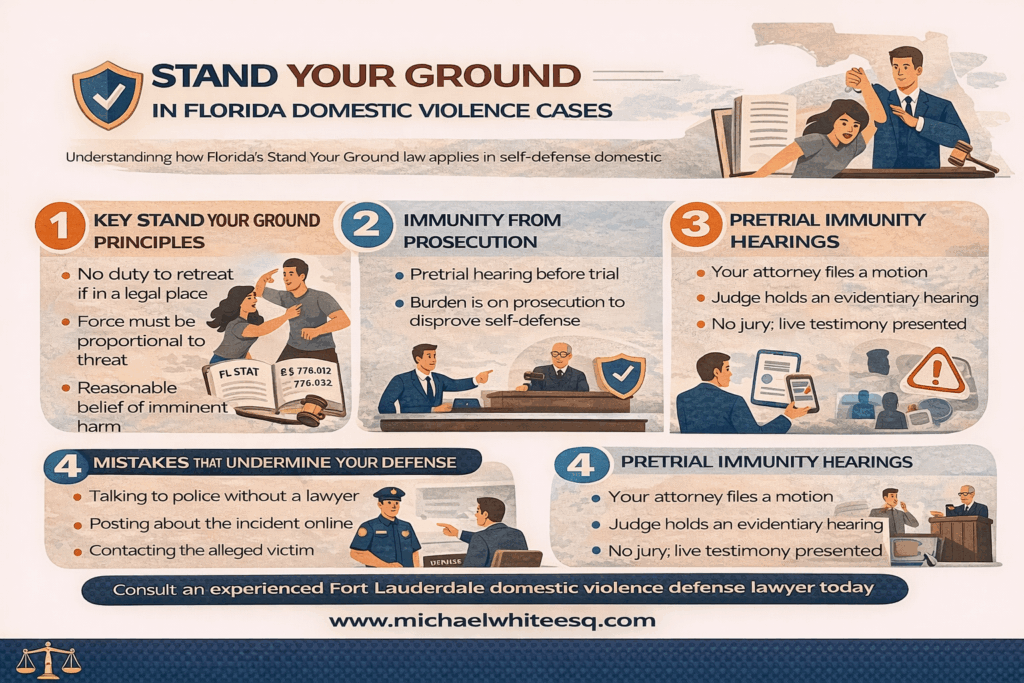
Key principles include:
No duty to retreat if you are in a place you have a legal right to be
The force used must be proportional to the perceived threat
The belief of danger must be reasonable under the circumstances
When properly raised, Stand Your Ground can provide immunity from arrest, prosecution, and trial.
🏠 Does Stand Your Ground Apply to Domestic Violence Cases?
Yes. Stand Your Ground is not limited to encounters with strangers.
The law can apply in domestic violence cases when:
The alleged victim is a spouse, partner, family member, or household member
You reasonably believed force was necessary to stop imminent harm
The incident occurred in a lawful location, including your home or vehicle
However, Stand Your Ground does not apply to verbal arguments alone. There must be evidence of actual or imminent physical harm.
When supported by facts, a Stand Your Ground claim can lead to dismissal before a jury is ever involved.
📜 Pretrial Immunity Hearings in Domestic Violence Cases
Stand Your Ground claims are typically raised through a pretrial immunity hearing.
Here’s how the process works:
Your attorney files a motion for immunity
The court holds an evidentiary hearing (a judge-only proceeding)
Evidence of self-defense is presented
The burden shifts to the prosecution to disprove self-defense beyond a reasonable doubt
If the judge finds the claim valid, the case is dismissed, and prosecution ends.
This process is one of the most effective ways to get domestic violence charges dismissed in Florida when self-defense is involved.
Stand Your Ground claims in domestic violence cases are evaluated under the same legal framework that governs all Florida self-defense cases, with additional scrutiny based on credibility, relationship dynamics, and alleged provocation. For a full explanation of how Florida’s self-defense and Stand Your Ground laws operate beyond the domestic violence context, see our comprehensive guide to self-defense and Stand Your Ground in Florida.
🚫 Common Mistakes That Undermine Stand Your Ground Claims
Even valid self-defense cases can fail due to avoidable mistakes, including:
Giving statements to police without legal counsel
Posting about the incident on social media
Contacting the alleged victim in violation of release conditions
Misunderstanding what qualifies as “imminent” danger
Stand Your Ground claims must be raised carefully and supported by evidence — not emotion.
🕰️ Timing Matters in Stand Your Ground Cases
Stand Your Ground is most effective when raised early. Waiting too long can limit available evidence and weaken the claim.
Early legal action allows counsel to:
Preserve physical and digital evidence
Identify witnesses
Control the narrative before charges solidify
Position the case for dismissal rather than trial
📞 Arrested for Domestic Violence After Defending Yourself?
Stand Your Ground is only one part of defending a domestic violence charge in Florida. These cases often involve injunctions, no-contact orders, credibility disputes, and mandatory court conditions that extend beyond self-defense immunity.
📞 Contact Michael White, P.A. to speak with a Fort Lauderdale domestic violence defense lawyer about whether Stand Your Ground applies to your case.
🙋♂️ Frequently Asked Questions About Stand Your Ground in Domestic Violence Cases
❓ What is Stand Your Ground in Florida domestic violence cases?
It’s a law that allows you to use force in self-defense without retreating — even against family or household members — if you reasonably fear imminent harm.
❓ Can Stand Your Ground lead to case dismissal before trial?
Yes. If you prove your self-defense claim in a pretrial immunity hearing, the judge can dismiss your charges without a trial.
❓ What is a pretrial immunity hearing?
It’s a special hearing where your lawyer argues that you acted in lawful self-defense, shifting the burden of proof onto the prosecution.
❓ Can I use Stand Your Ground against a spouse or romantic partner?
Yes. Stand Your Ground applies to any lawful location — including your home — and covers domestic relationships when real physical danger is present.
❓ Should I talk to the police after a domestic violence arrest?
No. Always consult with a criminal defense lawyer before making any statements to law enforcement.