
Last updated February 2026
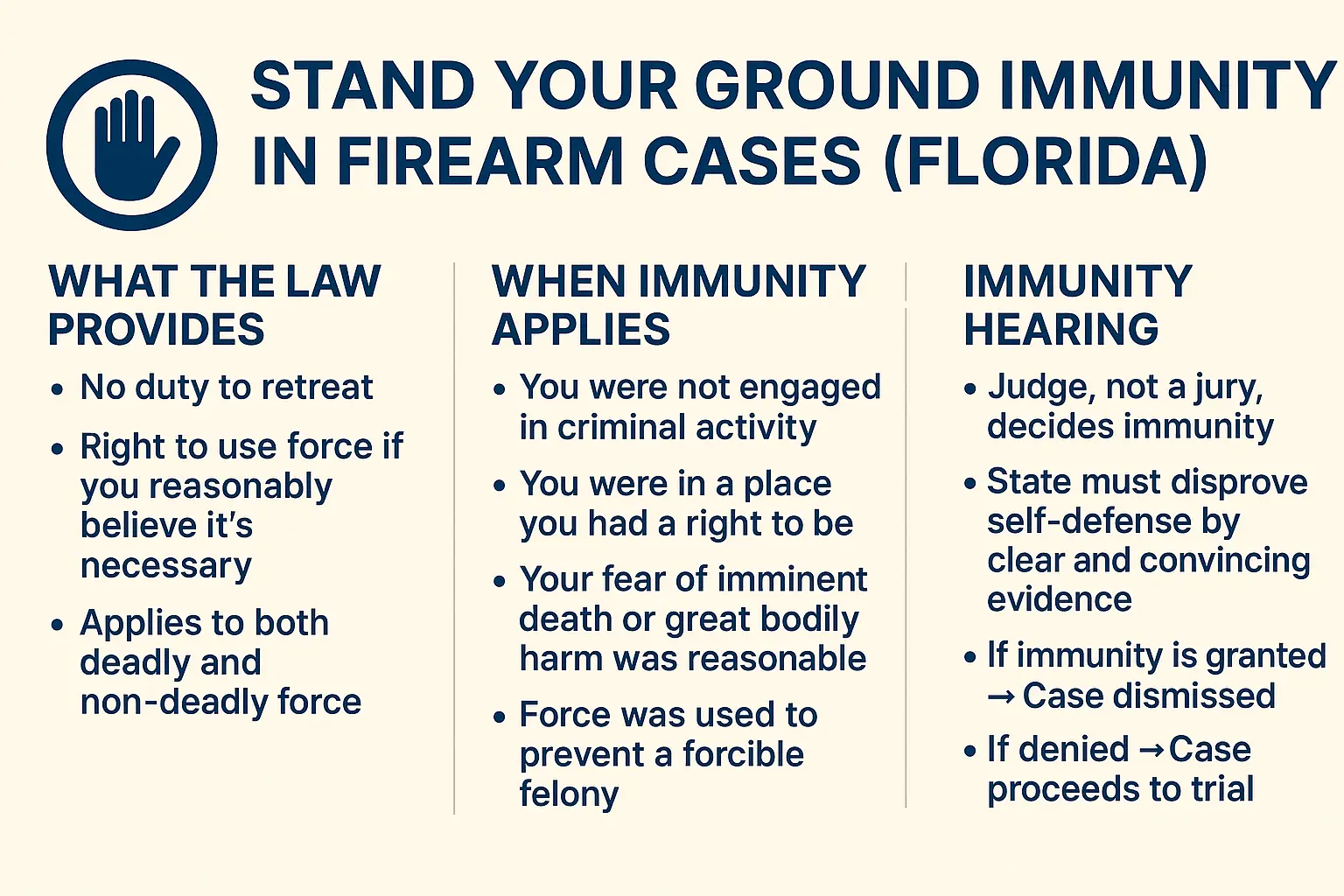
In Florida, Stand Your Ground (SYG) gives defendants a powerful opportunity: the chance to obtain full immunity from prosecution before trial in cases involving the use or threatened use of force with a firearm.
If granted, SYG immunity results in:
Complete dismissal of criminal charges
No trial
Civil immunity (no lawsuits by the alleged victim)
For firearm cases — where consequences can include decades in prison — SYG is often the most important early-stage defense.
Here’s how SYG works in Florida firearm cases, what courts consider, and why these hearings are so frequently won when handled correctly.
⚖️ What Stand Your Ground Immunity Requires
Under Fla. Stat. § 776.032, a defendant is entitled to immunity if:
They used or threatened force in lawful self-defense, and
The State cannot disprove self-defense by clear and convincing evidence.
This is a high burden on the prosecution, far stronger than what applies at trial.
Firearm-related SYG hearings often resemble a hybrid between a suppression hearing and a mini-bench trial — similar in structure to your Stand Your Ground hearing post and motion to suppress hearings.
For a full explanation of Florida’s self-defense and Stand Your Ground laws — including eligibility, immunity standards, and procedure — see our guide to Self-Defense and Stand Your Ground in Florida
🔍 When Stand Your Ground Applies to Firearm Cases
SYG immunity may apply in cases involving:
Defensive display of a firearm
Warning shots
Defensive discharge
Allegations of aggravated assault with a firearm
Defensive actions during a robbery or home invasion
Armed encounters in parking lots, apartment complexes, or road-rage situations
DV-related firearm allegations
Florida does not require you to retreat if you are lawfully present — a critical distinction in firearm cases involving public spaces.
🚫 When SYG Does Not Apply
Immunity may not apply if:
You were committing a crime at the time
You were the initial aggressor and did not withdraw
The firearm was brandished unlawfully
The use of force was not proportionate to the threat
Evidence contradicts the defendant’s narrative
These issues often hinge on credibility and video evidence — much like victim credibility and inconsistent-statement cases.
🧪 Evidence Used at a Stand Your Ground Immunity Hearing
Firearm SYG hearings frequently involve:
Body-worn camera footage
Surveillance video
Cell-phone videos
911 recordings
Firearm discharge analysis
Witness statements
Text messages or digital evidence
Medical or injury records
Crime-scene photographs
Your posts on digital evidence, cell-phone searches, and probable cause affidavits integrate perfectly here.
At the hearing, the judge, not a jury, decides whether immunity is granted.
🛑 Common Scenarios Where Firearm SYG Applies
Examples include:
✔ Confrontations in parking lots
SYG applies to defensive display when the defendant reasonably feared imminent harm.
✔ DV-related firearm accusations
Often based on inconsistent accounts, similar to victim-credibility posts.
✔ Road-rage incidents
If the other driver escalated or approached aggressively.
✔ Home or apartment confrontations
No duty to retreat inside one’s dwelling.
✔ Burglary / attempted burglary cases
Force used to stop a forcible felony.
✔ Armed threats by another person
Defensive firearm display may fall squarely under SYG.
🛡️ Defense Strategies in SYG Firearm Cases
At Michael White, P.A., we maximize SYG opportunities by:
✔ Establishing Reasonable Fear
Showing the threat was real, imminent, and credible.
✔ Using Video to Undermine the State
Video often disproves the alleged victim’s account — similar to victim-credibility strategies.
✔ Demonstrating Defendant’s Lawful Presence
Important in public spaces and bar/parking-lot encounters.
✔ Showing Defendant Was Not the Aggressor
Crucial in firearm brandishing or aggravated assault cases.
✔ Exposing Weakness in the State’s Theory
Contradictions, missing evidence, or inconsistent statements.
✔ Filing SYG and Motion to Dismiss
If SYG fails, a motion to dismiss under Rule 3.190(c)(4) can still be used.
This is why SYG hearings are often the best opportunity to win firearm cases early.
🚨 Speak With a Fort Lauderdale Criminal Defense Lawyer Today
Firearm cases are among the most serious charges in Florida — but Stand Your Ground immunity can end the case before trial ever begins.
Contact Michael White, P.A. today to evaluate your defense and pursue full immunity.
❓ FAQs — Stand Your Ground Immunity in Firearm Cases
1. Does Stand Your Ground apply to firearm cases in Florida?
Yes. SYG is commonly used in aggravated assault, defensive display, and shooting cases.
2. Who decides immunity — judge or jury?
A judge decides before trial at a SYG hearing.
3. What does the State have to prove?
They must disprove self-defense by clear and convincing evidence.
4. Can SYG apply if I only displayed a firearm?
Yes — SYG covers both use and threatened use of force.
5. What happens if SYG is denied?
The case continues, but you can still argue self-defense at trial.