
Last updated March 2026
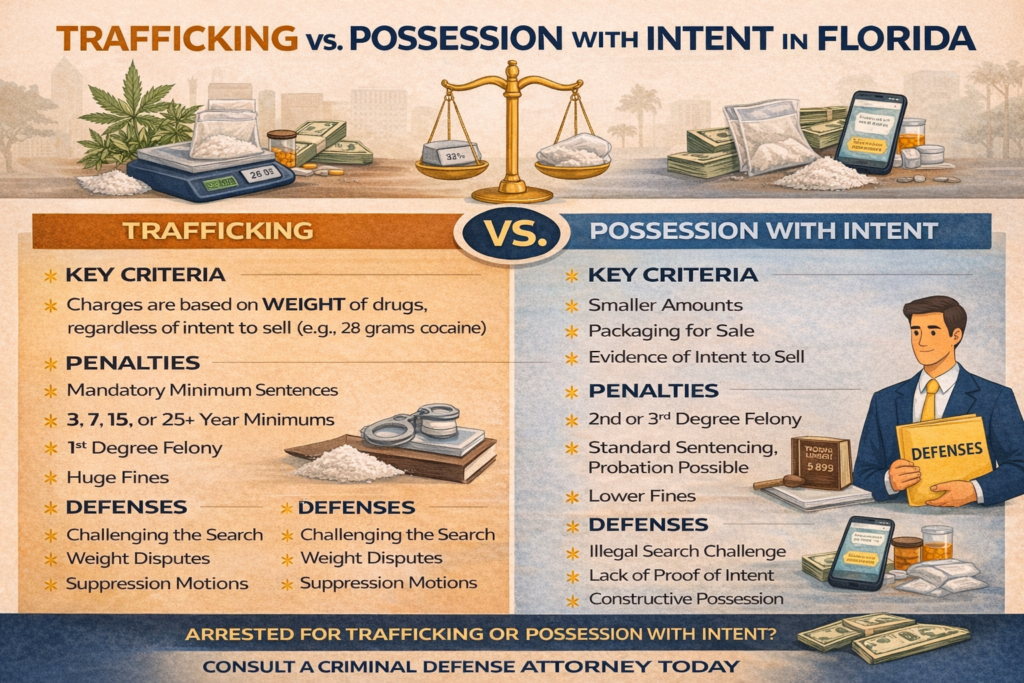
Florida law treats drug trafficking and possession with intent to sell or deliver as distinct offenses — even though they are often confused.
The difference can mean the difference between:
Mandatory minimum prison
Decades of exposure
Or a more flexible sentencing range
Understanding how these charges differ is critical if you are facing felony drug allegations.
For a broader overview of trafficking penalties and weight thresholds, see our guide to Drug Trafficking in Florida.
🚨 The Core Difference: Weight vs. Intent
The single most important distinction is this:
Trafficking is based on weight.
Possession with Intent (PWISD) is based on circumstantial evidence of distribution.
You do not have to sell drugs to be charged with either offense.
But the legal theory behind each charge is very different.
⚖️ What Is Drug Trafficking?
Under Florida Statute § 893.135, trafficking charges apply when the amount of a controlled substance meets statutory weight thresholds.
For example:
Cocaine → 28 grams or more
Fentanyl → 4 grams or more
Heroin → 4 grams or more
The prosecution does not need to prove:
A sale occurred
You intended to distribute
Money changed hands
If the weight threshold is met, trafficking charges may apply automatically.
⛓ Trafficking Penalties
Trafficking is typically charged as a first-degree felony and often carries:
3-year mandatory minimum prison
7-year mandatory minimum
15-year mandatory minimum
25-year mandatory minimum
Judges usually cannot go below these minimums unless the State files a substantial assistance motion.
That is why trafficking charges are so dangerous.
🔎 What Is Possession With Intent?
Possession with intent to sell or deliver is governed by Florida Statute § 893.13. Learn more in our guide to Possession With Intent to Sell in Florida.
Unlike trafficking, this charge focuses on whether the State can prove you intended to distribute drugs.
Prosecutors typically rely on circumstantial evidence such as:
Multiple baggies
Digital scales
Large amounts of cash
Text messages
Payment app transactions
Observed short-term traffic
Weight alone does not automatically equal intent.
⚖️ Sentencing Differences
Possession with intent is usually charged as:
A second-degree felony
Or a third-degree felony
Unlike trafficking, it often does not carry mandatory minimum prison — though penalties can still be severe.
This creates more negotiation flexibility.
🔥 When Charges Overlap
In some cases:
The amount may be just under trafficking threshold
Prosecutors may pursue PWISD instead
Or weight may be disputed
If weight falls below threshold, trafficking charges may not stand — and the case may shift to possession with intent.
Defense strategy depends heavily on which charge applies.
🛡 Defense Strategies Differ
Because the legal theory differs, the defense focus changes.
In Trafficking Cases:
Weight verification
Lab testing accuracy
Mixture calculation
Chain of custody
In Possession With Intent Cases:
Interpretation of circumstantial evidence
Innocent explanations for cash or packaging
Digital evidence challenges
Constructive possession issues
Understanding which theory the State is pursuing shapes the defense approach.
🚗 Traffic Stops and Vehicle Cases
Both charges often arise from vehicle stops.
Key issues may include:
Legality of the stop
Duration of detention
Consent searches
K-9 deployment
Passenger liability
Search challenges may affect either type of charge.
⚠️ Collateral Consequences
Both trafficking and possession with intent can result in:
Permanent felony record
Driver’s license suspension
Immigration consequences
Loss of civil rights
Professional license discipline
However, trafficking convictions typically carry significantly harsher mandatory penalties.
🏛 Can Charges Be Reduced?
In some cases:
Trafficking may be reduced if weight is successfully challenged
Possession with intent may be reduced to simple possession
Suppression issues may eliminate key evidence
Early litigation decisions often determine the outcome.
📍 Drug Trafficking & Intent Defense in South Florida
If you are facing trafficking or possession with intent charges in:
Fort Lauderdale
Broward County
Miami-Dade
Palm Beach County
The difference between weight-based trafficking and intent-based prosecution can dramatically affect your exposure.
Careful review of the evidence and charging decisions is critical.
🛡 Protect Your Future
The difference between trafficking and possession with intent can mean the difference between mandatory prison and a more flexible sentencing range.
If you are facing felony drug charges in Florida, consult a criminal defense attorney immediately to evaluate your exposure and defense options.