
Last updated March 2026
In Florida, trespassing charges can vary depending on where the alleged entry occurred. One of the most important distinctions is whether the location is classified as a dwelling or a structure.
This classification can affect how the charge is filed, how serious it is, and how the case is defended.
For a full overview of trespassing laws in Florida, see Florida Trespassing Law
⚖️ What Is a “Dwelling”?
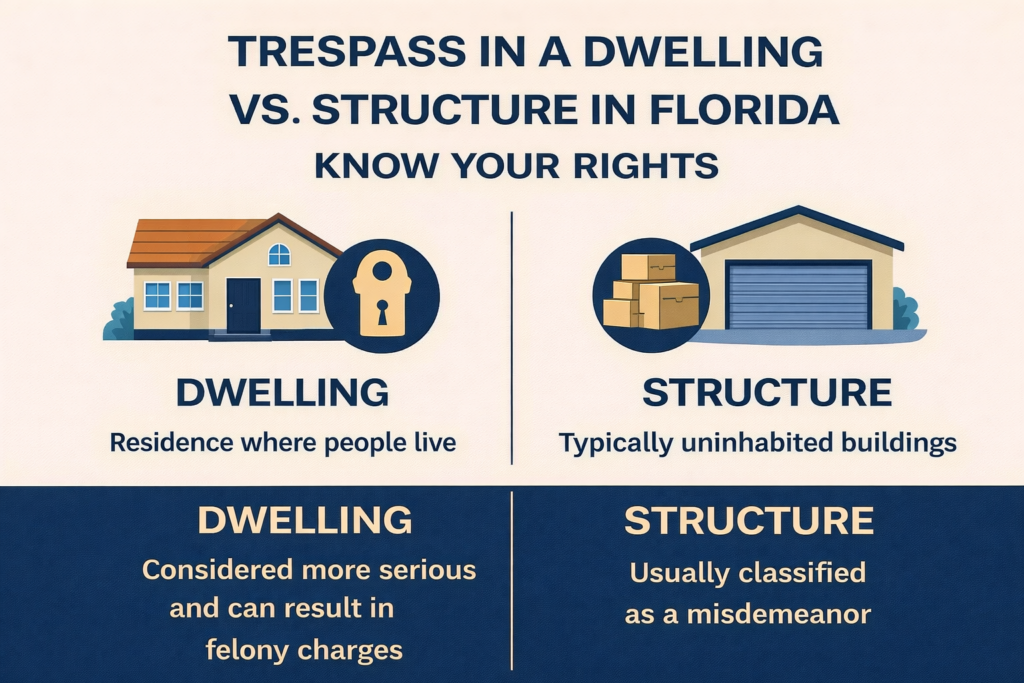
A dwelling generally refers to a place where people live.
This includes:
- Houses
- Apartments
- Condominiums
- Temporary residences
Trespass involving a dwelling is often treated more seriously because of the potential risk to occupants.
🏢 What Is a “Structure”?
A structure typically refers to a building that is not used as a residence.
Common examples include:
- Businesses
- Offices
- Warehouses
- Commercial properties
While still protected under Florida law, structures are treated differently than dwellings.
🔍 Why the Distinction Matters
The classification affects:
- The level of the charge
- Potential penalties
- How prosecutors evaluate the case
Generally:
- Trespass in a structure → typically a misdemeanor
- Trespass in a dwelling → may be treated more seriously depending on the facts
The presence of a person inside can also affect how the case is handled.
🚨 When Trespass Becomes More Serious
Certain factors can increase the severity of a trespass charge regardless of location.
These include:
- Refusing to leave after a warning
- Entering restricted or clearly posted areas
- Carrying a weapon
For example, refusing to leave after being told can strengthen the case against you. See Defiant Trespass / Refusal to Leave Property in Florida.
If a weapon is involved, the charge may be elevated significantly. See Armed Trespass in Florida.
🧠 Relationship to Burglary Charges
In some cases, disputes over whether a location is a dwelling or structure can affect whether a case is charged as trespass or burglary.
Burglary requires intent to commit a crime inside — while trespass does not.
When intent cannot be proven, cases that might otherwise be charged as burglary may instead be treated as trespass.
For a full comparison of these charges, see Trespassing vs. Burglary in Florida
⚖️ Common Defense Issues
Trespass classification cases often turn on:
Was the Location Properly Classified?
Disputes may arise over whether a location qualifies as a dwelling.
Occupancy Issues
Whether someone was present may affect how the case is treated.
Notice and Authorization
Was the person actually authorized to be there?
Evidence
Does the evidence clearly support unlawful entry?
🛡️ Why These Cases Are Often Defensible
Trespass cases involving classification issues are often:
- Fact-specific
- Dependent on how the property is defined
- Open to interpretation
Small details — such as how the space is used — can significantly affect the outcome.
📍 Charged With Trespassing in South Florida?
Trespass charges involving dwellings or structures can carry different legal consequences — but both types of cases often hinge on technical details and factual disputes.
If you are under investigation or facing charges, early legal strategy can make a major difference.
Call Michael White, P.A. at (954) 270-0769 for a confidential consultation.
FAQs
Is trespass in a dwelling more serious than a structure?
Often yes, because of the potential risk to people inside.
What if no one was inside?
That may still be treated as trespass, but occupancy can affect how the case is evaluated.
Do prosecutors have to prove intent?
No. Trespass does not require intent to commit another crime.
Can classification affect the charge?
Yes. Whether a location is a dwelling or structure can affect penalties and case strategy.