
Last updated March 2026
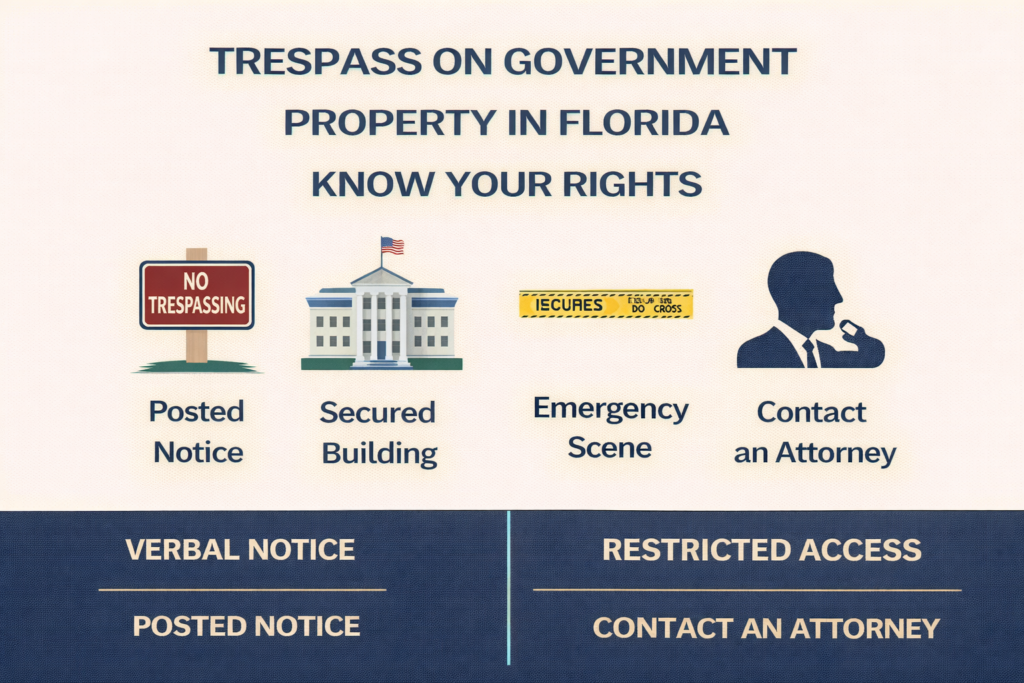
Trespassing on government property in Florida can carry serious consequences depending on the location and circumstances. While many government spaces are open to the public, others are restricted or controlled — and entering those areas without authorization can lead to criminal charges.
For a full overview of trespassing laws in Florida, see Florida Trespassing Law
⚖️ What Counts as Government Property?
Government property can include a wide range of locations, such as:
- Courthouses
- Government offices
- Police stations
- Public buildings
- Restricted municipal or state facilities
Some of these locations are open to the public — but only for specific purposes or during certain hours.
🔍 When Trespassing Occurs on Government Property
Trespass may be charged when a person:
- Enters a restricted or secured government area
- Remains after being told to leave
- Enters a location outside of permitted hours
- Returns after being warned not to come back
The key issue is whether the person exceeded the scope of authorized access.
🧠 What Prosecutors Must Prove
To convict someone of trespass on government property, the State must generally prove:
- The person was on government property
- The area was restricted or not open to the public
- Proper notice was given or restrictions were clear
- The person knowingly entered or remained
These cases often turn on notice and authorization. For a deeper look at that issue, see Trespass After Warning in Florida.
🚨 Why Government Property Cases Are Different
Government property cases can be more complex because:
- Some areas are open to the public
- Access may be limited by time, purpose, or location
- Restrictions may not always be obvious
This creates frequent disputes over whether a person was actually authorized to be there.
⚖️ When Charges Become More Serious
Trespass on government property may become more serious when additional factors are present:
- Refusal to comply with orders to leave
- Entering highly restricted or secure areas
- Disruptive or threatening behavior
- Carrying a weapon
For example, refusal to leave after a lawful order can strengthen the case. See Defiant Trespass / Refusal to Leave Property in Florida.
If a weapon is involved, the charge may escalate significantly. See Armed Trespass in Florida.
🛡️ Common Defense Issues
Government property trespass cases often turn on:
Authorization
Was the person actually prohibited from being there?
Notice
Were restrictions clearly communicated?
Scope of Access
Was the person using the property for a permitted purpose?
Intent
Did the person knowingly violate access rules?
🔑 Why These Cases Are Often Defensible
Because government property can be partially open to the public, these cases often involve:
- Confusion about access
- Unclear restrictions
- Disputes over purpose or timing
These factors can create reasonable doubt depending on the facts.
For situations where charges may be dismissed, see Can Trespassing Charges Be Dropped in Florida?
📍 Charged With Trespassing on Government Property in South Florida?
Trespassing on government property can quickly lead to arrest — even in situations involving misunderstanding or confusion.
If you are under investigation or facing charges, early legal strategy can make a major difference.
Call Michael White, P.A. at (954) 270-0769 for a confidential consultation.
FAQs
Can I be on government property legally?
Yes. Many government properties are open to the public, but only under certain conditions.
What if I stayed too long or entered the wrong area?
That may be a defense depending on whether the restrictions were clearly communicated.
Can I be arrested for refusing to leave government property?
Yes. Refusing to comply with a lawful order to leave can result in trespass charges.
Can these charges be dropped?
Yes. Many cases are dismissed when authorization or notice cannot be proven.