
Last updated March 2026
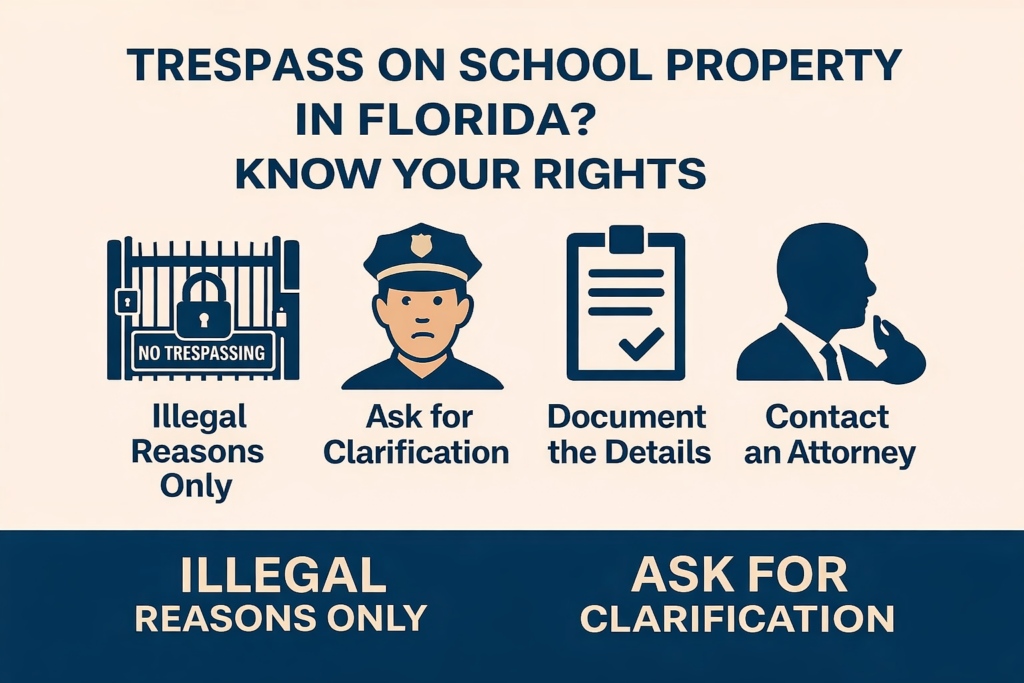
Trespassing on school property in Florida is taken more seriously than standard trespass cases. Schools are considered protected locations, and access is often restricted for safety reasons.
Even situations that seem minor — such as remaining on campus after being told to leave — can lead to criminal charges.
For a full overview of trespassing laws in Florida, see Florida Trespassing Law
⚖️ What Counts as Trespass on School Property?
Trespass on school grounds generally occurs when a person:
- Enters school property without authorization
- Remains after being told to leave
- Returns after being warned not to come back
This can apply to:
- Public schools
- Private schools
- College or university campuses (in certain situations)
🔍 What Prosecutors Must Prove
To convict someone of trespassing on school property, the State must typically prove:
- The person was on school property
- They were not authorized to be there
- Proper notice was given (or the restriction was clear)
- The person knowingly remained or entered anyway
Many of these cases turn on whether proper warning was given. For a deeper look at that issue, see Trespass After Warning in Florida.
🚨 Why School Trespass Is Treated More Seriously
Schools are considered sensitive and protected environments.
As a result:
- Access is often restricted
- Warnings are taken seriously
- Law enforcement may respond quickly
Even minor violations can result in arrest or charges depending on the circumstances.
🧠 Common Situations Leading to Charges
Trespass on school property often arises in situations such as:
- Parents or guardians involved in disputes
- Individuals returning after being banned from campus
- People lingering after school events
- Unauthorized visitors entering restricted areas
In many cases, these situations involve misunderstandings or unclear communication.
⚖️ When Charges Become More Serious
Trespass on school property can become more serious if additional factors are present, such as:
- Refusal to leave after being told
- Repeated violations
- Disruptive behavior
- Carrying a weapon
For example, refusing to leave after a clear warning can strengthen the case. See Defiant Trespass / Refusal to Leave Property in Florida.
If a weapon is involved, the charge may escalate significantly. See Armed Trespass in Florida
🛡️ Common Defense Issues
School trespass cases often turn on:
Authorization
Was the person actually prohibited from being there?
Notice
Was the warning clearly communicated?
Intent
Did the person knowingly remain or enter unlawfully?
Misunderstanding
Was there confusion about access or permission?
🔑 Why These Cases Are Often Defensible
Trespass cases involving schools are often:
- Fact-specific
- Dependent on communication and notice
- Influenced by context and timing
Small details — such as who gave the warning or whether it was understood — can significantly affect the outcome.
For situations where charges may be dismissed, see Can Trespassing Charges Be Dropped in Florida?
📍 Charged With Trespassing on School Property in South Florida?
Trespassing on school grounds can lead to serious consequences — even when the situation began as a misunderstanding.
If you are under investigation or facing charges, early legal strategy can make a major difference.
Call Michael White, P.A. at (954) 270-0769 for a confidential consultation.
FAQs
Can I be arrested for being on school property?
Yes. If you are not authorized or refuse to leave, you may be charged with trespassing.
Do schools have special trespass rules?
Yes. Schools are considered protected locations with restricted access.
What if I was there for a legitimate reason?
That may be a defense depending on the circumstances.
Can these charges be dropped?
Yes. Many cases are dismissed when notice or authorization cannot be proven.