
Last updated March 2026
What’s the Difference and Why It Matters
When a fatal crash occurs in Florida, two charges often cause confusion: vehicular homicide and DUI manslaughter. While both involve the death of another person, they are legally distinct crimes with different elements, evidence requirements, and defense strategies.
Understanding which charge applies — and why — is critical. Prosecutors make this decision early, and once a case is charged, it can be difficult to undo.
The Key Difference at a Glance
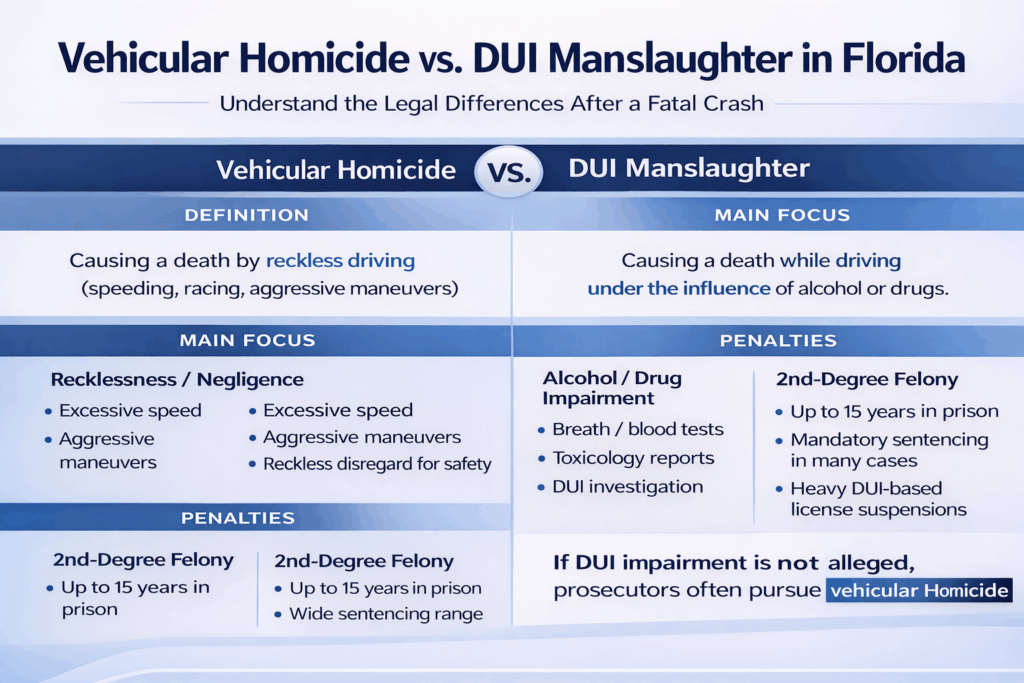
The difference comes down to what the State must prove first.
DUI Manslaughter is built on impairment
Vehicular Homicide is built on reckless or negligent driving
The presence or absence of alcohol or drugs often determines which charge prosecutors pursue.
What Is DUI Manslaughter in Florida?
DUI manslaughter occurs when a person causes the death of another while driving under the influence of alcohol or drugs.
To convict someone of DUI manslaughter, prosecutors must prove:
The defendant was driving or in actual physical control of a vehicle
The defendant was impaired or had an unlawful blood-alcohol or drug level
The driving caused or contributed to a death
DUI manslaughter cases rely heavily on:
Breath or blood test results
DUI investigation procedures
Toxicology reports
Officer observations
Because impairment is the foundation of the charge, DUI Manslaughter cases are typically handled within Florida’s felony DUI framework.
What Is Vehicular Homicide in Florida?
Vehicular homicide applies when a death is caused by the reckless operation of a motor vehicle, even when no intoxication is alleged.
To convict someone of vehicular homicide, the State must prove:
A death occurred
The defendant was operating a motor vehicle
The vehicle was operated in a reckless manner likely to cause death or great bodily harm
That reckless operation caused the death
Vehicular homicide cases often focus on:
Speed and driving behavior
Crash reconstruction analysis
Event data recorder (“black box”) evidence
Cell phone or distraction allegations
Why Prosecutors Choose One Charge Over the Other
DUI Manslaughter Is Charged When:
Alcohol or drugs are detected
DUI testing is performed
Officers believe impairment explains the crash
Vehicular Homicide Is Charged When:
No impairment evidence exists
The driving itself is alleged to be reckless
Speed, racing, or aggressive driving is the focus
In some cases, prosecutors initially pursue vehicular homicide and later amend charges if impairment evidence emerges.
Can Someone Be Charged With Both?
Yes — prosecutors may file both counts early as alternative theories. But for a single death, Florida courts generally do not allow a defendant to be convicted and sentenced for both DUI manslaughter and vehicular homicide.
In practice, the State may:
Investigate both impairment and recklessness theories
File both charges while evidence develops
Amend charges as toxicology and reconstruction evidence comes in
If the case goes to verdict, one conviction typically must be vacated/merged to avoid multiple punishments for the same death.
Penalties: How They Compare
Both offenses carry severe consequences, but the exposure differs.
DUI Manslaughter
Mandatory prison time in many cases
Long-term driver’s license consequences
DUI-specific sentencing enhancements
Vehicular Homicide
Typically charged as a second-degree felony
Focus on recklessness and causation
Sentencing varies widely based on facts
The practical difference often comes down to how convincingly the State can prove impairment versus recklessness.
Defense Strategies Differ Significantly
Defending DUI Manslaughter
Challenging breath or blood testing
Attacking DUI investigation procedures
Questioning impairment at the time of driving
Defending Vehicular Homicide
Disputing recklessness
Challenging accident reconstruction
Attacking causation
Examining road conditions or third-party fault
Misidentifying the charge — or defending the wrong theory — can be fatal to a case.
Where These Charges Fit in Florida Criminal Law
DUI manslaughter is best understood as a felony DUI offense involving death.
Vehicular homicide is a violent felony homicide charge arising from vehicle operation.
Vehicular homicide is prosecuted as a violent felony homicide offense based on reckless vehicle operation. For a full explanation of how these cases are charged, defended, and proven, see Vehicular Homicide in Florida.
Final Takeaway
If impairment is alleged, prosecutors pursue DUI manslaughter.
If impairment is not alleged, they often pursue vehicular homicide.
The distinction affects:
How evidence is gathered
What defenses apply
How the case is sentenced
Understanding that difference early can change the trajectory of the entire case.
Facing a Fatal Crash Investigation?
Charging decisions in fatal crash cases are often made before an arrest occurs. Early legal involvement can affect how evidence is preserved, how the incident is characterized, and whether charges escalate.
Request a confidential consultation to discuss your situation.
FAQs
❓ What is the main difference between vehicular homicide and DUI manslaughter in Florida?
The main difference is impairment. DUI manslaughter requires proof that the driver was under the influence of alcohol or drugs, while vehicular homicide is based on reckless or negligent driving, even when no intoxication is alleged.
❓ Can someone be charged with both vehicular homicide and DUI manslaughter?
A person is not convicted of both for the same death, but prosecutors may investigate both theories early in a case and later decide which charge to pursue based on the evidence.
❓ Is DUI required for a vehicular homicide charge?
No. Vehicular homicide does not require proof of alcohol or drug impairment. Prosecutors focus instead on driving behavior such as excessive speed, racing, aggressive maneuvers, or reckless disregard for safety.
❓ Which charge carries harsher penalties?
Both charges are extremely serious and can carry significant prison exposure. DUI manslaughter often includes mandatory sentencing components tied to DUI laws, while vehicular homicide sentencing depends heavily on the facts and degree of recklessness alleged.
❓ Why does the distinction between these charges matter?
The distinction affects how the case is investigated, what evidence is used, which defenses apply, and how sentencing works. Defending a DUI-based case is very different from defending a recklessness-based homicide case.