
Last updated February 2026
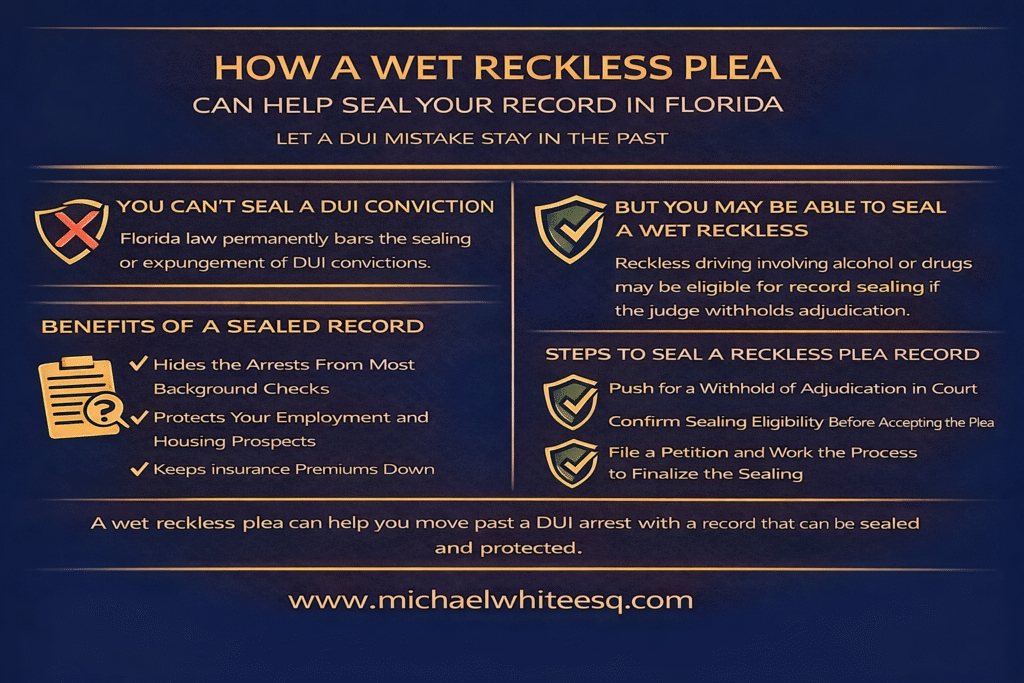
A DUI conviction in Florida can never be sealed.
That permanent visibility is often more damaging than the short-term penalties.
But when a DUI charge is reduced to reckless driving (commonly called a “wet reckless”), sealing eligibility may be preserved — if handled correctly from the start.
👉 For a full explanation of how wet reckless pleas work, see our guide to Wet Reckless in Florida.
This page focuses specifically on what happens after a wet reckless plea — and how to protect future sealing eligibility.
⚖️ Why DUI Convictions Cannot Be Sealed
Florida law permanently excludes DUI convictions from record sealing or expungement.
Even if adjudication is withheld, a DUI conviction remains public for life.
That means:
Employers can see it
Licensing boards can see it
Background-check companies can report it
Housing applications may be affected
This is why strategic plea negotiation matters.
✅ Why Wet Reckless Is Different
A wet reckless is legally a reckless driving conviction, not a DUI.
That classification makes all the difference for sealing purposes.
Key distinction:
DUI conviction → never sealable
Reckless driving (withhold) → potentially sealable
Because reckless driving is a criminal traffic offense — not a DUI conviction — eligibility may exist if all statutory requirements are satisfied.
👉 Learn more about Reckless Driving in Florida.
🔐 When Can a Wet Reckless Be Sealed?
Sealing may be available if:
The court withholds adjudication
You have no prior convictions
You have not previously sealed or expunged a record
You meet all statutory eligibility requirements
Sealing is not automatic.
It requires:
Certificate of eligibility from FDLE
Court petition
Judicial approval
Timing and plea structure matter.
🧠 Why Sealing Strategy Begins During Plea Negotiations
Sealing eligibility is not something to consider after the case ends.
It must be protected during negotiations.
When pursuing a wet reckless resolution, we:
Confirm eligibility before accepting any plea
Secure a withhold of adjudication
Avoid plea terms that would block sealing
Structure the case for future record protection
Once a conviction is entered instead of a withhold, sealing eligibility may be permanently lost.
🚫 Common Mistakes That Destroy Sealing Eligibility
Drivers often lose the opportunity to seal their record by:
Accepting adjudication when a withhold was available
Pleading without understanding long-term consequences
Failing to review prior record eligibility
Waiting too long to begin the sealing process
These mistakes cannot always be undone.
📘 How Sealing a Wet Reckless Helps Long-Term
A sealed record:
Removes the case from public view
Prevents most employers from accessing it
Protects housing applications
Reduces background-check complications
Limits online database visibility
For many clients, this long-term protection is the most important part of the case.
👨⚖️ Fort Lauderdale DUI Defense Focused on the Long Term
If you are facing DUI charges in Fort Lauderdale or South Florida, the question is not only how to resolve the case — but how it will look five years from now.
As a former prosecutor, Michael White approaches wet reckless negotiations with sealing eligibility in mind from day one.
📞 Call (954) 270-0769 or schedule a confidential consultation to discuss whether your case can be resolved in a way that protects future sealing eligibility.
❓ Wet Reckless & Record Sealing – FAQs
Can a wet reckless be sealed in Florida?
Possibly. If adjudication is withheld and you meet eligibility requirements, sealing may be available.
Why can’t DUI convictions be sealed?
Florida law permanently excludes DUI convictions from sealing or expungement, regardless of adjudication.
Does a wet reckless still appear on background checks?
Yes — unless it is sealed. Once sealed, it is hidden from most public and private background checks.
Will the court automatically seal my case?
No. Sealing requires a separate petition after your criminal case ends.
When should I start thinking about sealing?
Before you accept a plea. Sealing eligibility should be considered during negotiations, not after the case is closed.