
Last updated February 2026
Being charged with resisting arrest with violence in Florida is serious. Unlike misdemeanor obstruction charges, this offense is treated as a violent felony and can expose you to prison, probation, and a permanent criminal record — even when no one was seriously injured.
In many cases, the charge doesn’t reflect what actually happened. It’s often filed when an arrest escalates quickly, force is used by police, or body-worn camera footage contradicts the written report.
Understanding what Florida law actually requires — and how these cases are defended — is critical to protecting your freedom.
⚖️ What Is Resisting Arrest With Violence in Florida?
Resisting arrest with violence is defined under Florida Statute § 843.01. The State must prove that a person:
Knowingly and willfully
Resisted, obstructed, or opposed
A law enforcement officer
Who was engaged in the lawful execution of a legal duty
By offering or doing violence
This is what separates felony resisting from misdemeanor obstruction.
👉 For non-violent cases, see our guide to resisting arrest without violence in Florida.
🚔 Why This Charge Is Treated as a Violent Felony
Resisting with violence is classified as a third-degree felony because it involves the use or threat of force against law enforcement. Prosecutors treat it as a violent offense even when the alleged “violence” consists of split-second movement during handcuffing.
These charges frequently appear alongside:
Battery on a law enforcement officer (BAT LEO)
Aggravated assault on an officer
Disorderly conduct
DUI or domestic-related arrests that escalated
Because of this, resisting with violence is best understood — and defended — as a violent crime, not merely an obstruction offense.
👉 Learn more about how violent felony charges are handled on our Violent Crimes Defense page.
🔍 Common Allegations Police Use to Support RWV Charges
In Fort Lauderdale and across Broward County, officers often allege “violence” based on:
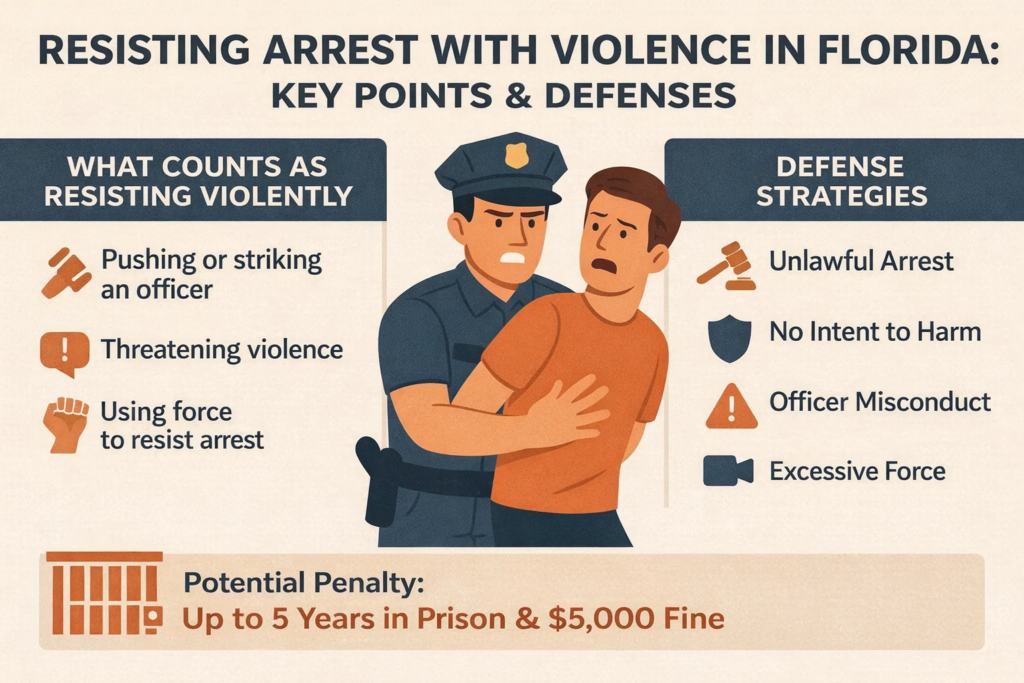
Pushing or striking an officer
Kicking, elbowing, or head-butting during arrest
Pulling away while force is being applied
Grabbing an officer’s arm or equipment
Threatening language during a physical struggle
In reality, many of these cases involve mutual force, reflexive movement, or an officer losing balance — not intentional violence.
🧾 Penalties for Resisting Arrest With Violence
Resisting with violence is a third-degree felony, punishable by:
Up to 5 years in prison
Up to 5 years of probation
Up to $5,000 in fines
A permanent felony record if convicted
Even first-time offenders face serious exposure, especially when the charge is stacked with other alleged offenses.
🛑 Police Overcharging: How RWOV Becomes RWV
A common pattern in these cases is charge escalation. What begins as alleged resisting without violence (§ 843.02) is upgraded to a felony when:
An officer escalates force first
The suspect tenses or pulls away reflexively
A chaotic arrest involves multiple officers
Body-worn camera footage contradicts the narrative
The officer is injured accidentally during the struggle
Prosecutors often rely heavily on officer testimony — which makes video evidence and credibility challenges decisive.
🛡️ Defenses That Actually Work in RWV Cases
A strong defense focuses on lawfulness, intent, and force.
✔ Unlawful Arrest or Detention
If the officer lacked legal authority to stop, detain, or arrest you, the resisting charge may fail entirely. Resistance to an unlawful arrest cannot support a conviction.
✔ No Violence Occurred
Reflexive movement, tensing, or pulling away does not automatically qualify as “violence.” The State must prove intentional force, not accidental contact.
✔ Excessive Force or Self-Defense
Florida law allows reasonable resistance to excessive or unlawful force. If officers escalated the encounter, your response may be legally justified.
✔ Lack of Intent
RWV requires knowing and willful conduct. Panic, confusion, intoxication, or fear can undermine the State’s ability to prove intent.
✔ Body-Worn Camera Contradictions
Video evidence frequently contradicts arrest reports. Discrepancies between footage and testimony are powerful impeachment tools.
⚔️ Resisting With Violence vs. Battery on a Law Enforcement Officer
RWV charges are often paired with battery on a law enforcement officer, but the elements are different. In many cases, one charge collapses when the other is challenged.
👉 See our breakdown of resisting with violence vs. resisting without violence in Florida to understand how prosecutors overcharge these cases — and how they’re reduced or dismissed.
📍 What to Do If You’re Charged in Fort Lauderdale
If you’re arrested for resisting with violence:
Do not give statements without a lawyer
Preserve any video, photos, or witness information
Avoid discussing the incident on social media
Act quickly — early intervention often prevents formal filing
Local experience matters. These cases are highly fact-specific and often resolved through early motion practice.
❓ FAQs: Resisting Arrest With Violence in Florida
Is resisting arrest with violence always a felony?
Yes. It is charged as a third-degree felony under Florida law.
Can resisting with violence be reduced to resisting without violence?
Often, yes — especially when video evidence contradicts claims of violence.
What if the officer used excessive force first?
You may raise self-defense or unlawful force as a defense.
Can this charge be dismissed?
Yes. Many cases are dismissed or reduced when the arrest was unlawful or evidence is weak.
Will this stay on my record forever?
A conviction creates a permanent felony record, but dismissed or reduced cases may be eligible for sealing.
📞 Charged With Resisting Arrest With Violence? Act Fast.
Felony resisting charges are often filed to justify an aggressive arrest — not because real violence occurred. With the right defense strategy, many of these cases can be reduced or dismissed.
👉 Contact Michael White, P.A. today to speak with a former prosecutor who knows how these cases are charged — and how to tear them apart.