
Last updated April 2026
🛑 Self-defense is powerful—but it has limits.
Florida law allows people to protect themselves, even with force in dangerous situations. But when those legal boundaries are crossed, what may feel like self-defense can quickly turn into a criminal charge.
If you are facing allegations involving force, one of the most important questions is not just what happened—but whether your actions meet Florida’s strict legal requirements for self-defense.
For a complete overview of how these laws work across different types of cases, see our guide to Self-Defense and Stand Your Ground in Florida.
⚖️ Florida Self-Defense Law Has Clear Limits
Under Florida law, self-defense is not based on personal belief alone. It must satisfy specific legal standards.
To qualify, the use of force must involve:
- A reasonable belief of imminent danger
- A proportional response to that danger
- A situation where you were not the initial aggressor
- No unlawful activity at the time
If any of these elements fail, the entire self-defense claim can collapse.
For a detailed breakdown of these legal standards—including deadly force and non-deadly force—see Florida Self-Defense and Use of Force Law.
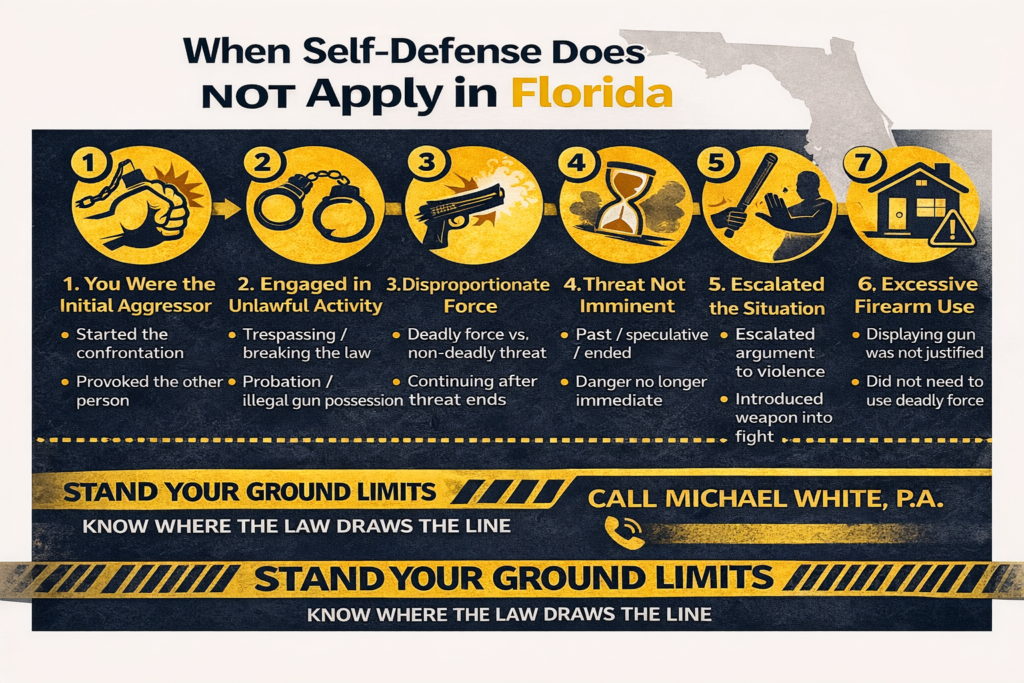
🚨 1. You Were the Initial Aggressor
Self-defense often fails when the State argues that you started the confrontation.
This can include:
- initiating physical contact
- provoking the other person
- escalating a verbal dispute into violence
Even if the situation later turned dangerous, being labeled the initial aggressor can eliminate Stand Your Ground protections.
⚠️ Limited Exception:
If you clearly withdraw from the encounter and the other person continues the threat, self-defense may still apply—but this is highly fact-dependent.
🚫 2. You Were Engaged in Unlawful Activity
Stand Your Ground law generally requires that you were not engaged in unlawful activity.
This becomes a major issue in cases involving:
- illegal firearm possession
- trespassing
- drug activity
- probation or community control violations
Even minor unlawful conduct can be used by prosecutors to argue that immunity should not apply.
⚖️ 3. The Force Used Was Disproportionate
Self-defense is limited by proportional force.
Problems arise when:
- deadly force is used against a non-deadly threat
- force continues after the threat ends
- the response goes beyond what was reasonably necessary
This is one of the most common ways self-defense claims fail in Florida.
⏱️ 4. The Threat Was Not Imminent
Florida law requires an immediate, real threat.
Self-defense may fail when:
- the danger had already passed
- the threat was speculative
- force was used in retaliation
Using force after the situation has ended is a frequent basis for criminal charges.
🔁 5. You Escalated the Situation
Even if you did not start the incident, self-defense can fail if you:
- escalate a verbal argument into a physical confrontation
- introduce a weapon into a non-deadly situation
- continue the conflict instead of disengaging
Prosecutors often characterize these cases as mutual combat or escalation.
🔫 6. Firearm Use Was Not Justified
In firearm-related cases, prosecutors frequently argue:
- the threat did not justify displaying or using a gun
- deadly force was unnecessary
- the situation could have been handled without a weapon
These cases often hinge on seconds of footage, perception, and context.
🏠 7. Misunderstanding Castle Doctrine
Being in your home does not automatically justify force.
Florida’s Castle Doctrine still requires:
- a qualifying threat
- lawful presence
- a legally justified response
Misunderstanding these protections can lead to serious felony charges.
🏛️ What Happens When Self-Defense Does Not Apply?
When self-defense or Stand Your Ground immunity fails:
- The case proceeds through prosecution
- You may face charges such as assault, battery, or homicide
- The focus shifts to defending the case at trial
At that point, strategy becomes critical.
👉 For how these cases are fought and won, see How to Beat a Self-Defense Case in Florida.
⚖️ Can You Still Win If Immunity Is Denied?
Yes—but the strategy changes.
If a Stand Your Ground claim is rejected, the case continues toward trial. However, self-defense can still be argued before a jury.
Understanding how the immunity process works is critical.
👉 Learn how these hearings work and how cases are dismissed early: What Is a Stand Your Ground Hearing in Florida?
🔍 Why These Cases Turn on Evidence
Self-defense cases are rarely decided by argument alone.
They often depend on:
- surveillance or body-worn camera footage
- 911 calls and timing
- witness credibility and inconsistencies
- physical injuries and scene evidence
- how the initial police narrative was written
Small details can determine whether a case qualifies for immunity—or fails entirely.
🧠 The Reality: Belief Alone Is Not Enough
Many people charged in these cases believe they were justified.
But Florida law does not ask whether you felt threatened.
It asks whether your actions meet specific legal standards.
That gap—between perception and legal justification—is where many self-defense claims fail.
📞 Charged After Claiming Self-Defense? Act Early.
If self-defense is an issue in your case, timing and strategy matter.
We evaluate:
- whether Stand Your Ground immunity is still viable
- whether the State can overcome a self-defense claim
- what evidence must be preserved immediately
- how to position the case for dismissal or defense
Call Michael White, P.A. for a confidential consultation.
Frequently Asked Questions About When Self-Defense Does Not Apply in Florida
Can you claim self-defense if you started the fight?
Usually no. Florida law limits self-defense when you are the initial aggressor unless you clearly withdraw and the other person continues the threat.
Does Stand Your Ground apply if you were committing a crime?
Generally no. Stand Your Ground protections typically require that you were not engaged in unlawful activity at the time.
Can self-defense fail even if you were attacked?
Yes. If the force used was excessive or the threat was no longer imminent, the defense may not apply.
What happens if a Stand Your Ground hearing is denied?
The case proceeds to trial, but you can still argue self-defense to a jury.
Can you use deadly force in any self-defense situation?
No. Deadly force is only justified in limited situations involving imminent danger of death, great bodily harm, or a forcible felony.