
Last updated April 2026
If you’re facing criminal charges in Florida — including in Fort Lauderdale and Broward County — one of the first questions is: How long will this take?
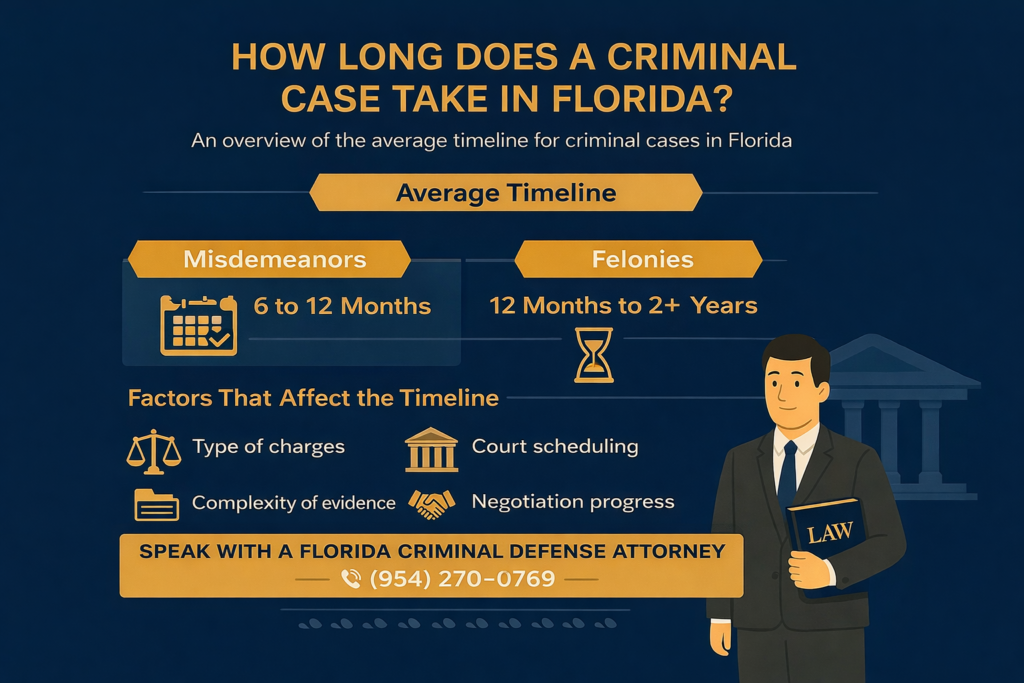
The answer depends on the type of charge, the complexity of the evidence, court scheduling, and whether the case resolves through negotiation or proceeds to trial.
While every case is different, Florida criminal cases generally follow predictable timelines.
Criminal cases move through structured court stages after arrest. For a broader explanation of arraignment, pretrial conferences, and trial progression, see how Florida criminal court stages work from arraignment through trial.
After an arrest, a defendant may be released or held in jail before trial, depending on bond and pretrial release decisions.
Those decisions are typically made during the Florida bond hearing process, which determines whether a person remains in custody or is released.
🎥 Watch: How Long Does a Criminal Case Take in Florida?
One of the most common questions after an arrest is: “How long is this going to take?”
In this video, I explain:
• The typical timeline for misdemeanor vs. felony cases
• How arraignment and pretrial conferences affect timing
• What speedy trial rules mean — and when they’re waived
• Why some cases resolve in months while others take years
• What factors can speed up — or slow down — your case
Understanding the timeline helps you plan, reduce stress, and avoid strategic mistakes that can delay resolution.
https://www.youtube.com/watch?v=FGTG57_YFiY
⏱️ Misdemeanor Cases: Often 6–12 Months
Most misdemeanor cases resolve within six months to one year.
This timeline includes:
• Arraignment
• Discovery exchange
• Pretrial conferences
• Plea negotiations
• Possible motion hearings
Delays can occur when:
• Discovery is incomplete
• Witnesses are unavailable
• Motions are filed
• Trial dockets are crowded
Many misdemeanors resolve before trial—particularly in situations where criminal charges can be dropped before trial in Florida or when defendants are eligible to qualify for diversion programs in Florida depending on the charge and record.
⏳ Felony Cases: Often 12–24 Months (or More)
Felony cases typically take longer because they involve:
• More extensive discovery
• Depositions
• Motion practice
• Expert witnesses
• More complex negotiations
Third-degree felonies often resolve within 12 to 18 months.
More serious or multi-defendant cases may take two years or longer.
Complex financial crimes, violent felonies, or cases involving forensic evidence frequently extend timelines.
In some cases, resolution may involve negotiated outcomes such as how adjudication withheld works in Florida and when it’s available.
🗂 What Impacts the Timeline?
In Broward County, case timelines are often influenced by courtroom availability, prosecutor caseloads, and whether key witnesses are available. Cases with early legal challenges or evidentiary issues may resolve much faster than expected.
Several factors affect how long a criminal case takes:
• Whether the defendant is in custody
• Speedy trial demands (or waivers)
• Court backlog
• Negotiation posture
• Complexity of legal issues
• Whether motions to suppress are filed
Under Florida’s speedy trial rules:
• Misdemeanor cases generally must be tried within 90 days
• Felony cases generally must be tried within 175 days
However, defendants often waive speedy trial to allow time for negotiation and defense preparation.
📆 Typical Court Progression
Most cases move through:
1️⃣ Arraignment
2️⃣ Pretrial conferences
3️⃣ Motion hearings (if needed)
4️⃣ Plea negotiations or diversion
5️⃣ Trial (if unresolved)
For a detailed explanation of those stages, see our guides to:
• What happens at a criminal arraignment in Florida
• What happens at a pretrial conference in Florida
⚖️ Can a Case Be Dismissed for Delay?
Possibly — but only if your constitutional or speedy trial rights are violated.
Dismissal for delay is rare and highly technical. It requires precise procedural analysis and timely motion practice.
🛡 Why Early Strategy Matters
In many cases, the timeline of a criminal case is not just about court scheduling—it reflects how quickly the strengths and weaknesses of the case are identified and addressed.
The timeline of your case affects:
• Release conditions
• Employment stability
• Negotiation leverage
• Emotional stress
• Long-term planning
An experienced defense attorney monitors deadlines, pushes back against unnecessary delays, and positions the case efficiently.
❓ Frequently Asked Questions
1. How long does a misdemeanor case take in Florida?
Most misdemeanor cases in Florida take between six months and one year. However, court scheduling, prosecutor response times, and the complexity of your case can all cause delays.
2. Why do felony cases take longer than misdemeanors?
Felony cases typically involve more serious charges, more evidence, additional hearings, and longer plea negotiations. As a result, they often take a year or more to resolve.
3. Can I speed up my criminal case in Fort Lauderdale?
You can’t control everything, but hiring an experienced defense attorney helps move things forward. A good lawyer pushes for timely responses, files motions efficiently, and avoids unnecessary delays.
4. What causes delays in a criminal case?
Delays often stem from slow prosecutor response times, complex charges that require more investigation, and issues with witness availability or cooperation.
5. Can my case be dismissed if it takes too long?
In some cases, yes. If your right to a speedy trial is violated, your attorney can file a motion to dismiss. Every situation is different, so it’s important to speak with a lawyer early on.