
Last updated February 2026
💬 Think Before You Post: Social Media Evidence in Florida Criminal Cases
If you are under investigation or facing criminal charges in Florida, your social media activity can become evidence.
Prosecutors routinely use content from platforms like:
Facebook
Instagram
TikTok
Snapchat
X (Twitter)
Private messages and direct messages
Even deleted or “private” posts may still be accessible through lawful process — and sometimes through unconstitutional searches.
Digital evidence has become one of the most common forms of proof in modern criminal prosecutions.
🔍 How Law Enforcement Obtains Social Media Evidence
Florida prosecutors and law enforcement agencies use several legal tools to gather online content, including:
Search warrants
Subpoenas
Preservation requests
Forensic extractions of phones
Screenshots provided by third parties
They may collect:
Public posts and comments
Direct messages
Photos and videos
Geolocation metadata
Stories and disappearing content
Tagged posts from other users
Even if your account is private, that does not mean it is legally protected from court-authorized access.
🛑 When Social Media Evidence Can Be Suppressed
Not all digital evidence is lawfully obtained.
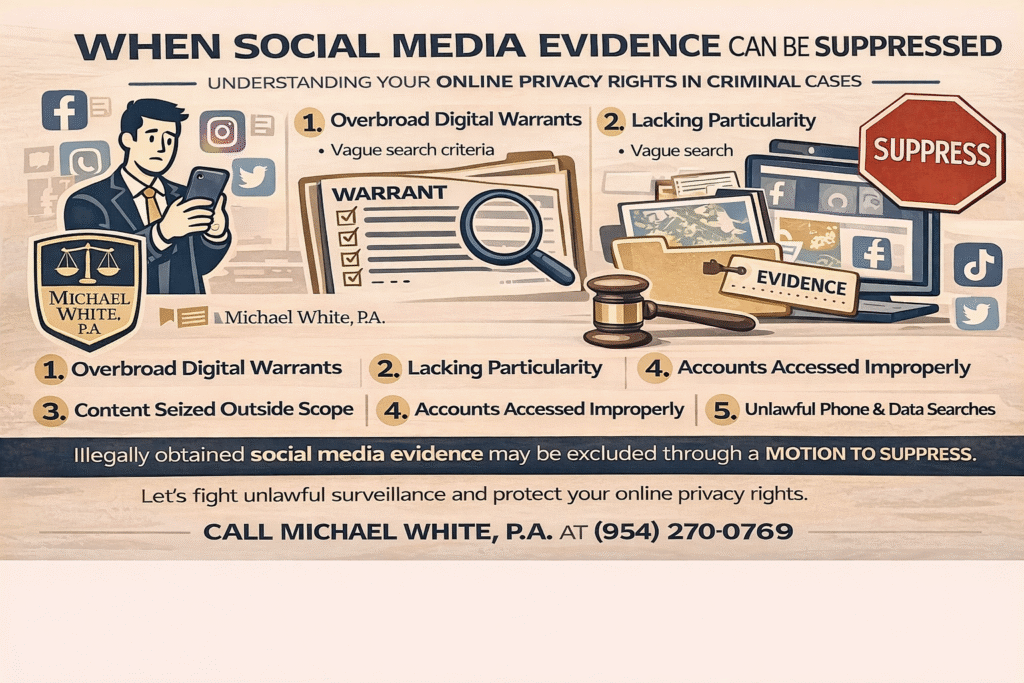
Courts may exclude social media evidence when:
Warrants are overbroad
Warrants lack particularity
Data is seized outside the warrant’s scope
Accounts are accessed without proper legal process
Phone extractions exceed constitutional limits
If evidence is obtained in violation of the Fourth Amendment, your attorney can file a motion to suppress.
For a broader overview of how digital and forensic evidence is attacked in court, see our guide to challenging criminal evidence in Florida.
⚖️ Is Social Media Evidence Always Admissible?
No.
Under the Florida Evidence Code, prosecutors must establish:
Relevance
Proper authentication (proof that the content came from you)
Compliance with hearsay rules
Compliance with constitutional protections
Authentication is often the key issue. Screenshots alone may not be enough. The State must connect the content to the defendant.
However, even questionable evidence can influence:
Bond decisions
Pre-trial negotiations
Charging decisions
Plea discussions
That makes early intervention critical.
📂 Example: Social Media in a DUI Case
In DUI and serious felony cases, prosecutors sometimes attempt to introduce:
Photos showing alcohol use before an incident
Old posts suggesting prior behavior
Tagged content implying intoxication
Comments interpreted as admissions
Even when not directly tied to the charged offense, this content may be used to shape perception.
The defense response focuses on:
Relevance
Prejudice versus probative value
Improper character evidence
Authentication weaknesses
🔒 “Private” and “Deleted” Content: What You Should Know
Many people assume private accounts or deleted posts are safe.
They often are not.
Law enforcement may:
Subpoena platforms directly
Recover deleted data through forensic tools
Rely on third-party screenshots
Use tagged or reposted content
If you are under investigation:
🚫 Stop posting
🚫 Do not discuss your case online
🚫 Do not delete content without speaking to counsel
Deleting posts after an arrest may be interpreted as destruction of evidence.
🛡️ How a Defense Lawyer Challenges Digital Evidence
An experienced criminal defense attorney will examine:
Whether the warrant was valid
Whether the data seized exceeded legal scope
Whether metadata supports authenticity
Whether the content violates hearsay rules
Whether the evidence is unfairly prejudicial
Social media evidence is often presented as definitive — but it is frequently vulnerable to legal attack.
📞 Protect Yourself Early
If you are being investigated or charged in Florida, your digital footprint may already be under review.
Strategic legal action early in the case can:
Limit improper data seizures
Challenge overbroad warrants
Prevent inadmissible content from reaching a jury
Reduce long-term exposure
Call (954) 270-0769 to schedule a consultation.
❓ Frequently Asked Questions About Social Media Evidence in Florida
Can police access private social media accounts?
Yes. Fort Lauderdale police can subpoena your private social media activity with a warrant or legal order—even if your account is set to “private.”
Should I delete my posts after being arrested?
No. Deleting posts may be interpreted as evidence tampering. Speak to an attorney first.
Is social media evidence always shown in court?
Not always, but prosecutors can still use it to influence bail, plea offers, and pre-trial strategy.
What kind of social media content do prosecutors look for?
Prosecutors may look for photos, comments, messages, and posts that suggest criminal activity, drug or alcohol use, gang affiliation, or anything that contradicts your defense. Even memes, likes, or tags can be used to imply behavior or intent.
Can someone else’s post be used against me if I’m tagged in it?
Yes. If you’re tagged in someone else’s photo or post, prosecutors may try to use it to place you at a scene or show alleged behavior. Even if you didn’t post it yourself, it can still be introduced as circumstantial evidence.