
Last updated February 2026
Every criminal case in Florida ultimately turns on one question:
Is the evidence legally sufficient — and was it obtained lawfully?
Prosecutors rely on physical evidence, digital records, forensic testing, witness testimony, and police reports to prove guilt beyond a reasonable doubt. But evidence is not automatically admissible, reliable, or constitutional.
In many cases, the strongest defense strategy is not about telling a better story — it’s about attacking the State’s proof.
This guide explains how criminal evidence is challenged in Florida courts.
Evidence challenges are central to effective advocacy within the broader framework of Fort Lauderdale criminal defense.
⚖️ The Foundation: The State’s Burden of Proof
Before any evidence can lead to a conviction, the State must meet strict legal standards.
At trial, the prosecution must prove every element beyond a reasonable doubt.
At earlier stages, different burdens apply, including:
Probable cause (arrests and warrants)
Preponderance of the evidence (probation violations)
Clear and convincing evidence (certain hearings)
If you want a deeper breakdown of these standards, read our guide on Standards of Proof and Evidentiary Burdens in Florida Criminal Cases.
If the burden is not met at trial, the court may grant a
Judgment of Acquittal.
Understanding the burden is step one. Challenging the evidence is step two.
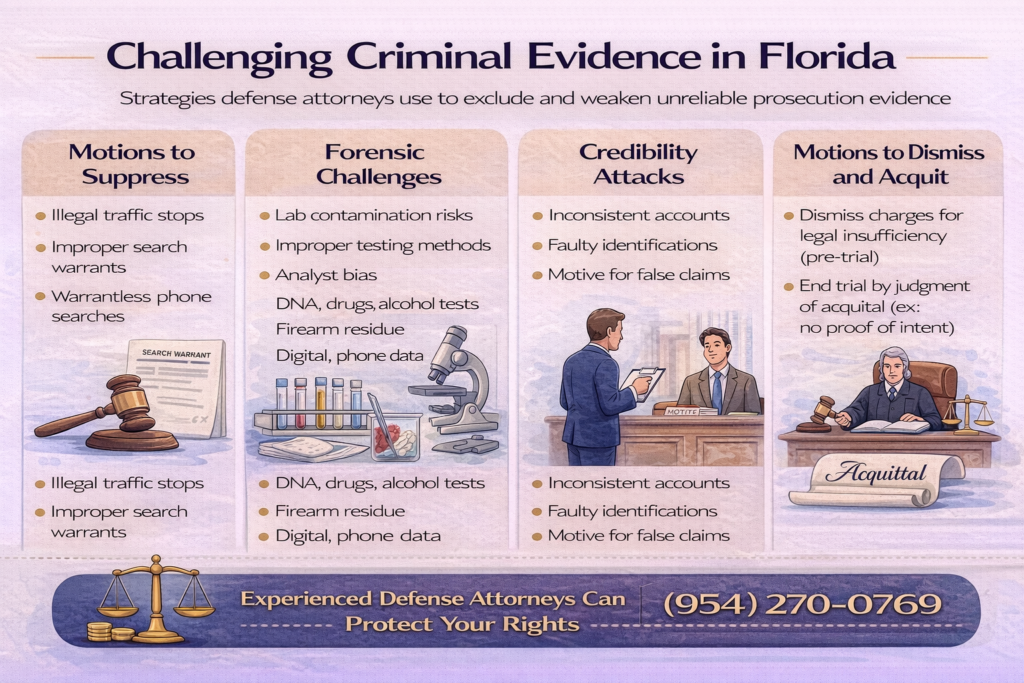
🚨 Motion to Suppress: Excluding Unlawfully Obtained Evidence
One of the most powerful tools in Florida criminal defense is the motion to suppress.
Evidence may be excluded if it was obtained in violation of:
The Fourth Amendment (illegal search or seizure)
The Fifth Amendment (coerced statements)
The Sixth Amendment (right to counsel violations)
Common suppression issues include:
Unlawful traffic stops
Overbroad search warrants
Warrantless phone searches
Improper interrogations
Evidence seized outside the scope of a warrant
If the judge suppresses key evidence, the prosecution’s case may collapse.
🔬 Challenging Forensic Evidence
Forensic evidence is often presented as scientific and definitive. In reality, it is frequently vulnerable to challenge.
Defense attorneys examine:
Chain of custody errors
Lab contamination risks
Improper testing procedures
Questionable methodologies
Analyst bias or error
Incomplete reports
Types of forensic evidence commonly attacked include:
DNA testing
Drug weight analysis
Blood and breath alcohol testing
Gunshot residue
Fingerprints
Digital extraction reports
A single procedural flaw can undermine the reliability of the entire analysis.
📱 Social Media and Digital Evidence Challenges
Modern prosecutions often rely on digital evidence.
This may include:
Social media posts
Direct messages
Photos and videos
Location metadata
Deleted content recovered from devices
However, digital evidence must be:
Properly authenticated
Lawfully obtained
Relevant to the charges
Not unfairly prejudicial
For more information, see our guide on how Social Media Evidence is Challenged.
🧑⚖️ Witness Credibility Attacks
Not all evidence is physical. Much of it comes from people.
Defense strategy frequently involves attacking:
Inconsistent statements
Prior contradictory testimony
Bias or motive to fabricate
Faulty identification procedures
Incentives for cooperation (plea deals, immunity)
Even when a witness is believable, the testimony must still establish every required element of the offense.
📂 Relevance, Hearsay, and Character Evidence
Florida’s Evidence Code limits what juries can hear.
Defense counsel may object to:
Irrelevant evidence
Improper character attacks
Prior bad acts
Hearsay statements
Speculative testimony
Even technically admissible evidence can be excluded if its prejudicial effect substantially outweighs its probative value.
This is often critical in:
DUI cases
Drug prosecutions
Violent felony trials
White-collar crime cases
🛑 Motions to Dismiss vs. Judgment of Acquittal
Challenging evidence can happen at multiple stages.
Motion to Dismiss
Filed before trial when the facts are undisputed but legally insufficient.
Motion for Judgment of Acquittal (JOA)
Filed during trial when the State’s evidence fails to prove all elements beyond a reasonable doubt.
A JOA ends the case immediately if granted.
Read more about Judgments of Acquittal in our comprehensive guide.
🧠 Why Early Litigation Strategy Matters
Evidence challenges are strongest when raised early.
If your defense attorney:
Identifies constitutional issues quickly
Preserves objections
Files timely suppression motions
Forces evidentiary hearings
…the State may lose leverage long before trial.
The worst strategy is waiting until the jury hears damaging evidence that could have been excluded.
🔎 What Happens If Evidence Is Weak?
If key evidence is suppressed or deemed legally insufficient:
Charges may be reduced
Cases may be dismissed
Plea offers may improve dramatically
The court may grant a judgment of acquittal
Prosecutors must prove their case. The defense’s role is to test that proof relentlessly.
🛡️ Strategic Criminal Defense in Fort Lauderdale and South Florida
At Michael White, P.A., every case begins with one question:
How strong is the State’s evidence — really?
From suppression hearings to cross-examination strategy to trial motions, evidence challenges are central to effective criminal defense.
If you are under investigation or charged with a crime in Florida, your defense should begin with a careful analysis of:
How the evidence was obtained
Whether it meets legal standards
Whether it can be excluded
Whether it proves every element
📞 Call (954) 270-0769 to schedule a consultation.