
Last updated February 2026
In every Florida criminal case — from arrest to trial — the outcome depends on one central question:
Has the required burden of proof been met?
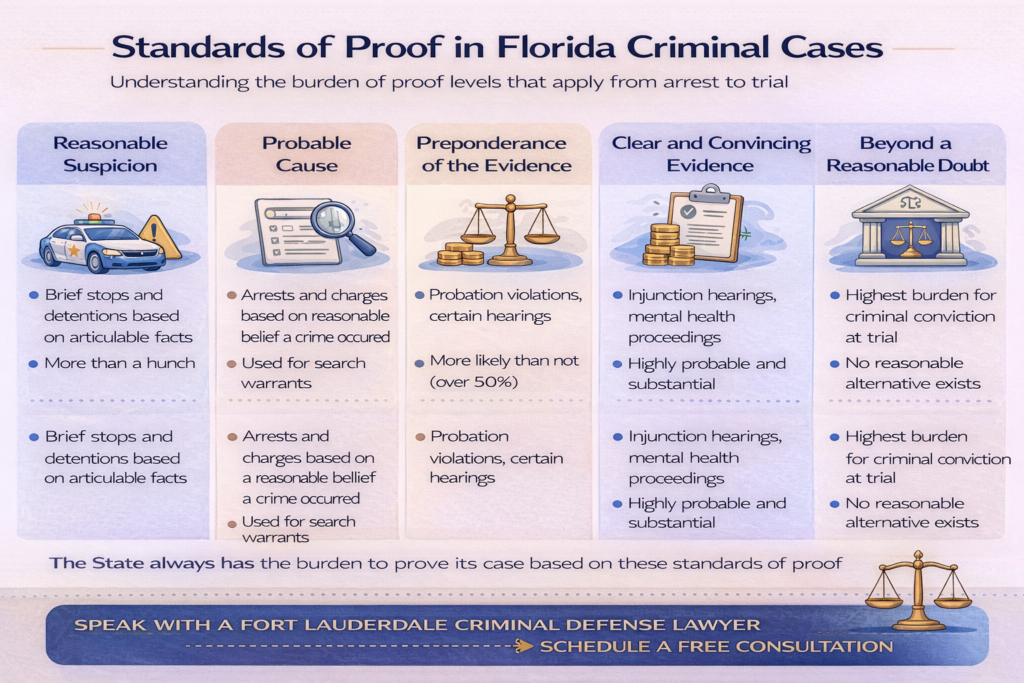
Different stages of a case require different evidentiary standards. Understanding these burdens is critical because they determine:
Whether police can stop or arrest you
Whether charges can be filed
Whether bond is granted
Whether a jury can convict
Whether probation can be revoked
Each standard serves a different constitutional function.
Understanding the burden of proof is only one part of the defense strategy. For a deeper look at how lawyers attack weak evidence, suppress unreliable testimony, and challenge forensic proof, see our guide to challenging criminal evidence in Florida.
🔒 Beyond a Reasonable Doubt (Trial Standard)
This is the highest burden used in a Florida criminal trial.
The State must prove each element of the offense beyond a reasonable doubt before a defendant can be convicted.
Under Florida Standard Jury Instructions:
A mere suspicion is not enough
A possible doubt is not enough
The jury must have an abiding conviction of guilt
Doubt may arise from the evidence — or from the lack of evidence
If jurors are uncertain or wavering, the burden has not been met.
This standard protects the presumption of innocence and is the foundation of criminal trial law.
🧠 Clear and Convincing Evidence
This burden falls between preponderance of the evidence and beyond a reasonable doubt.
It requires proof that is highly and substantially more likely to be true than not.
It commonly appears in:
Certain injunction hearings
Mental health or involuntary commitment proceedings
Some post-conviction or appellate contexts
It is more demanding than “more likely than not,” but does not reach the level required for criminal conviction.
⚖️ Preponderance of the Evidence
This is the lowest burden of proof that still requires persuasion.
It means:
More likely than not (over 50%).
It commonly applies in:
Probation violation hearings
Certain sentencing issues
Affirmative defenses where the defendant carries the burden
In probation violation cases, the State does not have to prove guilt beyond a reasonable doubt — only that the violation likely occurred.
That distinction is critical.
🚓 Probable Cause
Probable cause is not a trial burden — it is an investigative threshold.
It applies when:
Police make an arrest
Officers apply for a search warrant
Prosecutors file formal charges
Probable cause requires more than a bare suspicion, but less than proof beyond a reasonable doubt.
It asks whether the facts and circumstances would lead a reasonable person to believe a crime occurred.
👮 Reasonable Suspicion
This is a lower standard than probable cause.
Police may briefly detain someone based on:
Specific, articulable facts
More than a mere hunch
For example, erratic driving may justify a DUI stop based on reasonable suspicion — even if probable cause to arrest has not yet developed.
🧾 Proof Evident, Presumption Great (Arthur Hearings)
This rare and demanding burden applies in bond hearings involving capital or life felonies.
At an Arthur hearing, the State must show:
The evidence of guilt is evident
The presumption of guilt is great
This burden is considered even higher than beyond a reasonable doubt.
If the State meets it, the judge then decides whether discretionary bond is appropriate.
These hearings are pivotal in serious violent felony cases.
📊 Why Burdens of Proof Matter in Litigation
Understanding evidentiary burdens is not academic — it shapes defense strategy.
For example:
A motion for judgment of acquittal challenges whether the State met its burden beyond a reasonable doubt.
A motion to suppress challenges whether probable cause existed.
A probation violation defense focuses on whether the State met a preponderance standard.
If the burden is misapplied — or not met — the case can collapse.
For a deeper look at how insufficient evidence is challenged at trial, see our guide to: 👉 Judgment of Acquittal in Florida
🛡️ Strategic Defense Starts With the Burden
Every criminal defense case ultimately turns on one issue:
Has the State carried its burden?
At Michael White, P.A., we analyze every case through that lens — whether at the suppression stage, bond hearing, trial, or post-conviction motion.
Understanding the burden is the first step in defeating the charge.
❓ Frequently Asked Questions: Standards of Proof in Florida
What is the highest burden of proof in Florida criminal law?
“Proof evident, presumption great” is the highest burden and applies in rare Arthur hearings. At trial, the highest burden is beyond a reasonable doubt.
What does beyond a reasonable doubt mean?
It means the jury must have an abiding conviction of guilt after considering all the evidence. Suspicion or possible doubt is not enough.
What is clear and convincing evidence?
It is proof that is highly and substantially more likely to be true than not — a middle-level burden between preponderance and reasonable doubt.
What is a preponderance of the evidence?
It means more likely than not — just over 50 percent.
Do police need probable cause to stop someone?
Not always. A brief investigative stop only requires reasonable suspicion.