
Last updated April 2026
If police searched your phone after an arrest, the evidence they found may not be admissible in court.
In Florida, cellphone searches are one of the most heavily litigated Fourth Amendment issues. Because phones contain vast amounts of private data, courts place strict limits on when officers can access digital information without a warrant.
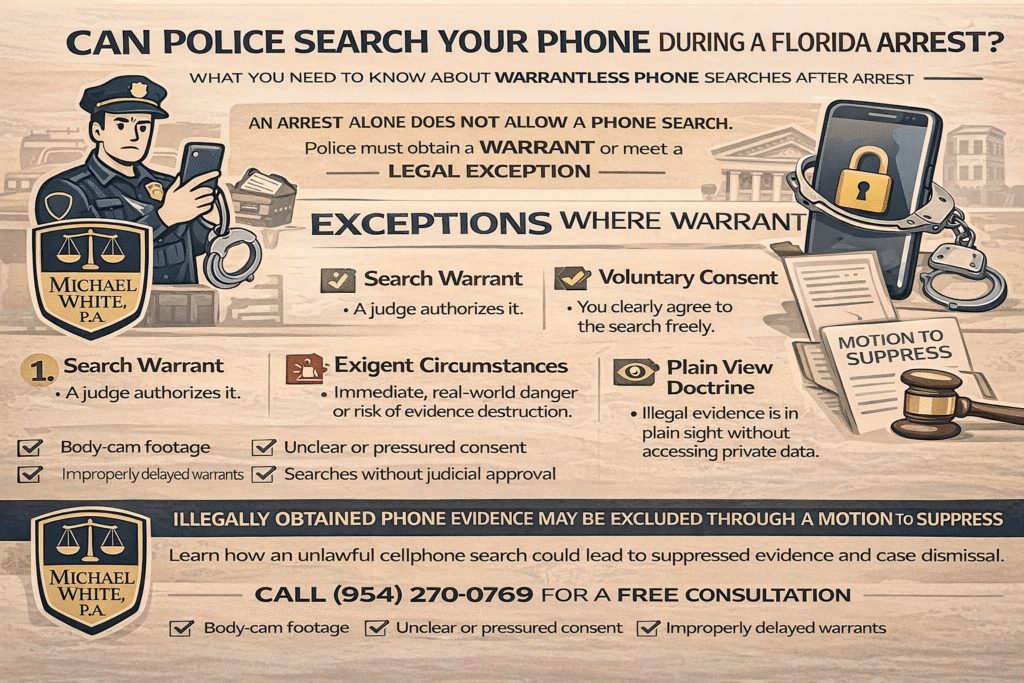
An arrest alone does not give police the right to search your phone.
Under the Fourth Amendment and Article I, Section 12 of the Florida Constitution, digital devices receive heightened protection.
Phone searches after arrest are analyzed under Fourth Amendment search-and-seizure principles. For a broader look at these protections,, see our guide to Illegal Search and Seizure in Florida.
Here’s what the law actually allows — and where officers frequently cross the line.
⚖️ The Law on Phone Searches After Arrest
The United States Supreme Court made this clear in Riley v. California:
Cellphones are different.
Although police may search a person incident to a lawful arrest for weapons or destructible evidence, the digital contents of a cellphone cannot be searched without a warrant — absent a narrow exception.
That means:
-
Police may seize your phone during an arrest
-
Police generally may not search its digital contents without a warrant
-
Arrest alone does not authorize scrolling through texts, photos, apps, or call logs
If police obtained your phone during an unlawful arrest or detention, the legality of the search may also be challenged. Learn more in illegal traffic stops in Florida.
🚫 Arrest Does NOT Automatically Allow a Phone Search
Many people assume that once they are arrested, police can search everything in their possession. That is not true for digital data.
The traditional “search incident to arrest” doctrine:
-
Allows officers to search for weapons
-
Allows officers to prevent destruction of physical evidence
-
Does not automatically permit access to digital data
Courts recognize that phones contain vast quantities of personal information far beyond the alleged crime.
Even outside of an arrest, police face similar restrictions. For example, officers generally cannot search a phone during a traffic stop without a warrant or valid exception, as explained in when police can search your phone during a traffic stop in Florida.
🔎 How Courts Analyze Phone Searches After Arrest
When a digital search is challenged, courts typically examine:
-
Whether a valid warrant existed
-
Whether any exception truly applied
-
Whether consent was voluntary
-
Whether officers exceeded the scope of the warrant
-
Whether the search occurred before judicial authorization
Timing often determines admissibility. Accessing digital data before obtaining a warrant can invalidate the search.
When a phone search violates the Constitution, any evidence obtained may be excluded under the fruit of the poisonous tree doctrine.
🚔 Common Florida Arrest Scenarios Where Phone Searches Go Wrong
Illegal phone searches frequently arise in:
-
DUI arrests involving text message review
-
Drug arrests where officers scroll contacts or messages
-
Domestic violence arrests involving alleged communications
-
Firearm arrests involving social media searches
-
Probation or warrant arrests followed by immediate phone access
In many cases, officers begin searching before a warrant is issued or rely on vague claims of consent that do not withstand judicial scrutiny.
🧠 Where Phone Search Cases Often Break Down
In many cases, the issue is not whether police eventually obtained a warrant — it’s when and how they accessed the data.
Common problems include:
- officers viewing messages or apps before a warrant is issued
- vague or overbroad warrant language
- delays between seizure and warrant application
- reliance on consent obtained under pressure
These timing and scope issues often determine whether digital evidence is admitted or suppressed.
🚨 Narrow Exceptions to the Warrant Requirement
Courts recognize only limited exceptions.
✅ Consent
If you clearly and voluntarily consent, officers may rely on that permission. Consent given while in custody is frequently challenged if pressured or unclear.
⚠️ Exigent Circumstances
Police must show a genuine emergency — such as imminent danger or immediate destruction of evidence. Routine arrests almost never qualify.
👀 Plain View (Extremely Limited)
If contraband is visible on a locked screen without accessing private data, officers may rely on plain view. Unlocking or scrolling exceeds that authority.
🌎 Border Searches
Different standards apply at international borders and ports of entry. These cases are highly fact-specific.
🔐 Can Police Force You to Unlock Your Phone?
The law regarding compelled unlocking continues to evolve.
Courts often distinguish between:
-
Compelling disclosure of a memorized passcode, and
-
Compelling biometric unlocking (fingerprint or facial recognition).
Whether forced unlocking is lawful depends heavily on the facts and procedural posture of the case.
If officers attempt to compel access without proper authority, the issue may be litigated in court.
🛡️ How Illegal Phone Searches Are Challenged
If police search a phone without a warrant or valid exception, the evidence may be excluded through a motion to suppress in Florida.
Suppression challenges commonly focus on:
-
Warrantless digital searches after arrest
-
Searches conducted before judicial approval
-
Overbroad warrants
-
Delayed warrant applications
-
Coerced or ambiguous consent
-
Searches exceeding authorized scope
When digital evidence is suppressed, prosecutors often lose critical proof — and cases may be reduced or dismissed.
⚖️ Why Digital Suppression Matters
Phone evidence often includes:
-
Text messages
-
Photos and videos
-
Location history
-
App data
-
Social media activity
In many prosecutions, this digital data forms the backbone of the State’s theory. If the search was unconstitutional, the case may weaken significantly before trial.
Digital evidence cases are frequently won or lost on the legality of the search itself.
📍 Fort Lauderdale Defense for Unlawful Phone Searches
If police searched — or attempted to search — your phone after an arrest, the legality of that search must be analyzed carefully.
At Michael White, P.A., we examine:
-
Bodycam footage
-
Arrest timelines
-
Warrant applications
-
Claims of consent
-
Digital extraction procedures
📞 Call (954) 270-0769 for a confidential consultation.
Serving Fort Lauderdale, Broward County, Miami-Dade, Palm Beach County, and South Florida.
❓ FAQs — Phone Searches After Arrest in Florida
Can police take my phone if I’m arrested?
Yes. Police may seize your phone, but they generally cannot search its contents without a warrant or valid exception.
Can police force me to unlock my phone?
In most cases, no. Forced access to a phone is heavily contested and usually requires a warrant.
What if I unlocked my phone for police?
If consent was voluntary, the search may be upheld. If consent was pressured or unclear, it can often be challenged.
Can phone evidence be thrown out in court?
Yes. Illegally obtained digital evidence may be suppressed through a motion to suppress.
What should I say if officers ask to search my phone?
Politely state: “I do not consent to a search of my phone.” Then ask for a lawyer.