
Last updated April 2026
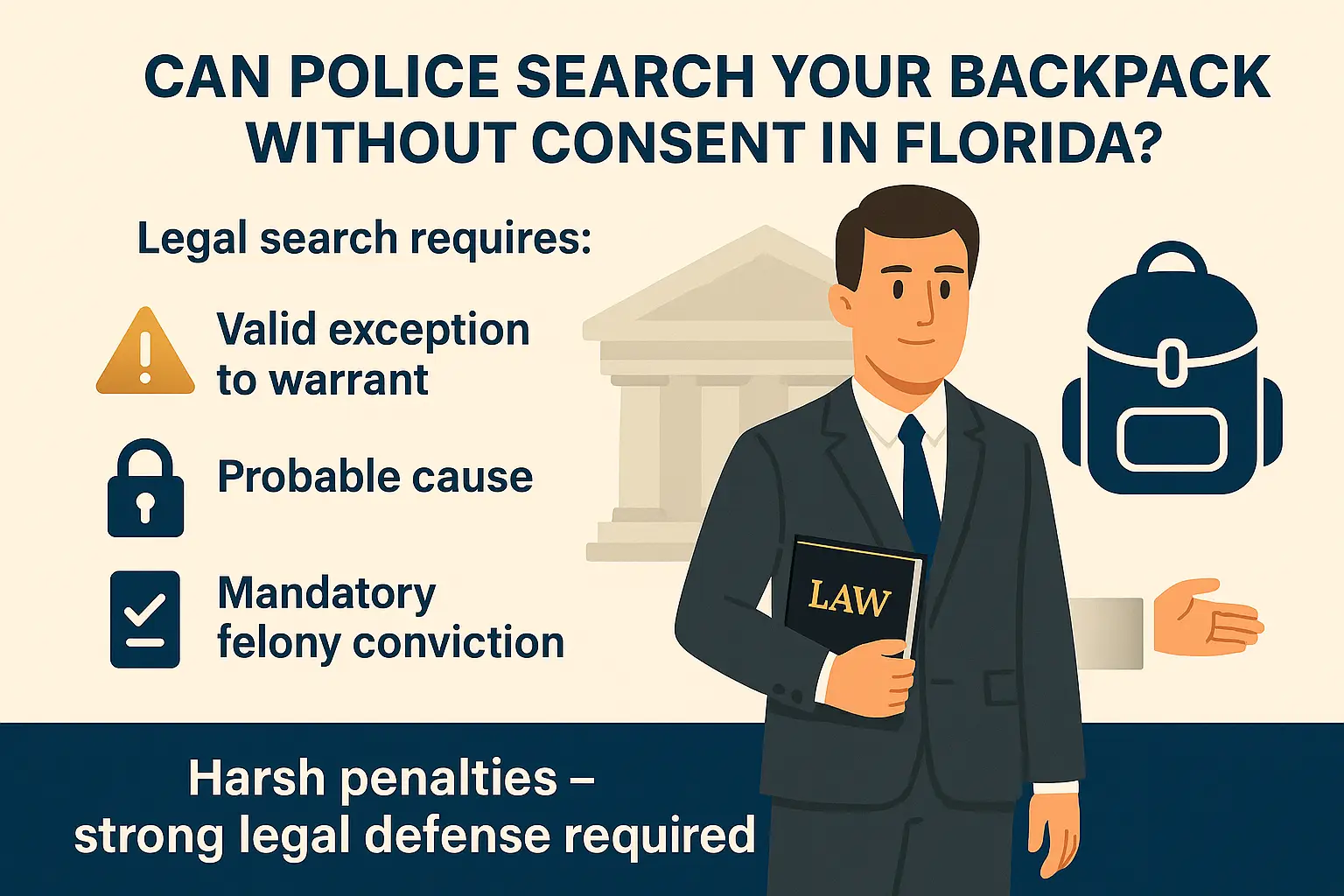
Whether you’re walking down the street, riding as a passenger, or pulled over during a traffic stop, officers sometimes ask to “look in your bag” or “check your backpack real quick.”
A backpack is not just a bag. Under the Fourth Amendment and Article I, Section 12 of the Florida Constitution, it is considered a protected container.
Police generally cannot search your backpack without lawful justification.
Backpack searches are one type of container search analyzed under Fourth Amendment principles. For a broader For a broader look at these protections, see our guide to, see our guide to illegal search and seizure in Florida.
Here’s when police may search a backpack — and when they cannot.
⚖️ When Police May Search Your Backpack
Police may search a backpack only under limited, legally recognized circumstances.
1️⃣ You Give Clear, Voluntary Consent
This is the most common method officers use.
Statements like:
-
“Mind if I take a look?”
-
“Open it real quick for me.”
-
“Let me just check something.”
are designed to obtain consent.
If you voluntarily agree, the search is typically lawful — even if you later regret the decision.
Consent must be voluntary and not the product of coercion, threats, or unlawful detention. Courts closely examine bodycam footage to determine whether consent was truly free and voluntary.
You always have the right to refuse consent. It’s also important to understand that your obligation to cooperate depends on whether you are lawfully detained in the first place. In many cases, whether you must comply with police requests — including providing identification — turns on that distinction, as explained in our guide to when you are required to identify yourself during a police encounter in Florida.
2️⃣ Search Incident to a Lawful Arrest
If you are lawfully arrested, police may search containers on your person, including:
-
Backpacks
-
Purses
-
Crossbody bags
-
Waist packs
However, this authority depends entirely on the arrest being lawful. If the arrest itself is unconstitutional, the search that follows may also be invalid.
Backpack searches often overlap with vehicle search rules when a bag is inside a car. Learn how those searches are evaluated in vehicle searches in Florida.
3️⃣ Probable Cause + Exigent Circumstances
Police may search a backpack without consent if:
-
They have probable cause to believe it contains evidence of a crime, and
-
There is a legitimate exigency (such as risk of destruction of evidence or immediate safety concerns).
This exception is narrow and frequently litigated.
4️⃣ Lawful Inventory Search
If a vehicle is lawfully impounded, officers may inventory personal property inside it, including containers.
However:
-
The tow must be lawful
-
Officers must follow written departmental policy
-
The purpose must be administrative, not investigatory
Inventory searches cannot be used as a pretext to search for evidence.
Inventory searches cannot be used as a pretext to search for evidence. Courts closely examine whether officers followed proper procedures and made the decision to tow before conducting the search. Learn more about how these issues arise in inventory searches after a vehicle tow in Florida.
🚫 When Police May NOT Search Your Backpack
Officers generally cannot search your backpack when:
-
You are in a consensual encounter
-
You are not lawfully detained
-
The detention is unsupported by reasonable suspicion
-
The stop is unlawfully prolonged
-
There is no probable cause
-
They rely only on vague “officer safety” claims
-
You clearly refuse consent
Backpacks receive strong privacy protection because they commonly contain personal and sensitive items.
If you are not lawfully detained, officers generally cannot compel cooperation — including demanding identification without a legal basis. These encounters often hinge on whether the interaction was truly voluntary, as discussed in our breakdown of when police can and cannot require identification in Florida.
🔎 How Courts Analyze Backpack Searches
When a backpack search is challenged, courts typically examine:
-
Whether the initial stop or detention was lawful
-
Whether consent was voluntary
-
Whether probable cause existed
-
Whether the search exceeded lawful scope
-
Whether any exception to the warrant requirement truly applied
Timing often matters. A search conducted before a lawful arrest — or before probable cause develops — may be unconstitutional.
🧠 Where Backpack Search Cases Often Break Down
In many cases, the issue is not whether police claim authority to search — it’s whether that authority actually applied at that moment.
Common problems include:
- obtaining consent during an unlawful detention
- searching before probable cause develops
- expanding the search beyond what was justified
- relying on vague safety concerns
These details often determine whether evidence is admitted or suppressed.
🧭 Common Real-World Scenarios
Backpack search issues frequently arise in:
-
Pedestrian stops
-
Passenger traffic stops
-
Trespass investigations
-
Transit or bus encounters
-
Bicycle stops
-
School zone policing
-
Marijuana-odor claims
In many cases, officers rely on vague suspicion or pressure tactics to obtain access.
🛡️ How Illegal Backpack Searches Are Challenged
When defending backpack search cases, we examine:
✔ Whether the stop or detention was lawful
✔ Whether consent was clear and voluntary
✔ Whether probable cause existed
✔ Whether the arrest was valid
✔ Whether the search exceeded lawful scope
If the search violated the Fourth Amendment, the evidence may be excluded through a motion to suppress in Florida.
In some cases, courts may treat evidence found during an illegal search as tainted under the fruit of the poisonous tree doctrine.
Digital evidence, drugs, weapons, or alleged contraband found inside a backpack often form the core of the prosecution’s case. Suppressing that evidence can significantly weaken or dismantle the charges.
📍 Fort Lauderdale Defense for Unlawful Backpack Searches
If police searched your backpack without lawful justification — or pressured you into allowing access — the legality of that search must be examined carefully.
At Michael White, P.A., we review bodycam footage, detention timelines, and search justifications to determine whether your rights were violated.
📞 Call (954) 270-0769 for a confidential consultation.
Serving Fort Lauderdale, Broward County, Miami-Dade, Palm Beach County, and South Florida.
❓ FAQs — Police Searching Backpacks in Florida
1. Can police search my backpack during a traffic stop?
Not without consent, probable cause, or a lawful arrest.
2. Can I refuse a backpack search?
Yes. You can (and often should) politely decline.
3. Can police search my backpack if I’m just walking?
Not unless you are lawfully detained and linked to suspected criminal activity.
4. What if the officer says it’s for “safety”?
Officer safety alone isn’t enough without articulable facts.
5. Can evidence from an illegal backpack search be suppressed?
Yes. Illegally obtained evidence is suppressible and often leads to dismissals.