
Last updated June 2026
If police searched your car without a warrant, the search may not be legal—and the evidence against you may not be usable in court.
In Florida, vehicle searches are one of the most heavily litigated Fourth Amendment issues. While there are several exceptions that allow warrantless searches, those exceptions are often misunderstood, misapplied, or stretched beyond their limits.
Both the Fourth Amendment of the U.S. Constitution and Article I, Section 12 of the Florida Constitution protect citizens from unreasonable searches and seizures. But there are important exceptions—especially when it comes to vehicles.
Learn more about how Florida courts evaluate unlawful searches and when evidence can be suppressed in our guide to Illegal Searches, Seizures & Suppression.
Understanding your rights can mean the difference between a conviction and a successful defense.
⚖️ The Fourth Amendment and Vehicle Searches
The Constitution generally requires police to have probable cause (PC) and a search warrant to conduct a lawful search. In most cases, this means going before a judge.
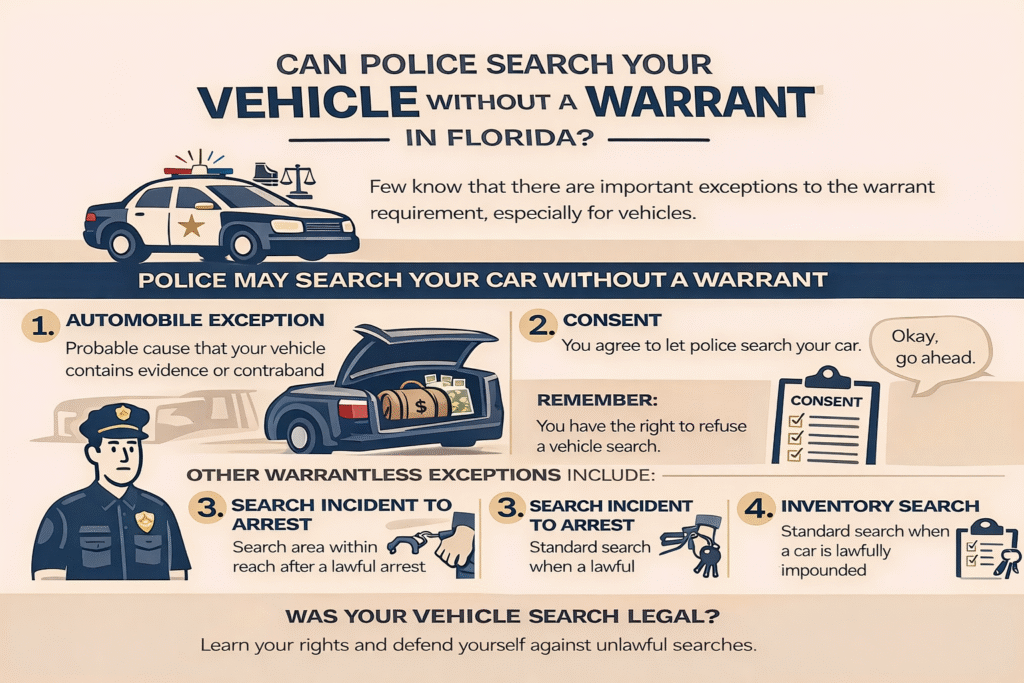
However, several major exceptions allow law enforcement to search your car without first getting a warrant. These exceptions are heavily litigated—and often misused—by police.
🚗 The Automobile Exception
The Automobile Exception allows police to search a vehicle without a warrant if they have probable cause to believe it contains contraband or evidence of a crime.
✅ Key Rules:
-
Applies to entire vehicles and containers (e.g., backpacks, duffel bags)
-
Doesn’t matter if the container belongs to the driver or a passenger
-
Police may search any part of the car that could reasonably contain the item in question
💡 Example:
If officers believe there’s a suitcase full of cocaine in a car, they can search the trunk or back seat—but not the glovebox (unless it’s suitcase-sized 😉).
🔄 Inadvertent Discovery:
If police are lawfully searching a vehicle under the automobile exception and find evidence of another crime, they can still use it in court.
📍 Example in Fort Lauderdale:
Police stop a driver for running a red light. During the stop, they detect alcohol and begin a lawful DUI investigation. If they spot open containers, they may lawfully search the car. If they find cocaine during that lawful search, the State can prosecute for both DUI and cocaine possession.
🧠 Where Vehicle Search Cases Often Break Down
In many cases, the issue is not whether police claim probable cause existed — it’s whether the facts actually support it.
Common issues include:
- vague claims like “odor of marijuana” without corroboration
- inconsistent officer reports compared to bodycam footage
- searches that go beyond what probable cause allows
- reliance on consent that may not have been voluntary
These details often determine whether evidence is admitted or suppressed.
🚫 Vehicle Searches Without Probable Cause
Even without probable cause, officers may still search a car under these exceptions:
✅ 1. Consent
If you agree to let police search your vehicle, they don’t need a warrant—or even probable cause.
- Police often use pressure, confusion, or your lack of legal knowledge to get your consent
- You can legally refuse a search request—no matter how intimidating it feels
- If they’re asking, it often means they don’t have probable cause
✋ Pro tip: If they ask to search, you can say, “No, I do not consent to a search.”
Your right to refuse a search is closely tied to whether you are legally required to comply with police requests in the first place. In many cases, that depends on whether you are actually detained — including whether you must provide identification during the encounter, as explained in our guide to when you are required to identify yourself during a police encounter in Florida.
If consent was obtained during an unlawful detention, the search may still be challenged. In many cases, the timing and length of the stop determine whether consent was valid, as explained in unlawful prolonged traffic stops in Florida.
✅ 2. Search Incident to Arrest
Police may search a suspect and the area within their immediate control after a lawful arrest. For vehicles, this means:
- The person must be able to reach into the vehicle
- If the suspect is already handcuffed or detained away from the car, this exception does not apply
✅ 3. Inventory Search
When police lawfully impound or take custody of a car, they may conduct an inventory search to catalog its contents—so long as it’s:
- Non-investigative (e.g., not just a pretext for looking for drugs or weapons)
- Part of standard policy
Inventory searches are frequently abused after traffic arrests and impoundments. Learn when these searches are lawful — and when they are unconstitutional — in our guide to inventory searches after a vehicle tow in Florida.
Even when a search appears valid, courts may still examine whether the evidence should be excluded due to earlier constitutional violations.
👉 Learn how this works in fruit of the poisonous tree in Florida
📍 Example:
A DUI arrest in Fort Lauderdale leads to an impounded vehicle. Officers inventory the car and find fentanyl in the trunk. If done properly, this evidence may be used in court.
🛡️ Were Your Rights Violated?
Determining whether a warrantless search of your vehicle was legal is complex. Police officers make mistakes, overstep boundaries, and rely on shaky probable cause all the time.
At Michael White, P.A., we examine every detail of your stop, search, and arrest to determine whether:
-
The search was constitutional
-
Your consent was valid
-
The inventory search followed procedure
-
Evidence can be suppressed
📞 Call (954) 270-0769 now for a free case review. We fight unlawful searches and protect your rights across Fort Lauderdale and South Florida.
💬 FAQs: Vehicle Searches in Florida
Q: Can police search my car during a traffic stop without a warrant?
A: Only if they have probable cause, consent, or another legal exception.
Q: What happens if I refuse a car search?
A: You have the right to refuse. If they search anyway, your lawyer may challenge the evidence in court.
Q: Can they search my friend’s bag in my car?
A: Yes—if they lawfully search your car, they can inspect containers inside it, regardless of ownership.