
Last updated April 2026
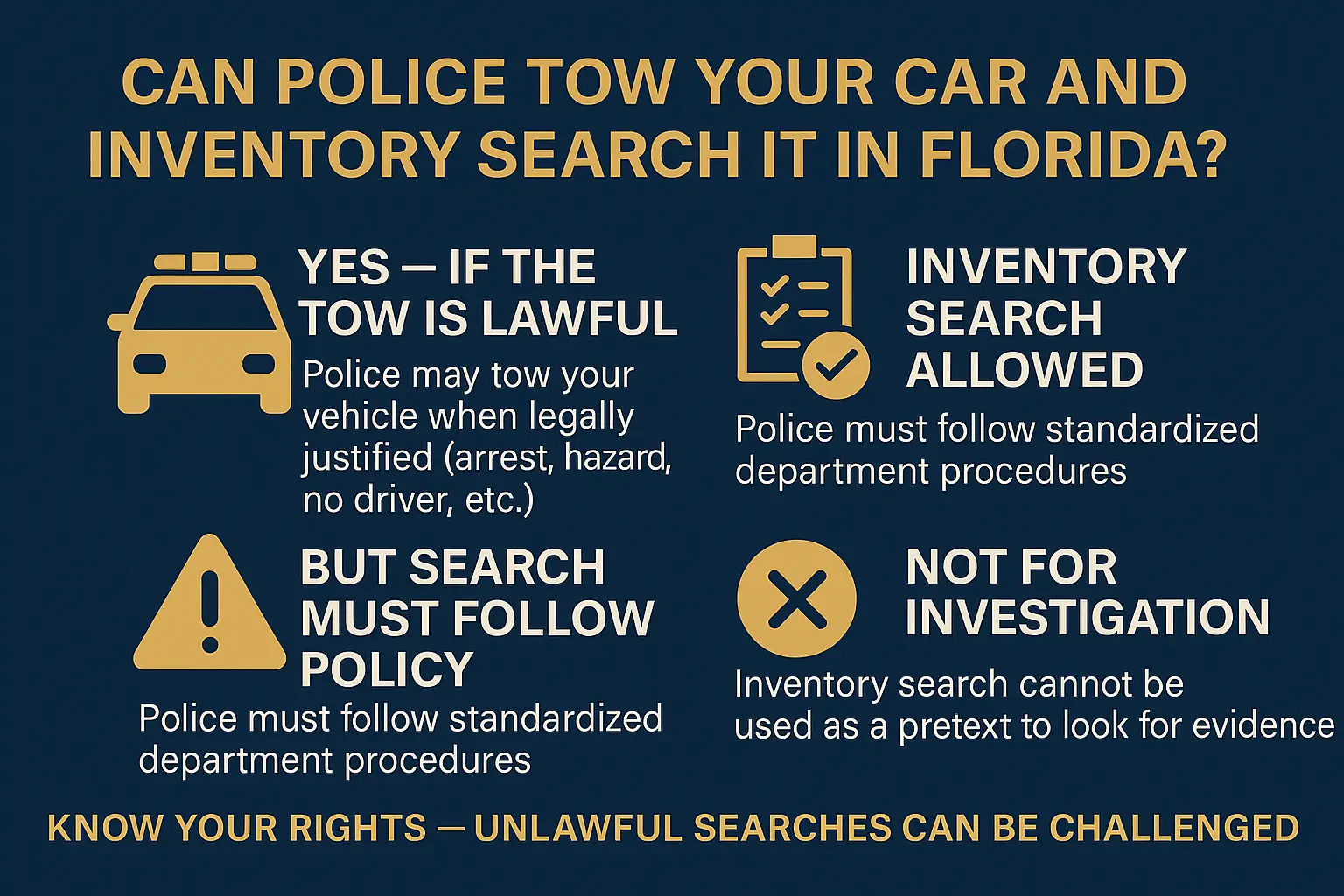
After a traffic stop or arrest, officers sometimes say they “have to tow the car” and “inventory the contents.” Many drivers assume they have no choice — but under Florida law, inventory searches are valid only under strict Fourth Amendment rules.
An inventory search is supposed to be administrative, not investigative. Its purpose is to protect your property and shield police from claims of theft — not to search for drugs, weapons, or evidence of a crime.
Inventory searches are a specific category of Fourth Amendment issue. For a broader look at these issues, see our guide to illegal search and seizure in Florida.
Here’s when police can lawfully tow and inventory your vehicle — and when the search becomes unconstitutional.
⚖️ When Police Can Tow and Inventory Your Vehicle in Florida
For an inventory search to be valid, each step must be lawful.
1️⃣ The Tow Must Be Lawful
Police must have a legitimate, non-pretextual reason to impound the vehicle, such as:
-
No licensed driver available to take custody
-
Arrest requiring removal of the vehicle
-
Vehicle obstructing traffic or creating a hazard
-
Disabled vehicle after a crash
-
A valid, written impound policy
If the tow itself is improper, any subsequent inventory search is invalid.
Inventory searches are often confused with other vehicle search doctrines. Learn how probable cause-based searches differ in vehicle searches in Florida.
2️⃣ The Agency Must Follow a Standardized Policy
Florida law requires a written departmental policy that governs:
-
When a vehicle may be impounded
-
How an inventory must be conducted
-
Whether containers may be opened
-
How property is documented
Officers cannot improvise an inventory search. Failure to follow policy can render the search unconstitutional.
3️⃣ The Purpose Must Be Administrative — Not Investigatory
Courts closely scrutinize whether an inventory search was truly administrative or simply a pretext to conduct a criminal investigation.
An inventory search must be conducted to:
-
Secure and document personal property
-
Protect the owner’s belongings
-
Protect law enforcement from false claims
It cannot be used as a pretext to “look for drugs” or “check for weapons.” If bodycam footage or officer testimony shows investigatory intent, courts may suppress the evidence.
4️⃣ Containers May Only Be Opened If Policy Allows It
Officers may open:
-
Backpacks
-
Purses
-
Closed compartments
-
Locked containers
-
Glove boxes
Only if their written policy explicitly authorizes it.
If the policy does not allow container searches, opening a bag or lockbox exceeds constitutional limits.
🚫 When Inventory Searches Become Unlawful
Inventory searches are frequently challenged when officers:
-
Search before deciding to tow
-
Claim impound is “routine” without policy justification
-
Extend a stop to justify towing
-
Force a tow when a licensed passenger is present
-
Use inventory as a substitute for probable cause
-
Deviate from written procedures
Courts closely scrutinize whether the tow decision was made before the search — not after.
In some cases, the decision to tow occurs only after a stop has been extended without legal justification. Learn how timing affects legality in unlawful prolonged traffic stops in Florida.
📹 Real-World Patterns in South Florida Cases
Inventory-search issues commonly arise when:
-
Drivers are arrested for DUI
-
Officers conduct DWLS stops
-
Vehicles are towed from private property
-
Drivers decline consent to search
-
Officers suspect drug activity but lack probable cause
Body-worn camera footage often reveals officers searching the vehicle before formally deciding to impound it — a critical timing issue under the Fourth Amendment.
🧠 Where Inventory Search Cases Often Break Down
In many cases, the issue is not whether officers claim they were following policy — it’s whether the facts actually support that claim.
Common problems include:
- deciding to tow only after beginning a search
- failing to follow written procedures
- opening containers not authorized by policy
- using inventory as a pretext for investigation
These timing and policy issues often determine whether evidence is admitted or suppressed.
🛡️ How Illegal Inventory Searches Are Challenged
When evaluating an inventory search, we examine:
✔ Whether the tow decision was legally justified
✔ Whether officers followed written policy
✔ Whether the search preceded the impound decision
✔ Whether containers were opened lawfully
✔ Whether the officer’s purpose was investigatory
If the search was unlawful, evidence obtained may be excluded through a motion to suppress in Florida.
In many cases, courts treat evidence discovered after an improper tow or inventory as tainted under the fruit of the poisonous tree doctrine.
⚖️ Why Inventory Search Challenges Matter
Inventory searches often uncover:
-
Drugs
-
Firearms
-
Paraphernalia
-
Cash
-
Digital evidence
If the search was unconstitutional, that evidence may be suppressed — and without it, the prosecution’s case may weaken significantly or collapse before trial.
📍 Fort Lauderdale Defense for Illegal Inventory Searches
If your vehicle was searched after a tow — or if you believe police used an inventory search as a pretext — the legality of the tow and the policy compliance must be examined carefully.
At Michael White, P.A., we review bodycam footage, impound policies, and timing to determine whether the search violated the Fourth Amendment.
📞 Call (954) 270-0769 for a confidential consultation.
Serving Fort Lauderdale, Broward County, Miami-Dade, Palm Beach County, and South Florida.
❓ FAQs — Inventory Searches in Florida
1. Can police search my car after deciding to tow it?
Only if they follow their written inventory-search policy.
2. Can officers open my backpack or purse during inventory?
Only if department policy explicitly allows container searches.
3. Can police force a tow even if a licensed driver is available?
Usually no. If someone can legally take the car, a forced tow may be unlawful.
4. Can evidence from an unlawful inventory search be suppressed?
Yes — and suppression often leads to major reductions or dismissals.
5. What if the officer searched my car before announcing the tow?
That is almost always unlawful and can invalidate the entire search.