
Last updated April 2026
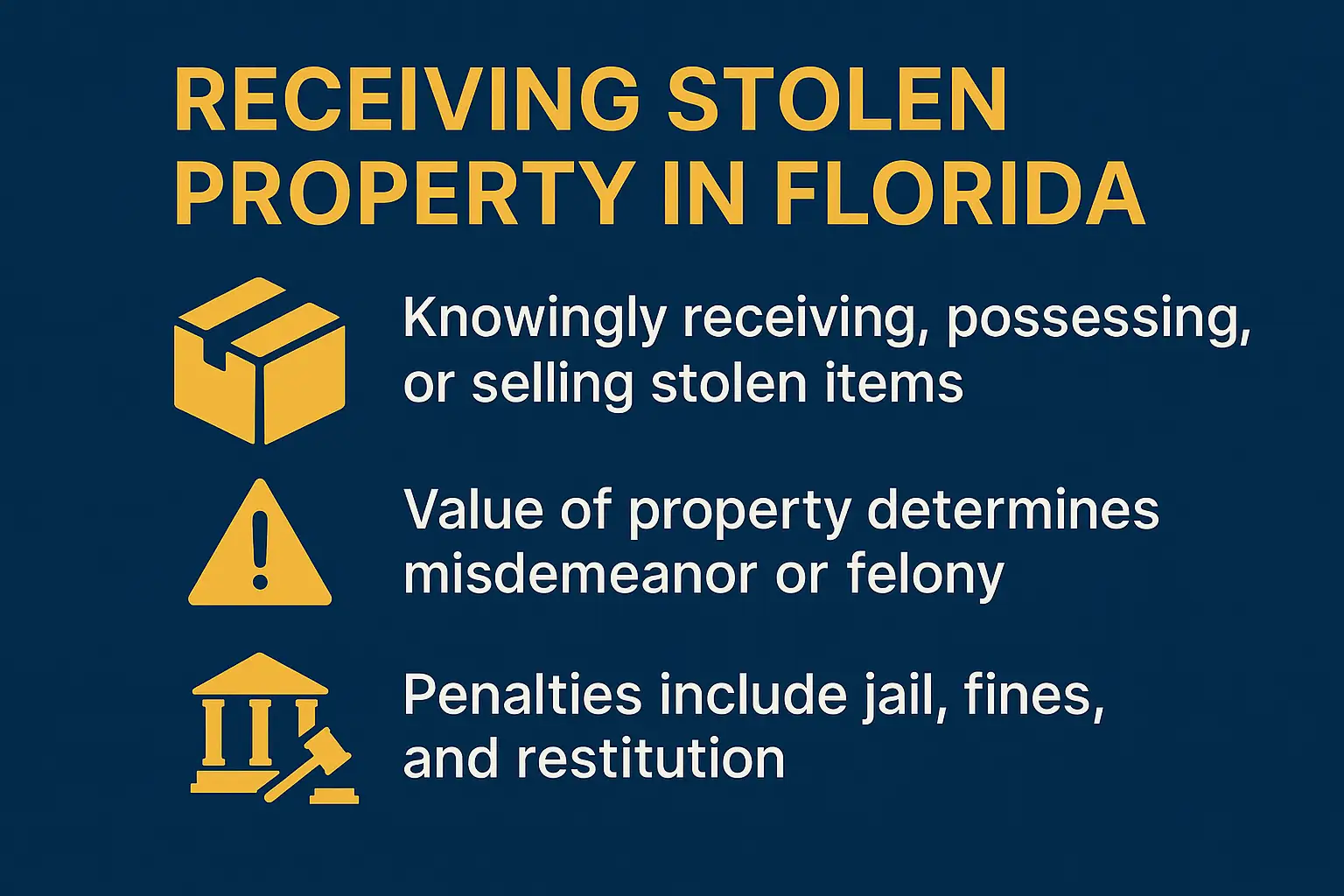
In Florida, receiving stolen property—also known as dealing in stolen property—is a felony that carries extremely harsh penalties. Many people are shocked to learn that simply possessing property can lead to arrest when police believe the circumstances suggest knowledge—even when no actual knowledge exists.
Dealing in stolen property is prosecuted as a serious grand theft–related felony, with penalties that often exceed those in standard theft cases. For a broader breakdown of felony theft levels and sentencing exposure, see grand theft felony penalties in Florida.
To understand how these charges fit within Florida’s theft laws, see theft charges in Florida.
Broward and Miami-Dade law enforcement aggressively file these charges, especially in cases involving electronics, jewelry, tools, bicycles, and items sold through marketplaces like OfferUp or Facebook Marketplace.
In many cases, these charges are based on assumptions about how property was obtained rather than direct evidence of knowledge.
These cases are often part of broader grand theft defense strategies in Florida.
Here’s what Florida law says — and how these cases are defended.
⚖️ Florida Law: § 812.019 — Dealing in Stolen Property
Under Florida Statute § 812.019, a person commits:
1. Trafficking in Stolen Property (F2)
Buying, selling, or otherwise distributing stolen property.
Penalties:
-
Up to 15 years in prison
-
Up to 15 years probation
-
$10,000 fine
2. Initiating, Organizing, or Financing Trafficking (F1)
Coordinating or supervising a stolen property scheme.
Penalties:
-
Up to 30 years in prison
3. Possessing Stolen Property (F3)
Knowingly possessing stolen property can also be charged as a felony.
These cases often overlap with grand theft, intent-to-defraud, and scheme-to-defraud investigations — and innocent buyers frequently get swept in when police assume knowledge or participation.
🕵️ How “Knowledge” Is Proven (Or Not Proven)
The State must prove you knew or should have known the property was stolen.
This is closely tied to whether intent can actually be proven—see how lack of intent defense in Florida theft cases applies.
Prosecutors often try to infer knowledge based on:
-
Extremely low purchase price
-
Removing serial numbers
-
Possession shortly after a burglary
-
Inconsistent explanations
-
Buying items from strangers in parking lots
-
Prior theft-related history
-
Text messages or online chats
These are inferences — not evidence.
We frequently see cases where normal buying behavior is misinterpreted as criminal conduct.
And these assumptions break down quickly under cross-examination or credibility-issues analysis.
🔗 Constructive Possession vs. Actual Possession
Receiving stolen property cases often involve issues similar to constructive possession, especially when the item is found:
-
In a shared car
-
In a shared residence
-
In a borrowed backpack or purse
-
In a room with multiple occupants
Just like in drug cases, the State must prove:
-
Knowledge of the property
-
Control over the property
If others had equal access, the State’s burden is significantly higher.
🚨 Real Examples in South Florida
In practice, many of these cases begin with a routine stop or investigation that expands based on assumptions rather than clear proof.
You can be charged even if you:
-
Bought an item at a flea market or garage sale
-
Purchased electronics cheaply online
-
Held property for a friend
-
Picked up an item from someone else’s home
-
Borrowed a car or bag containing stolen items
In many cases, police quickly escalate the charge to dealing in stolen property, even when the situation is a misunderstanding.
These cases often originate from traffic stops, welfare checks, or apartment searches — the same flawed procedures we challenge in motion to suppress hearings.
🛡️ Defenses to Receiving Stolen Property in Florida
These cases are often won by challenging assumptions early—before the State can build a narrative around incomplete facts.
At Michael White, P.A., we frequently use the following defenses:
✔ Lack of Knowledge
You didn’t know — and had no reason to know — the property was stolen.
✔ Innocent Possession
You briefly held the item for someone else without criminal intent.
✔ Constructive Possession Challenges
Others had equal access or ownership.
✔ Unlawful Search or Detention
If police found the property during an illegal search, the evidence may be suppressed.
✔ Inconsistent Statements by Witnesses
Pawnshop workers, complainants, or officers often exaggerate or misremember key details — similar to issues in victim credibility cases.
✔ Lack of Proof of Theft
Sometimes the item isn’t even proven to be stolen.
✔ Online Marketplace Entrapment Issues
Private sellers are not regulated, and police often misunderstand normal resale behavior.
These cases are far more defensible than most people think.
Early legal intervention can often prevent formal charges or lead to dismissal before the case gains momentum.
🚨 Speak With a Fort Lauderdale Criminal Defense Lawyer Today
If you’re facing allegations of receiving or dealing in stolen property, learn how our Fort Lauderdale theft and fraud defense team challenges felony charges and protects your future.
A stolen-property accusation does not mean you’re guilty — especially when police rely on assumptions instead of evidence.
Contact Michael White, P.A. to protect your rights, challenge the State’s theory, and pursue dismissal or reduction wherever possible.
❓ FAQs — Receiving Stolen Property in Florida
1. Can I be charged if I didn’t know the property was stolen?
Yes — but the State must prove knowledge, which is often difficult.
2. Is buying something cheaply enough to prove guilt?
No. Price alone is not proof you knew the item was stolen.
3. What if someone left stolen property in my car or home?
Constructive possession rules apply — the State must prove knowledge and control.
4. Is receiving stolen property a felony?
Yes. It is typically charged as a third-degree felony, but trafficking can be a second-degree felony.
5. Can the charge be dropped?
Yes. Many cases are dismissed when knowledge or possession cannot be proven.