
Last updated March 2026
🚨 You Can Be Arrested for DUI — Even If the Crash Wasn’t Your Fault
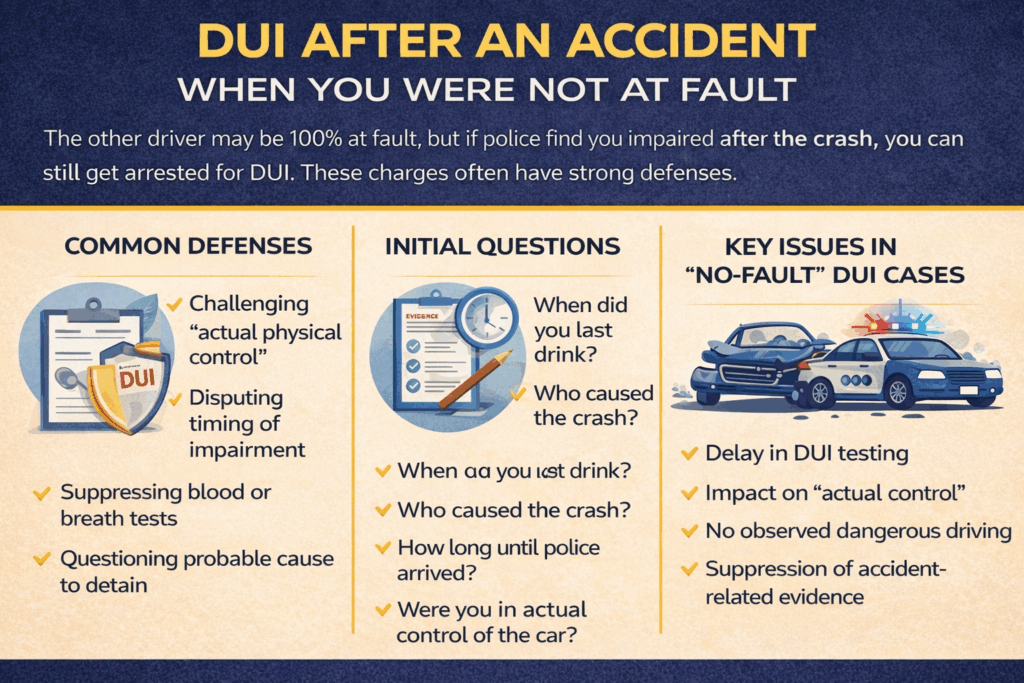
Many drivers are shocked to learn that they can be arrested for DUI after a car accident they did not cause.
In Florida, fault for the crash and impairment under DUI law are treated as two separate issues.
Even if the other driver caused the collision, police may still investigate whether you were impaired after the accident — and that distinction often creates strong defense opportunities.
For a broader understanding of how DUI stops and investigations are challenged, see our guide to DUI Traffic Stops & Investigations in Florida.
⚖️ Can You Get a DUI If the Accident Was Not Your Fault?
Yes. Florida law allows police to investigate DUI after a crash regardless of who caused it.
Officers often shift focus from accident causation to impairment once they arrive at the scene. However, the fact that you were not at fault can significantly weaken the State’s case—especially when there is no evidence of dangerous driving before the collision.
In many of these cases, the strongest defense involves challenging and suppressing the DUI evidence obtained after the accident.
🚔 How Post-Accident DUI Investigations Begin
After a crash, officers commonly:
- detain drivers at the scene
- ask about alcohol consumption
- delay testing while investigating the accident
- rely on statements made during a stressful situation
These encounters frequently raise questions about whether police had legal grounds to prolong detention or escalate the investigation into a DUI case.
Many of these issues overlap with broader investigative errors seen in DUI cases, as discussed in
DUI Arrest Mistakes Police Make in Fort Lauderdale.
🕒 Timing Matters More Than Fault
One of the most important issues in no-fault DUI cases is when impairment is alleged to have occurred.
Key questions include:
- when you last consumed alcohol
- how long police took to arrive
- when testing occurred
- whether alcohol absorption was still ongoing
Delays between the accident and testing often undermine the reliability of DUI evidence.
🧪 Testing Problems After Accidents
Post-crash DUI cases commonly involve:
- delayed breath or blood testing
- alcohol absorption after the collision
- stress or injury affecting observations
- reliance on hospital blood draws
These issues frequently arise in cases where officers stretch or prolong the investigation beyond what is legally justified.
🚘 Actual Physical Control After a Crash
Even when a vehicle is disabled after an accident, prosecutors may argue actual physical control instead of active driving.
They may focus on:
- whether the vehicle was operable
- key location
- seat position
- intent to move the vehicle
Accident-related facts often weaken this argument.
⚠️ Where These Cases Often Go Wrong
No-fault DUI cases frequently involve:
- prolonged detention without justification
- weak or nonexistent pre-crash driving evidence
- reliance on statements made under stress
- questionable searches following the crash
Search-related issues are especially common after accidents, particularly when officers escalate the investigation without proper legal basis. Learn more in
Can Police Search Your Car After a DUI Arrest in Florida?
Video evidence can also play a critical role in these cases, especially when it contradicts how the incident is described in police reports. See how this is used in
Broward DUI Bodycam Footage.
✅ Key Takeaways: DUI Defense in No-Fault Accident Cases
- You can face DUI charges even if the accident was not your fault
- Fault and impairment are separate legal questions
- Testing delays are common and critical
- Lack of dangerous driving can weaken the State’s case
- Suppression is often the strongest strategy
❓ FREQUENTLY ASKED QUESTIONS
Can I be charged with DUI if the other driver caused the accident?
Yes. Police may still investigate DUI after a crash, but fault matters when evaluating the strength of the evidence.
Does being not at fault help my DUI defense?
Often, yes. Lack of dangerous driving before the crash can weaken the State’s case.
What if testing happened long after the accident?
Delays can raise serious reliability issues, including alcohol absorption and rising BAC defenses.
Can statements made after a crash be challenged?
Yes. Statements made during stressful or custodial post-accident encounters may be suppressed in some cases.
Are no-fault DUI cases defensible?
Very often. These cases frequently involve weak timing evidence, improper escalation, or testing flaws.
📍 Arrested After an Accident in Fort Lauderdale?
A DUI arrest after a crash — especially one you didn’t cause — is often defensible.
These cases frequently involve weak timelines, improper investigation, and questionable evidence.