
Last updated April 2026
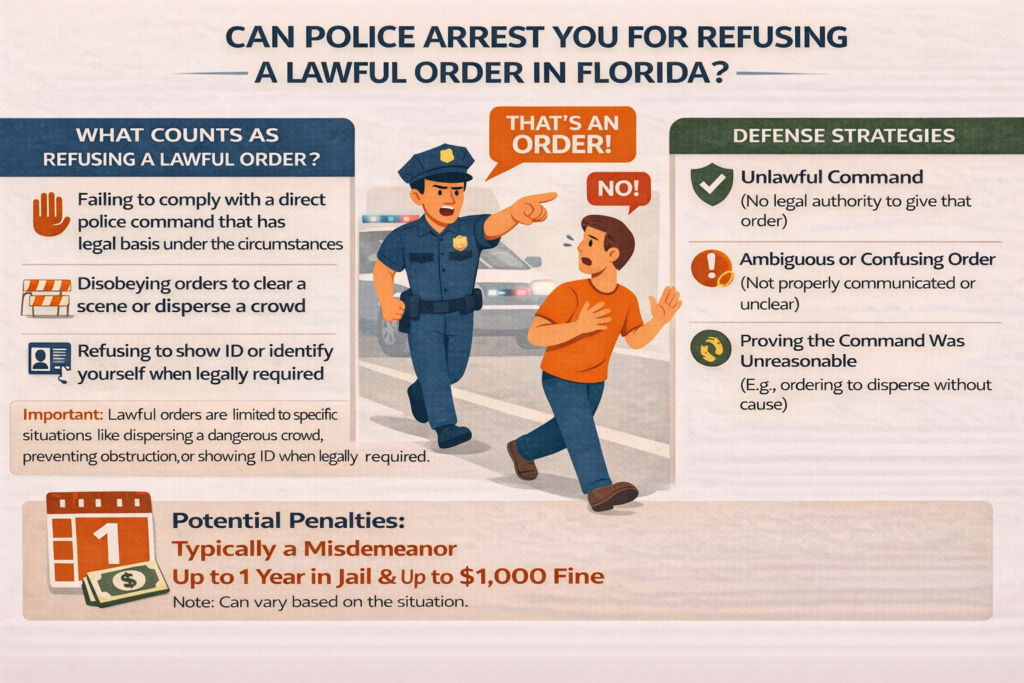
Yes — in certain circumstances, refusing to comply with a lawful police order can result in arrest in Florida.
But not every command issued by an officer is legally binding. And not every refusal amounts to obstruction.
The key question is whether the officer was acting within the lawful execution of a legal duty. For a broader overview of how these situations lead to charges, see our guide to Resisting Arrest & Obstruction Charges in Florida.
Understanding that distinction is critical.
The Law: Resisting an Officer Without Violence
Most cases involving refusal to comply are charged under § 843.02, Florida Statutes — Resisting an Officer Without Violence.
The statute makes it a crime to:
-
Obstruct
-
Resist
-
Oppose
An officer engaged in the lawful execution of a legal duty. If the officer was not acting within legal authority, the command itself may not qualify as a lawful order — and refusal may not support a criminal charge.
That means the State must prove:
-
The officer was lawfully performing a legal duty
-
You knew the officer was performing that duty
-
You intentionally refused to comply in a way that obstructed the officer
If any one of those elements is missing, the charge may fail.
What Is a “Lawful Order”?
A lawful order is a command issued by an officer who has legal authority to give it under the circumstances.
Examples may include:
-
Ordering a driver to exit a vehicle during a traffic stop
-
Directing someone to stop during a lawful investigatory detention
-
Instructing a person to step back during an active investigation
-
Ordering compliance during a valid arrest
If the officer lacks legal authority, the order may not be enforceable.
When Does a Police Command Become Legally Binding?
Not every instruction from a police officer is a lawful order.
In many cases, the key issue is whether the officer had legal authority to issue the command — and whether a reasonable person would understand that compliance was required.
Situations that often fall into a gray area include:
- officers giving suggestions or requests rather than clear commands
- unclear or conflicting instructions
- commands issued during consensual encounters
- rapidly escalating interactions where expectations are not explained
In these scenarios, what may appear to be refusal can actually be confusion about whether the command was legally enforceable.
These distinctions are often central to whether an obstruction charge can be proven.
When Refusing a Command Can Lead to Arrest
You may face arrest if:
-
The officer had reasonable suspicion or probable cause
-
The command was clear and lawful
-
Your refusal interfered with the officer’s duties
-
The conduct went beyond verbal disagreement
Simply arguing, questioning the officer, or asserting your rights is not automatically obstruction.
But physically refusing to comply with a lawful directive can be. Learn how these charges are applied in Resisting Without Violence in Florida.
When Refusing an Order Is Not a Crime
There are important limits.
Unlawful Detention
If the stop itself was unlawful, refusal to comply may not support a conviction.
Consensual Encounter
If you are free to leave, you are not required to obey commands that exceed the scope of a voluntary interaction. See also Walking Away from Police in Florida.
Unlawful or Overbroad Commands
Police authority is not unlimited. Commands that lack legal basis may not qualify as lawful orders under § 843.02.
What About Refusing to Answer Questions?
Florida law generally does not require you to answer investigative questions during a consensual encounter.
You may:
-
Decline to answer
-
Request an attorney
-
Remain silent
Issues involving identification often arise in these encounters. See Refusing to Show ID in Florida.
Refusing to speak is not the same as refusing a lawful physical command.
The distinction matters.
Common Defense Strategies
Charges based on “refusal to comply” often hinge on the legality of the underlying stop.
Challenging the Lawfulness of the Order
If the officer lacked reasonable suspicion or probable cause, the command may not have been lawful.
Lack of Obstruction
Not every refusal interferes with police duties.
Video Evidence
Body camera and dash camera footage often determine whether the order was clear and lawful.
Suppression Motions
If the detention violated the Fourth Amendment, evidence may be excluded.
Potential Penalties
Resisting an officer without violence is a:
First-Degree Misdemeanor
Maximum penalties include:
-
Up to 1 year in jail
-
Up to $1,000 fine
-
Up to 12 months of probation
-
A permanent criminal record
In some cases, prosecutors use obstruction-related charges to strengthen negotiations on underlying offenses.
In practice, many of these cases turn on whether the command was clearly communicated and whether body camera footage supports the officer’s version of events.
Arrested in Broward County for Refusing an Officer’s Order?
If you were arrested in Fort Lauderdale or anywhere in South Florida for allegedly refusing a lawful command, the legality of the order is often the central issue.
At Michael White, P.A., we evaluate:
-
Whether the officer had authority
-
Whether the command was lawful
-
Whether your conduct actually obstructed
-
Whether suppression or dismissal is available
Before accepting a plea, make sure the order itself was legally valid.
📞 Confidential consultations available.