
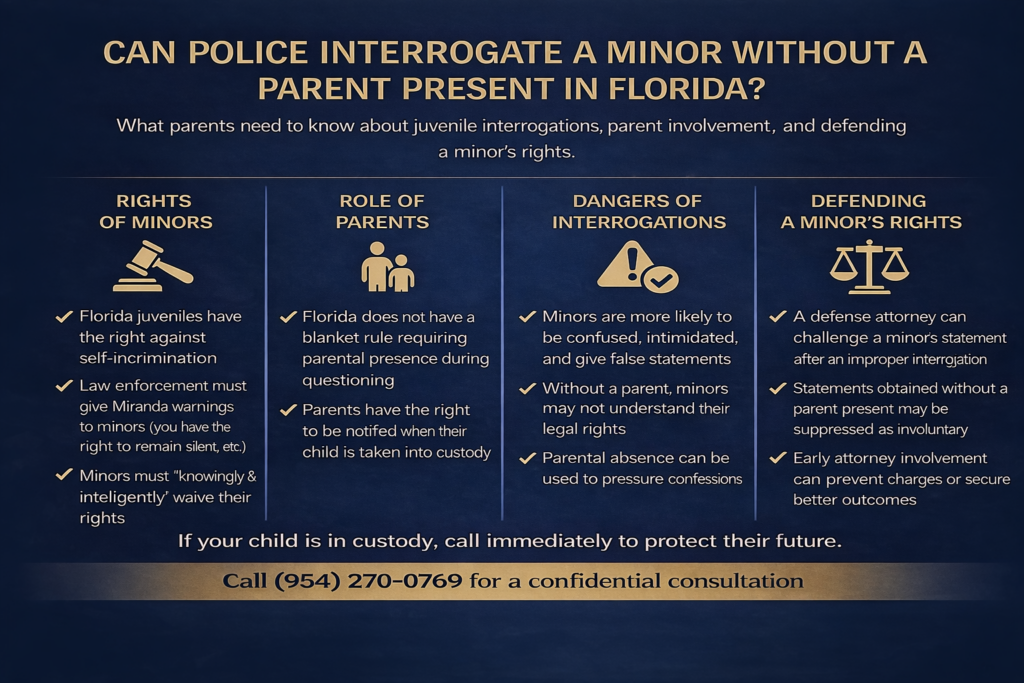
Last updated March 2026
When a child is questioned by police, panic sets in quickly — especially if a parent was not present.
For a broader overview of how juvenile arrests, detention hearings, and filing decisions work in Broward County, see our complete guide to Juvenile Crimes in Fort Lauderdale.
Many parents assume officers cannot question a minor without a parent present. In Florida, however, the law is more complicated.
Understanding when police can interrogate a juvenile — and when a statement can be suppressed — can dramatically affect the outcome of a case.
⚖️ Is a Parent Required to Be Present During Juvenile Questioning?
Short answer: No — not automatically.
Florida law does not require police to have a parent physically present before questioning a minor.
However, that does not mean officers have unlimited authority.
Courts closely examine whether a juvenile’s statement was voluntary, knowing, and intelligent under the totality of the circumstances.
📜 How Miranda Rights Apply to Minors
Just like adults, juveniles must be advised of their Miranda rights before custodial interrogation:
-
The right to remain silent
-
The right to an attorney
-
That statements can be used against them
But with minors, courts ask additional questions:
-
Did the child truly understand those rights?
-
Was the explanation age-appropriate?
-
Did officers use intimidation or deception?
-
Was the minor pressured into waiving rights?
A 15-year-old’s waiver is evaluated differently than a 35-year-old’s.
Courts analyze these issues closely, especially in juvenile cases where understanding and voluntariness are not always clear. For a deeper breakdown, see Juvenile Miranda Rights in Florida.
🧠 The “Totality of the Circumstances” Test
Florida courts look at multiple factors when deciding whether a juvenile’s statement is admissible:
-
Age and maturity
-
Intelligence and education level
-
Length of questioning
-
Whether parents were notified
-
Whether threats or promises were made
-
Whether the child asked for a parent or lawyer
Even if a parent was not legally required to be present, the absence of a parent can weigh heavily in a suppression motion.
🚨 What If a Child Asks for a Parent?
If a juvenile clearly requests a parent during questioning, courts may interpret that as an attempt to invoke rights.
In some cases, continuing interrogation after such a request can render statements inadmissible.
The facts matter. The wording matters. The timing matters.
📱 School-Based Interrogations
Many juvenile interrogations happen at school.
Important points:
-
School administrators are not required to give Miranda warnings.
-
Police officers on campus must follow constitutional standards.
-
Statements made to school staff can sometimes later be used in court.
-
Phone searches conducted at school may raise additional constitutional issues.
Improper school-based questioning is one of the most common issues in juvenile defense cases.
These situations often overlap with search issues involving backpacks, lockers, or phones on campus. For more on how those searches are evaluated, see School Searches & Student Rights in Florida.
🔒 Can a Juvenile’s Statement Be Suppressed?
Yes — in many cases.
If police failed to properly advise Miranda rights, used coercive tactics, or obtained a statement that was not voluntary, a defense attorney may file a motion to suppress.
Successful suppression can:
-
Weaken the prosecution’s case
-
Increase leverage for diversion
-
Lead to dismissal
-
Reduce the risk of direct file
To understand when juvenile cases can escalate into adult court, see our guid on Juvenile Direct-File to Adult Court.
👨👩👦 What Parents Should Do Immediately
If your child is contacted by police:
❌ Do not allow questioning without legal advice
❌ Do not assume officers “just want to talk”
❌ Do not rely on verbal assurances
Instead:
✅ Clearly state that your child will not answer questions without an attorney
✅ Avoid consenting to phone or device searches
✅ Contact a juvenile defense attorney immediately
Early intervention can prevent damaging statements from becoming the foundation of a case.
🛡 Why Early Legal Intervention Matters
Juvenile cases often turn on statements made in the first hours of investigation.
If a confession is suppressed:
-
Prosecutors may decline filing
-
Diversion becomes more likely
-
Direct file risk may decrease
-
Negotiation leverage increases
If a confession stands, options narrow significantly.
❓ Frequently Asked Questions
1) Do police have to notify a parent before questioning a minor in Florida?
Not always. Florida law does not automatically require police to notify or wait for a parent before questioning a minor. However, courts consider whether parents were contacted when determining whether a juvenile’s statement was voluntary.
2) Can a minor ask for a parent instead of a lawyer during questioning?
A minor can request a parent during questioning. In some cases, courts treat a clear request for a parent as an attempt to invoke constitutional rights. If officers continue interrogation after such a request, the statement may be challenged in court.
3) Can a juvenile confession be thrown out in Florida?
Yes. If police failed to properly advise Miranda rights, used coercive tactics, or obtained a statement that was not voluntary under the totality of the circumstances, a judge may suppress the confession.