
Last updated March 2026
School searches occupy a gray area between school discipline and criminal law. Many parents are surprised to learn that school officials do not need the same level of justification that police usually need on the street. But that does not mean students have no rights. In Florida, school searches still have constitutional limits, and evidence gathered at school can become a major issue if a juvenile case follows. For a broader overview of how these cases are handled, see our guide to Juvenile Crimes.
When Can School Officials Search a Student?
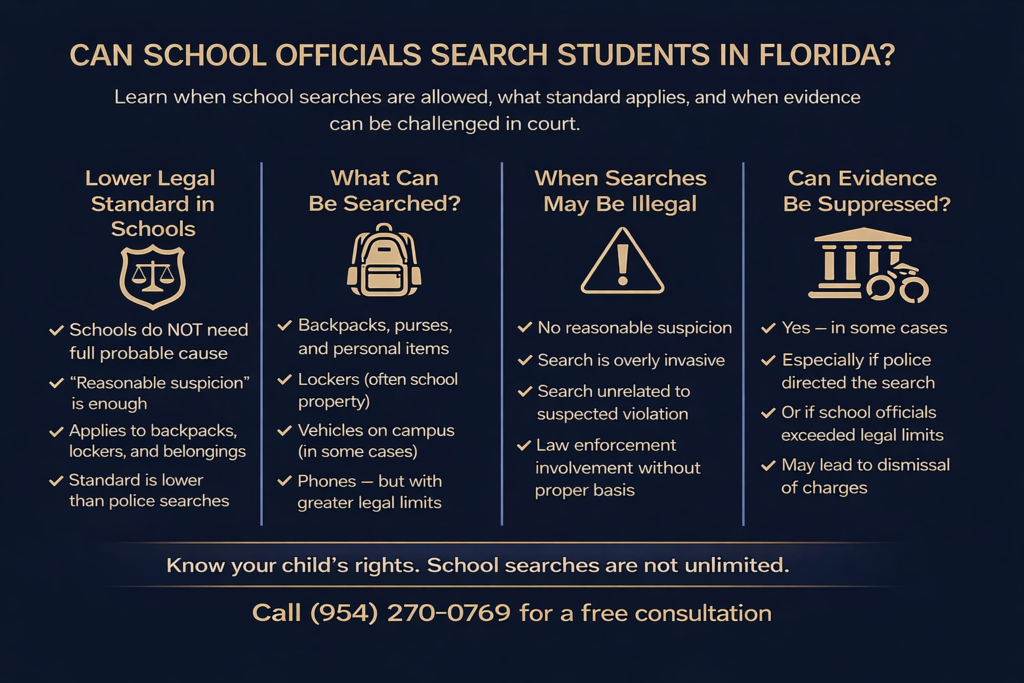
In most situations, school officials do not need full probable cause to search a student. Instead, courts generally look at whether the search was supported by reasonable suspicion. That is a lower standard than police normally need for a warrant or arrest, but it still requires more than a hunch.
A school search may be considered justified when staff members have specific facts suggesting the student violated school rules or the law. That might involve suspected drugs, a weapon, stolen property, or contraband on campus.
What Can Be Searched at School?
Depending on the circumstances, school officials may search:
- Backpacks
- Purses
- Lockers
- Desks
- Outer clothing
- In some situations, vehicles parked on campus
The scope of the search still matters. A search should generally be related to the reason it began and not excessively intrusive in light of the student’s age and the suspected issue.
When Does a School Search Cross the Line?
A school search may become legally vulnerable when:
- There was no reasonable suspicion to begin with
- The search was too invasive for the suspected violation
- The search expanded far beyond its original purpose
- Law enforcement effectively directed the search without proper constitutional safeguards
That last point matters. The more police become involved, the more the case begins to look like a traditional criminal investigation rather than a school discipline matter. That can create a stronger basis to challenge the search later.
School Searches and Juvenile Charges
A school incident can quickly turn into a juvenile delinquency case. Drugs found in a backpack, messages found on a phone, or statements made to administrators may all become evidence. That is why early legal analysis matters. In some situations, what looked like an ordinary school discipline issue may support a motion to suppress in court.
If the issue involves a phone or other device, see our article on Can Police Search a Juvenile’s Phone in Florida?. If the case involves whether a minor could refuse or challenge the search in the first place, see Can a Juvenile Refuse a Search in Florida?
Can Evidence From a School Search Be Suppressed?
Sometimes, yes. Whether evidence can be suppressed depends on who conducted the search, why it was done, how intrusive it became, and whether school officials were acting independently or effectively as agents of law enforcement.
If the search was legally defective, the defense may be able to challenge the evidence and weaken the prosecution’s case. That can make a major difference in drug, weapons, theft, or digital evidence cases involving juveniles.
Why Parents Should Take These Cases Seriously
Parents sometimes hear that a school search is “just a school matter” and assume the situation will stay internal. That can be a costly mistake. Once police become involved, the case may move quickly into the juvenile court system, with real consequences for the child’s future.
The right response often begins with determining whether the search was lawful, whether the student made any statements, and whether the evidence can be challenged before the case gains momentum.
Frequently Asked Questions
Can a school search a student in Florida without probable cause?
Yes. School officials usually need reasonable suspicion rather than full probable cause, but the search still must be justified and reasonably related to the suspected issue.
<h3>Can evidence from a school search be used in juvenile court?
Yes, but the defense may be able to challenge the evidence if the search lacked reasonable suspicion, became overly intrusive, or was effectively directed by law enforcement.