
Last updated March 2026
Search and seizure issues are some of the most important—and most misunderstood—parts of juvenile cases. Many families assume that minors do not have the same rights as adults when it comes to police searches. That is not true. While the analysis can differ in some situations, juveniles still have constitutional protections, including the right to refuse certain searches.
For a broader overview of how juvenile cases are handled in South Florida, see our guide to Juvenile Crimes in Fort Lauderdale.
Can a Juvenile Refuse a Search?
In many situations, yes.
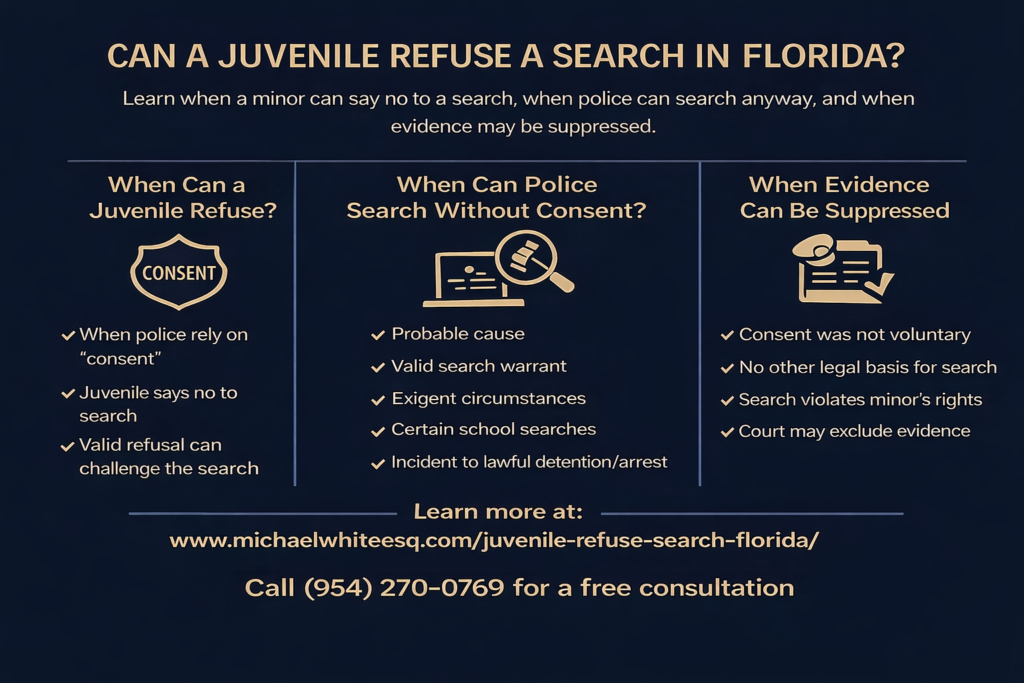
A juvenile can refuse a search when law enforcement is relying on consent as the legal basis for the search. Just like an adult, a minor is not required to agree to a search simply because an officer asks.
However, whether a refusal is effective—and whether a search is ultimately legal—depends on the circumstances.
When Can Police Search Without Consent?
Police do not always need consent to conduct a search. A juvenile’s refusal does not automatically stop a search if law enforcement has another legal basis, such as:
- Probable cause
- A valid search warrant
- Exigent circumstances
- Certain school-based standards
- Searches connected to lawful detention or arrest
If one of these applies, police may proceed even if the juvenile objects.
Why “Consent” Is a Major Issue in Juvenile Cases
Consent is one of the most commonly disputed issues in juvenile search cases. Police may claim that a minor agreed to the search—but that does not end the analysis.
Courts often look closely at whether the consent was truly voluntary. In juvenile cases, this can be a complex question.
Key considerations may include:
- The minor’s age and maturity
- Whether the juvenile understood the right to refuse
- Whether the officer applied pressure or authority
- The environment in which the consent was given
If consent was not valid, the search may be challenged.
How This Comes Up in Real Cases
Search issues involving juveniles often arise in situations such as:
- School investigations
- Phone or digital evidence cases
- Traffic stops or street encounters
- Reports involving other students or witnesses
For example, if a search began in a school setting, see School Searches & Student Rights in Florida. If the search involved a phone or digital evidence, see Can Police Search a Juvenile’s Phone in Florida?.
What Happens If a Juvenile Says “No”?
If a juvenile clearly refuses consent, that can become an important legal issue later—even if police proceed with the search.
A refusal may:
- Undermine the State’s claim of voluntary consent
- Strengthen a motion to suppress
- Highlight potential coercion or pressure
- Affect how a court views the officer’s conduct
The key question is not just whether the juvenile said “no,” but whether police had a lawful basis to search anyway.
Can Evidence Be Suppressed?
Yes.
Evidence obtained through an unlawful search may be challenged through a motion to suppress. If the court finds that the search violated constitutional protections, the evidence may be excluded from the case.
This can have a major impact—especially in cases involving drugs, weapons, or digital evidence.
For issues involving statements made after a search or during questioning, see Juvenile Miranda Rights in Florida.
Why This Issue Matters Early
Search issues often shape the entire direction of a juvenile case. If key evidence is suppressed, the prosecution’s case may weaken significantly.
That is why early legal analysis matters. A case that looks strong on paper may have serious legal vulnerabilities once the search is examined closely.
Frequently Asked Questions
Can a juvenile refuse a search in Florida?
Yes, in many situations a juvenile can refuse a search when police are relying on consent. However, officers may still search if they have another legal basis such as probable cause or a warrant.
Can police search a minor without permission?
Yes, if a valid exception applies, such as probable cause, a warrant, or certain school-related standards. Otherwise, a search based only on consent may be challenged.
What happens if a juvenile refuses a search and police search anyway?
<p>The legality of the search will depend on whether police had a lawful basis to proceed. If not, the evidence may be subject to suppression.