
Last updated March 2026
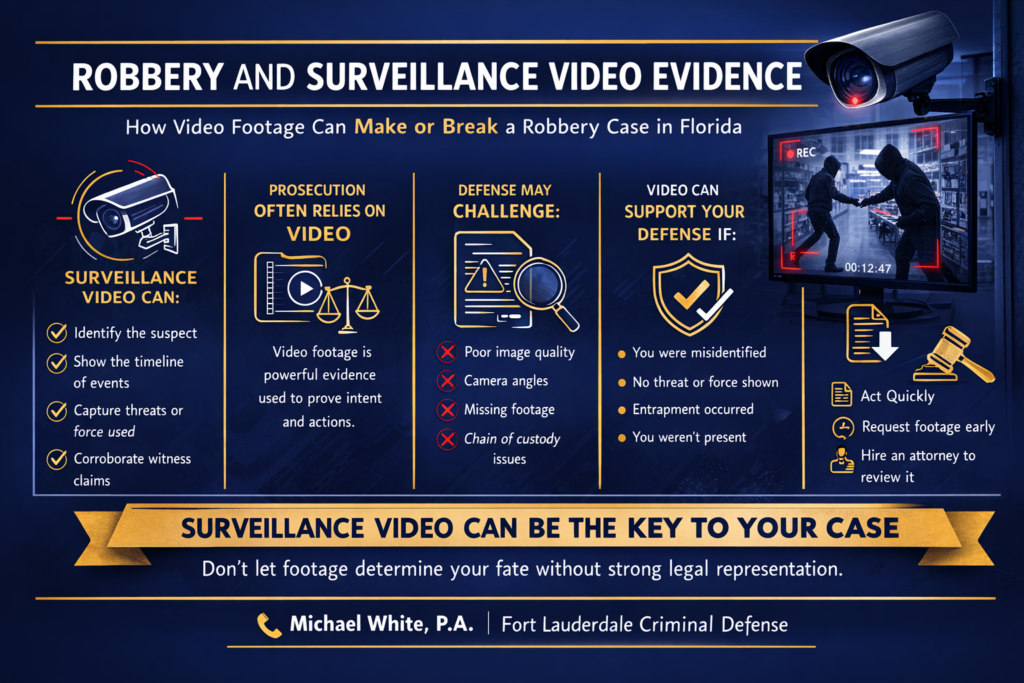
Surveillance video often becomes the most powerful piece of evidence in a Florida robbery case.
In many prosecutions, the State relies heavily on camera footage from:
Retail stores
Gas stations
Apartment complexes
Traffic cameras
Body-worn law enforcement cameras
Under Florida Statutes § 812.13, prosecutors must prove the taking of property occurred through force, violence, assault, or “putting in fear.” Increasingly, they attempt to use video footage to establish those elements.
If you are facing a robbery charge, understanding how surveillance evidence is used — and challenged — is critical. For a complete breakdown of robbery penalties and defenses, visit our guide to Robbery Charges in Florida.
How Prosecutors Use Surveillance Video in Robbery Cases
The State typically uses video to attempt to prove:
Identity of the accused
Presence at the scene
Physical contact or force
Victim reactions suggesting fear
Timing of events
Video can make a case appear straightforward — especially when jurors see an incident unfold visually rather than hearing conflicting testimony.
However, video rarely tells the full story.
Video Does Not Always Show What Prosecutors Claim
Camera footage has limitations.
Surveillance video may:
Capture only part of the interaction
Lack audio
Be recorded from a poor angle
Be grainy or distorted
Omit critical moments
A brief physical movement on camera may be interpreted as force — or may simply be incidental contact.
A victim stepping back may be portrayed as fear — or may be unrelated.
Context matters.
Identification Based on Video Can Be Unreliable
Many robbery cases hinge on identifying a suspect from:
Blurry footage
Partial facial images
Clothing similarities
Body type comparisons
Misidentification is a recurring issue in criminal prosecutions.
Lighting, camera resolution, and distance all affect reliability. In some cases, what appears obvious on first viewing becomes questionable upon closer forensic review.
We explore how misidentification occurs in these cases — even when video is present — in our breakdown of mistaken identity in robbery cases.
“Putting in Fear” and What Video Really Shows
When robbery allegations are based on intimidation rather than physical violence, prosecutors may argue that:
The victim’s body language shows fear
The defendant’s gestures appear threatening
The interaction suggests coercion
But video interpretation is subjective.
Without audio, tone of voice is unknown. Without full context, gestures may be mischaracterized.
The defense often argues that the footage does not objectively demonstrate reasonable fear.
We break down how Florida courts evaluate that element — and where it often fails — in our guide to what “putting in fear” means in Florida robbery cases.
Chain of Custody and Authenticity Issues
Surveillance footage must be properly:
Preserved
Collected
Authenticated
Introduced into evidence
Questions may arise regarding:
Editing
Missing segments
Time stamp discrepancies
Improper copying or storage
If foundational requirements are not satisfied, admissibility may be challenged.
Body-Worn Camera Footage
Law enforcement body cameras often provide additional perspective.
Body cam footage may show:
The alleged victim’s demeanor immediately after the incident
Inconsistent statements
The condition of the scene
The absence of visible injuries
Sometimes body camera footage contradicts initial allegations.
Other times, it strengthens the State’s case.
Either way, it must be carefully analyzed.
Can Surveillance Video Help the Defense?
Absolutely.
Video evidence may show:
No physical force
No resistance
No visible fear
A consensual exchange
Another person involved
Timeline inconsistencies
In some cases, video undermines the prosecution’s theory more than it supports it.
Early review and forensic enhancement can be critical.
In cases where no weapon is involved, video often becomes the primary evidence — as we explain in our guide to robbery with no weapon in Florida.
Why Early Intervention Matters in Video-Based Robbery Cases
Surveillance footage is often automatically overwritten within days.
Delays in requesting and preserving footage can permanently affect a defense.
Once preserved, careful analysis can:
Challenge identification
Undermine the force element
Dispute the “fear” requirement
Expose inconsistencies
Robbery prosecutions frequently rise or fall based on what video actually shows — not what is alleged.
Video Can Strengthen or Weaken a Robbery Case
Surveillance evidence does not automatically guarantee conviction.
It is a tool.
How it is interpreted, challenged, and contextualized often determines the outcome.
If you are facing robbery allegations involving video evidence in Fort Lauderdale or Broward County, strategic early review can significantly impact negotiating leverage and trial preparation.
FAQs
Can surveillance video prove robbery in Florida?
Yes. Prosecutors often use video to attempt to prove identity, force, or that the victim was placed in fear. However, footage may be incomplete or subject to interpretation.
What if the video is blurry or unclear?
Poor quality footage can weaken identification and may create reasonable doubt regarding who was involved.
Can video evidence be challenged in court?
Yes. Issues involving authenticity, chain of custody, editing, or incomplete footage may affect admissibility or weight.