
Last updated March 2026
Understanding Second-Degree Murder Charges in Florida
Second-degree murder is one of the most serious homicide charges under Florida law. While it does not require proof of premeditation like first-degree murder, prosecutors must still prove that the defendant committed an act that was imminently dangerous to another person and demonstrated a depraved mind without regard for human life.
These cases often involve complex factual disputes about intent, conduct, and causation. Because the penalties can include life imprisonment, second-degree murder charges are aggressively prosecuted throughout Florida.
For a broader overview of homicide offenses and how they are prosecuted, see our guide to Florida Homicide Charges.
Florida Law on Second-Degree Murder
Second-degree murder is defined under Florida Statute § 782.04.
Under the statute, a person commits second-degree murder when a killing results from an act that is:
• imminently dangerous to another person
• done with a depraved mind
• without regard for human life
• and without premeditation
Unlike first-degree murder, prosecutors do not need to prove that the defendant planned or intended the killing in advance. Instead, the focus is on whether the conduct was so reckless and dangerous that it demonstrated extreme disregard for human life.
Because the legal standard involves concepts like “depraved mind” and “imminently dangerous,” these cases frequently involve extensive legal arguments about whether the evidence actually meets the statutory definition.
What Prosecutors Must Prove
To obtain a conviction for second-degree murder, prosecutors must prove several elements beyond a reasonable doubt.
Generally, the prosecution must establish:
• the victim is deceased
• the defendant’s act caused the death
• the act was imminently dangerous
• the act demonstrated a depraved mind without regard for human life
Evidence in these cases may include forensic reports, medical examiner testimony, witness statements, surveillance footage, and digital evidence.
Because homicide investigations often rely on circumstantial evidence, disputes about the interpretation of evidence frequently become central issues during trial.
These same issues often arise in attempted murder cases, where prosecutors must prove intent to kill even when the victim survives.
The Difference Between First-Degree and Second-Degree Murder
Florida law recognizes multiple categories of homicide. The primary distinction between first-degree murder and second-degree murder typically involves the issue of intent.
First-degree murder usually requires premeditation or felony murder, meaning the killing was planned in advance or occurred during certain dangerous felonies.
Second-degree murder, by contrast, involves conduct that shows a depraved disregard for human life, but without proof that the defendant formed a deliberate plan to kill.
For a detailed explanation of premeditated murder, see our guide to First-Degree Murder in Florida.
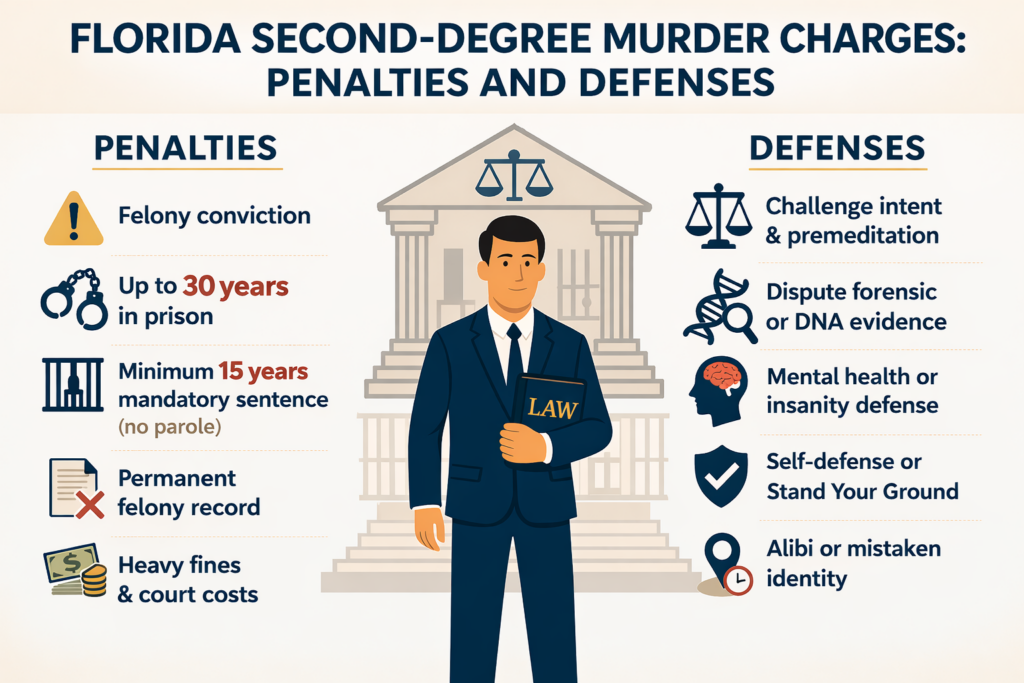
Penalties for Second-Degree Murder in Florida
Second-degree murder is typically classified as a first-degree felony under Florida law.
Possible penalties may include:
Life Imprisonment
A conviction may result in a sentence of up to life in prison depending on the circumstances of the case and the defendant’s criminal history.
Enhanced Sentences
Certain factors may increase potential penalties, including the use of firearms, prior violent offenses, or the involvement of vulnerable victims.
Permanent Felony Record
A homicide conviction results in a permanent criminal record that cannot be sealed or expunged under Florida law.
When Charges May Be Reduced to Manslaughter
In some cases, the evidence may not support the legal standard required for second-degree murder.
If prosecutors cannot prove the existence of a depraved mind, the charge may instead be reduced to manslaughter, which involves a different legal standard.
You can learn more about that offense in or guide to Manslaughter Charges in Florida.
Common Defense Strategies in Second-Degree Murder Cases
Every homicide case is different, and the appropriate defense depends on the facts and evidence involved. However, several strategies commonly arise in second-degree murder prosecutions.
Challenging the “Depraved Mind” Element
The defense may argue that the alleged conduct does not legally qualify as an act demonstrating a depraved mind under Florida law.
If prosecutors cannot prove this element, the murder charge may not stand.
Self-Defense and Stand Your Ground
Florida law recognizes the right to use force — including deadly force — in certain circumstances when a person reasonably believes it is necessary to prevent death, great bodily harm, or the commission of a forcible felony.
Under Florida’s Stand Your Ground law, a person who is lawfully present in a location may not have a duty to retreat before using defensive force if the legal requirements are met.
In homicide and attempted homicide cases, a successful self-defense argument may completely justify the use of force and result in the dismissal of charges.
Learn more about these legal protections in our guide to Self-Defense and Stand Your Ground in Florida.
Challenging Forensic Evidence
Homicide cases frequently rely on forensic evidence such as DNA testing, ballistic analysis, or medical examiner conclusions.
Defense attorneys may consult independent experts to evaluate whether forensic findings are scientifically reliable.
Mistaken Identity or Alibi
Witness testimony can sometimes be unreliable, particularly in chaotic or high-stress situations. The defense may present evidence showing that the defendant was not responsible for the alleged conduct.
Why Early Legal Representation Matters
Homicide investigations often begin long before formal charges are filed. Law enforcement may conduct interviews, collect physical evidence, and obtain digital records as part of the investigation.
Early legal representation can help protect constitutional rights, prevent damaging statements, and ensure that important evidence is preserved.
Individuals under investigation for homicide should seek legal counsel immediately.
Frequently Asked Questions About Second-Degree Murder in Florida
What is second-degree murder in Florida?
Second-degree murder is an unlawful killing that results from an act demonstrating a depraved mind without regard for human life but without premeditation.
What is the penalty for second-degree murder in Florida?
Second-degree murder is typically punishable by up to life in prison under Florida law.
What does “depraved mind” mean?
A depraved mind refers to conduct that shows extreme indifference to human life and creates a high risk of death or serious harm.
What is the difference between first-degree and second-degree murder?
First-degree murder usually requires premeditation or felony murder, while second-degree murder involves a killing caused by reckless conduct showing a depraved disregard for human life.
Can second-degree murder charges be reduced?
Yes. Depending on the circumstances, charges may sometimes be reduced to manslaughter if prosecutors cannot prove the required elements of second-degree murder.