
Last updated April 2026
Fleeing and eluding is one of the fastest ways a routine traffic stop turns into a serious felony in Florida. These cases are aggressively charged, often enhanced by allegations like lights-and-sirens activation, high-speed driving, or reckless conduct.
But fleeing cases are also highly defensible when you focus on what prosecutors must prove: knowledge, willfulness, and the specific conditions required for enhancements.
Below is what fleeing and eluding means in Florida, how felony levels escalate, and the defenses that can reduce or dismiss the charge.
For a broader overview of how these charges fit within Florida’s criminal traffic system, see our guide to Traffic Crimes in Florida.
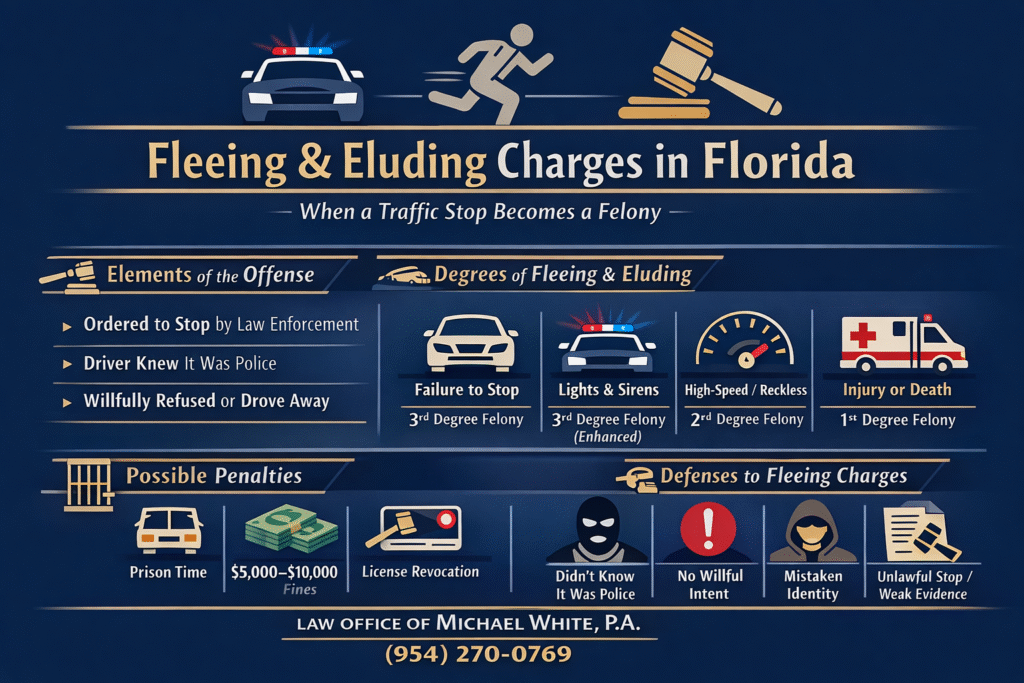
⚖️ What the State Must Prove
To convict someone of fleeing and eluding, the State generally must prove beyond a reasonable doubt that:
-
You were operating a motor vehicle on a Florida roadway, and
-
A law enforcement officer lawfully ordered you to stop or remain stopped, and
-
You knew you were being ordered to stop, and
-
You willfully refused to stop, failed to stop, or stopped and then drove away to elude the officer
Most defenses target one of three elements: identity, knowledge, or willfulness.
🧾 Real-World Example: When Fleeing Cannot Be Proven
In one South Florida case, a driver was charged with fleeing and eluding after continuing to drive for a short distance before stopping.
The State argued that the driver willfully refused to stop. However, evidence showed:
- The driver slowed down immediately
- The roadway was dark and poorly lit
- The driver continued only long enough to reach a safe, visible location
- The defense focused on lack of willful intent and lack of clear knowledge of the stop signal.
The case was ultimately reduced because the State could not prove intentional flight beyond a reasonable doubt.
These cases often turn on how the driver’s actions are interpreted — not just what happened.
🧾 Degrees of Fleeing and Eluding in Florida
Fleeing charges escalate based on what the State claims happened during the pursuit. Enhancements matter — because they can jump a case from a third-degree felony to a first-degree felony.
🚨 Baseline Fleeing and Eluding
This is the least severe version, but it is still a felony. Penalties can include prison exposure, probation, fines, and significant license consequences.
🚓 Marked Vehicle + Lights and Sirens (Enhanced Allegation)
A common enhancement requires proof that:
-
the officer was in a marked law enforcement vehicle, and
-
lights and sirens were activated, and
-
the driver still willfully fled or refused to stop
This is often litigated because the State must prove the driver reasonably perceived the stop command under real-world conditions (nighttime, traffic, distance, noise, etc.).
In some cases, drivers face overlapping allegations involving both accident duties and evasion — see Hit and Run vs. Fleeing and Eluding in Florida.
🛣️ High-Speed or Reckless Fleeing
Prosecutors often escalate the charge further by alleging high speed or reckless driving during the pursuit.
This is where the case becomes far more dangerous — and where proof problems frequently appear (estimated speed, lack of video, unclear traffic conditions).
👉 Related: Reckless Driving in Florida
💥 Fleeing Causing Serious Injury or Death
If the State claims fleeing caused serious bodily injury or death, the charge can become one of Florida’s most serious non-homicide felonies, with enormous sentencing exposure.
When injury is alleged, sentencing arguments and mitigation become especially important.
🛡️ Defenses to Fleeing and Eluding Charges
Fleeing cases are not “automatic convictions.” Common defenses include:
✅ You Didn’t Know Police Were Signaling You to Stop
A driver may not realize it’s a police stop when:
-
the vehicle was unmarked or poorly marked
-
lights/sirens were not clearly visible or audible
-
conditions were chaotic (nighttime, rain, heavy traffic)
-
the driver intended to stop at a safer location (lit area, gas station, etc.)
Knowledge is often the central battleground.
✅ You Didn’t Act Willfully
Panic, confusion, or delayed compliance is not the same as willful flight. These cases often hinge on:
-
how long the alleged “failure to stop” lasted
-
whether the driver slowed down or signaled
-
whether the driver pulled over shortly after recognizing the stop
✅ Identity / Driver Proof Problems
If the State cannot prove who was driving (or relies on assumptions), the case weakens dramatically — especially when there is no clear video or witness identification.
✅ The Enhancement Elements Aren’t Actually Met
To elevate a fleeing charge, prosecutors must prove the technical requirements (marked unit, lights/sirens, reckless conduct, causation of injury). If they can’t, the case may be reduced.
✅ Unlawful Stop or Weak Evidence
If the initial stop was unlawful or evidence was gathered improperly, a defense attorney may be able to suppress evidence and undermine the prosecution’s theory.
📍 Arrested for Fleeing and Eluding in Fort Lauderdale or South Florida?
If you’ve been charged with fleeing and eluding, the stakes are too high to treat it like a standard traffic case. Early legal action can make the difference between a felony conviction and a reduced or dismissed charge.
As a former prosecutor, Michael White understands how fleeing cases are charged — and how to attack the weaknesses that prosecutors often rely on.
📞 Call (954) 270-0769 or schedule a free consultation today.
❓ Fleeing and Eluding in Florida – FAQs
What is fleeing and eluding in Florida?
Fleeing and eluding generally means willfully refusing to stop, failing to stop, or stopping and then driving away after law enforcement orders you to stop.
Is fleeing and eluding always a felony in Florida?
Yes. Even the least severe form is typically charged as a felony, and enhancements can increase the felony degree.
What makes fleeing charges more serious?
Allegations like lights-and-sirens activation, high speed, reckless driving, or causing injury can elevate the charge and increase prison exposure.
Can I be charged if I didn’t know the person was a police officer?
Possibly, but knowledge is often a key defense issue — especially if the vehicle was not clearly marked or the stop conditions made the signal unclear.
Are there defenses to fleeing and eluding?
Yes. Common defenses include lack of knowledge, lack of willful intent, identity issues, failure to prove enhancement elements, and legal challenges to the stop or evidence.