
Last updated March 2026
Police questioning can be one of the most important moments in a juvenile case. In many situations, what a minor says during an encounter with law enforcement becomes the centerpiece of the prosecution’s case. But in Florida, juvenile interrogations are subject to constitutional limits—and those limits are often misunderstood by both parents and minors.
For a broader overview of how juvenile cases are handled in South Florida, see our guide to Juvenile Crimes in Fort Lauderdale.
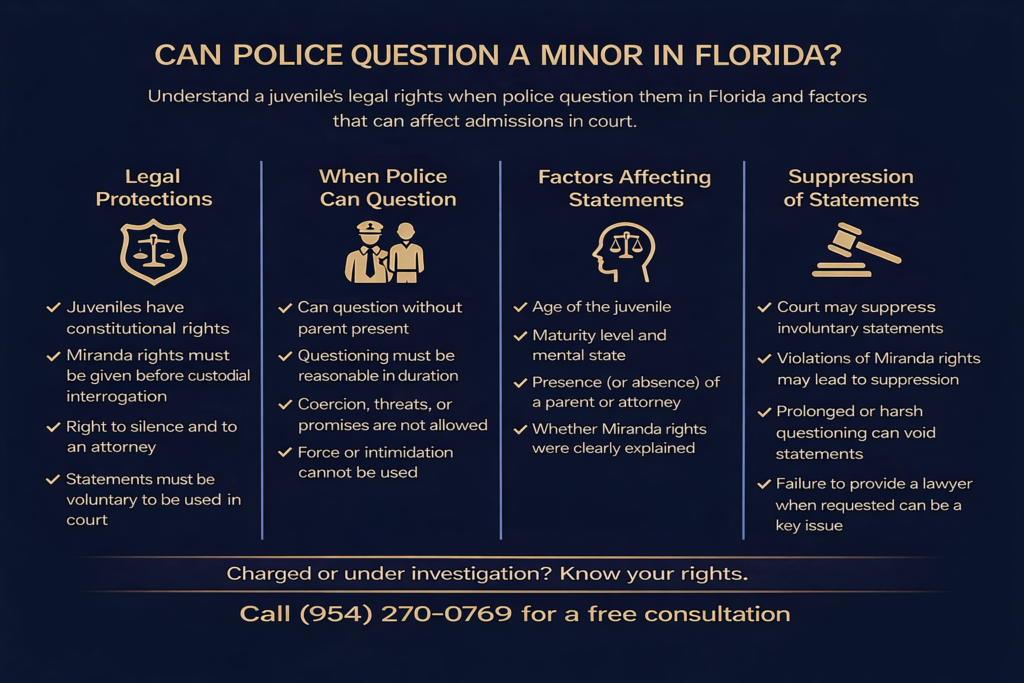
Can Police Question a Minor Without a Parent Present?
In some situations, yes.
Many parents assume that police cannot question a child unless a parent is present. However, Florida law does not automatically require parental presence for questioning to occur. A minor can be questioned without a parent under certain circumstances.
That said, the absence of a parent can become extremely important later when a court evaluates whether the questioning was fair and whether any statement should be allowed into evidence.
For a deeper breakdown of this exact issue, see Can Police Interrogate a Minor Without a Parent Present in Florida?.
When Do Miranda Rights Apply to Juveniles?
Miranda rights apply when a minor is:
- In custody, and
- Subject to interrogation
If both conditions are met, police must advise the juvenile of the right to remain silent and the right to an attorney before questioning.
If Miranda is not properly administered—or not properly understood—any resulting statement may be challenged.
For a more focused discussion of how courts evaluate these issues, see When Can a Juvenile’s Statement Be Thrown Out in Florida?.
What Makes Juvenile Questioning Legally Problematic?
Courts treat juvenile interrogations differently than adult interrogations. Judges often look closely at whether the minor truly understood what was happening and whether the statement was voluntary.
Key factors may include:
- The child’s age and maturity
- Prior experience with law enforcement
- Length and conditions of the questioning
- Whether pressure, threats, or promises were used
- Whether the minor understood their rights
Even if police followed basic procedures, a statement may still be challenged if the overall circumstances suggest the minor did not knowingly and voluntarily waive their rights.
How School or Phone Investigations Can Lead to Questioning
Juvenile questioning often arises from other investigations. For example:
- A school incident may lead to questioning by administrators or police
- A phone search may uncover messages that trigger further investigation
- A report from another student may lead to a police interview
For more on how these situations develop, seeSchool Searches & Student Rights in Florida.
Why Early Legal Analysis Matters
In many juvenile cases, the most damaging evidence is not physical—it is a statement. Once a statement is made, it can be difficult to undo unless there is a strong legal basis to challenge it.
That is why early analysis is critical. A defense strategy may focus on:
- Whether the questioning was lawful
- Whether Miranda was properly applied
- Whether the statement was voluntary
- Whether suppression is possible
Addressing these issues early can significantly change the direction of the case.
Frequently Asked Questions
Can police question a minor in Florida without a parent present?
Yes, in some situations. However, the absence of a parent can be an important factor when courts evaluate whether the minor’s statement was voluntary and admissible.
Can a juvenile’s statement be thrown out in Florida?
Yes. A statement may be suppressed if Miranda rights were violated, the waiver was not knowing and voluntary, or the questioning was coercive or unfair under the circumstances.