
Last updated March 2026
Police often rely heavily on statements made during questioning—especially in juvenile cases. But just because a minor spoke to law enforcement does not mean that statement can be used in court. In Florida, juvenile interrogations are subject to constitutional protections, and when those protections are violated, the statement may be thrown out entirely.
For a broader overview of how juvenile cases are handled in South Florida, see our guide to Juvenile Crimes in Fort Lauderdale.
What Are Miranda Rights for Juveniles?
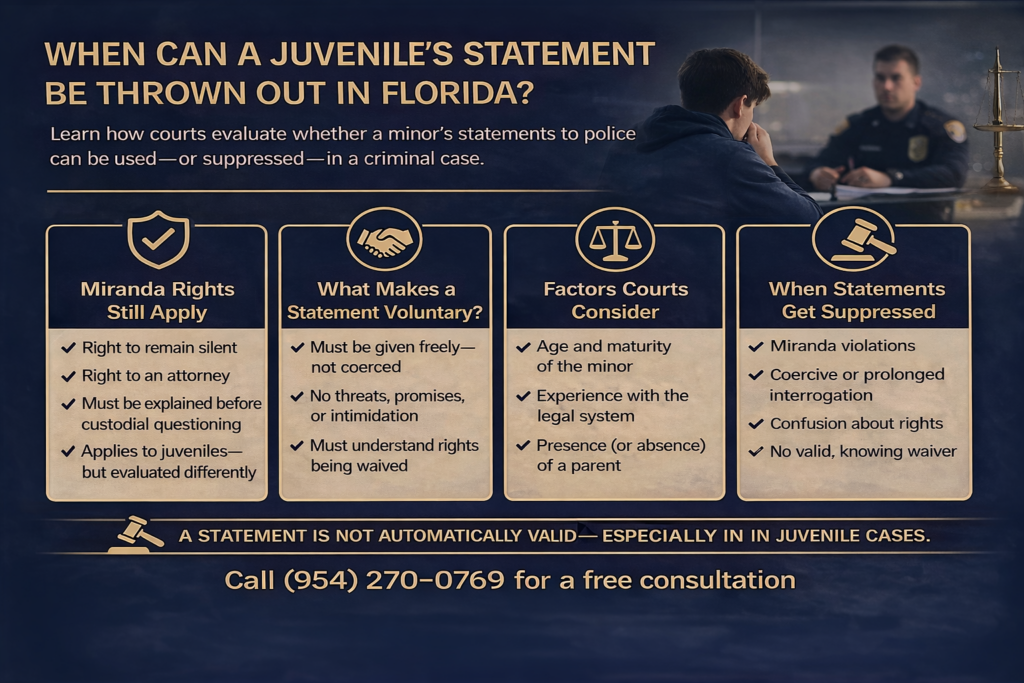
Miranda rights protect individuals from self-incrimination during custodial interrogation. These rights include:
- The right to remain silent
- The right to an attorney
- The warning that anything said can be used against them
These protections apply to juveniles—but courts recognize that minors may not understand those rights the same way adults do.
When Do Miranda Rights Apply?
Miranda is required when two conditions are met:
- The juvenile is in custody, and
- The juvenile is being interrogated
If both apply, police must advise the minor of their rights before questioning.
If law enforcement fails to do this, any resulting statement may be subject to suppression.
For more on how police questioning works in juvenile cases, see Can Police Question a Minor in Florida?
Can a Juvenile Waive Miranda Rights?
Yes—but this is where many cases become vulnerable.
Courts require that any waiver of Miranda rights be:
- Knowing
- Intelligent
- Voluntary
For juveniles, this analysis is more complex. A child may say they “understand” their rights, but that does not automatically make the waiver valid.
Courts often look closely at whether the minor truly understood:
- The right to remain silent
- The consequences of speaking
- The right to have an attorney present
When Is a Juvenile Statement Considered Involuntary?
Even if Miranda warnings were given, a statement can still be thrown out if it was not voluntary.
A statement may be challenged if it resulted from:
- Pressure or intimidation
- Promises of leniency
- Confusing or misleading questioning
- Prolonged interrogation
- A failure to understand the situation
Juveniles are often more susceptible to these pressures, which is why courts apply a more careful analysis.
What Factors Do Courts Consider?
Florida courts evaluate the totality of the circumstances, including:
- Age and maturity
- Education and intelligence
- Prior experience with law enforcement
- Length and location of questioning
- Presence (or absence) of a parent
- Whether the juvenile appeared to understand their rights
No single factor controls the outcome. Instead, courts look at the full picture to determine whether the statement was truly voluntary.
For a related issue involving parental presence, see Can Police Interrogate a Minor Without a Parent Present in Florida?.
When Can a Juvenile’s Statement Be Thrown Out?
A statement may be suppressed when:
- Miranda rights were not properly given
- The juvenile did not validly waive those rights
- The statement was involuntary
- The questioning was coercive or unfair
When a statement is excluded, the impact on the case can be significant. In some situations, the prosecution’s strongest evidence disappears.
How These Issues Arise in Real Cases
These issues often come up alongside other investigations, including:
- School incidents
- Phone searches
- Reports from other students
- Allegations involving digital evidence
For example, if a case began with a school investigation, see School Searches & Student Rights in Florida. If the case involves phone evidence, see Can Police Search a Juvenile’s Phone in Florida?.
Why Early Legal Analysis Matters
Once a statement is made, it can shape the entire case. But whether that statement is admissible is a separate legal question—and one that can often be challenged.
Early review allows the defense to:
- Identify Miranda issues
- Evaluate voluntariness
- Challenge improper questioning
- Move to suppress damaging evidence
In many cases, these issues are not obvious from the police report alone. They require a close review of how the questioning actually occurred.
Frequently Asked Questions
Do juveniles have Miranda rights in Florida?
Yes. Juveniles have the same Miranda rights as adults, including the right to remain silent and the right to an attorney, but courts evaluate whether those rights were understood more carefully in juvenile cases.
Can a juvenile’s statement be thrown out in Florida?
Yes. A statement may be suppressed if Miranda was violated, the waiver of rights was not valid, or the statement was obtained through coercion or unfair questioning.
Does a parent have to be present for a juvenile statement to be valid?
No, but the absence of a parent can be an important factor in determining whether the juvenile’s statement was voluntary and admissible.