
Last updated March 2026
Updated for 2026 — What Fort Lauderdale Defendants Need to Know
Most people use the terms assault and battery interchangeably, but under Florida law, they’re two distinct crimes with different elements, penalties, and long-term consequences. If you’re facing charges in Fort Lauderdale, Broward County, or South Florida, knowing the difference can play a major role in your defense strategy.
As a former prosecutor, Attorney Michael White has handled hundreds of assault and battery cases from both sides of the courtroom. Here’s what you need to know.
📜 What Is Assault Under Florida Law?
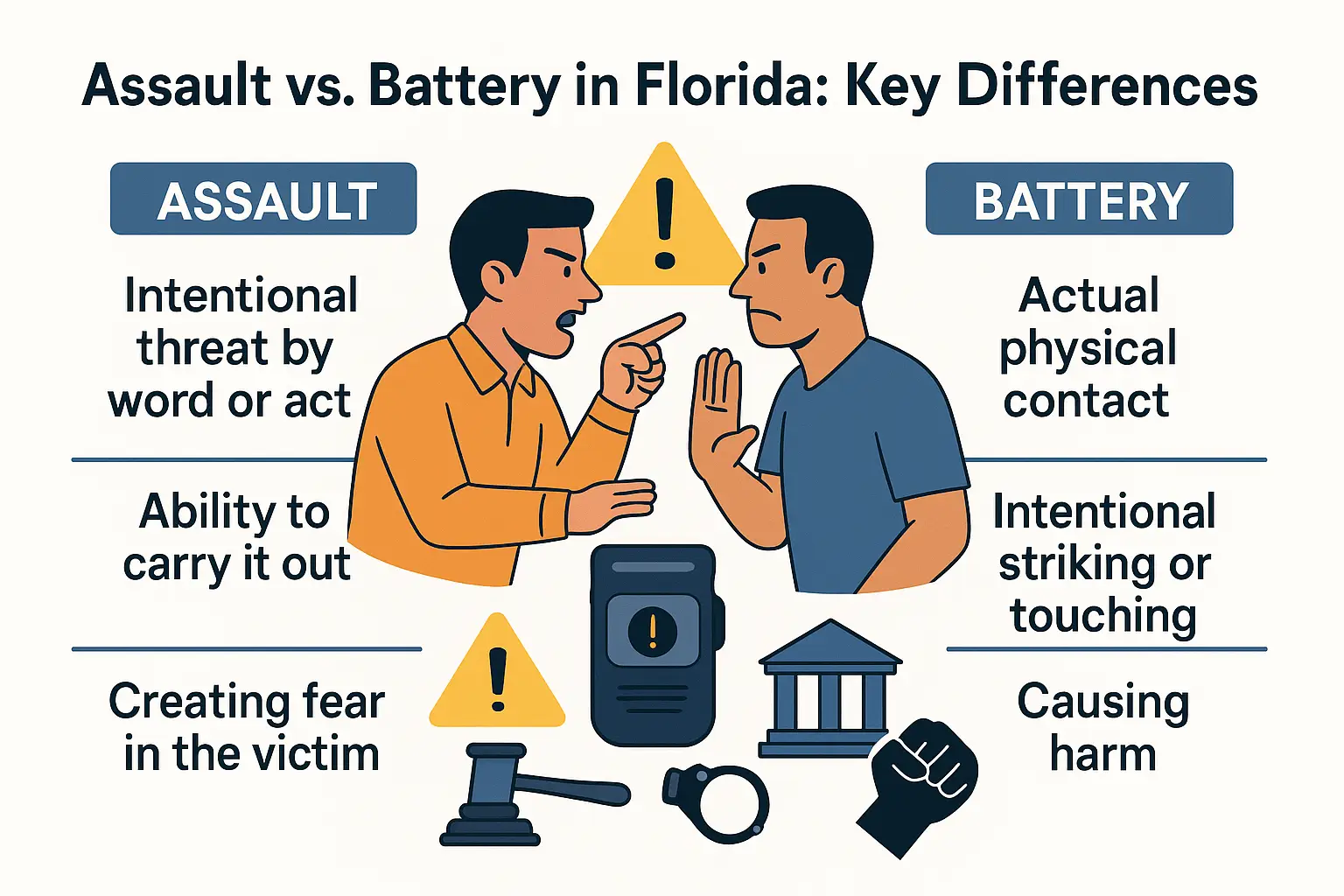
Under Florida Statute §784.011, assault occurs when somone:
Intentionally threatens another person by word or act,
Has the apparent ability to carry out the threat, and
Creates a well-founded fear of imminent violence.
🚫 Penalties for Simple Assault (Second-Degree Misdemeanor)
Up to 60 days in jail
Up to 6 months of probation
Up to $500 in fines
🔥 Aggravated Assault — § 784.021
Aggravated assault is a more serious felony and occurs when the threat is made:
With a deadly weapon, OR
With intent to commit a felony
Penalties:
Third-degree felony
Up to 5 years in prison
Up to $5,000 in fines
✔️ Key Element: Fear, Not Contact
Assault does not require physical contact — only a credible threat that places the victim in fear of immediate harm.
For a full breakdown of elements, penalties, and defenses, see our guide to Assault Charges in Florida
👊 What Is Battery Under Florida Law?
Under Florida Statute §784.03, battery occurs when someone:
Actually and intentionally touches or strikes another person against their will, or
Intentionally causes bodily harm to another person.
🔹 Penalties for Simple Battery (First-Degree Misdemeanor)
Up to 1 year in jail
Up to 1 year of probation
Up to $1,000 in fines
🔥 Felony Battery — § 784.041
Felony battery happens when the accused:
Intentionally strikes another person, and
Causes great bodily harm, permanent disability, or permanent disfigurement
Penalties:
Third-degree felony
Up to 5 years in prison
📝 Important: Prior Convictions Can Elevate Charges
If someone has a prior conviction for battery, domestic battery, or aggravated battery, a new battery charge can be enhanced to a felony.
To understand how Florida prosecutes battery cases — including misdemeanor and felony enhancements — see our guide to battery charges in Florida.
⚖️ Assault vs. Battery: What’s the Key Difference?
Assault = Threat
→ No physical contact
→ Victim must have a reasonable fear of immediate harm
Battery = Contact
→ Actual touching, striking, or bodily harm
→ No need for threats or fear
Here’s the simplest way to understand it:
Assault can happen without touching anyone.
Battery requires physical contact.
📌 Real-World Examples
👉 Example of Assault:
You raise your fist, yell “I’m going to hit you,” and step toward someone.
You never touch them — but they’re reasonably afraid you will.
👉 Example of Battery:
You shove someone during an argument.
Even if the shove was minor, that’s battery.
👉 Assault + Battery:
You threaten someone and then immediately hit them.
You may face both charges.
👉 No Assault, No Battery:
You accidentally bump someone or spill a drink on them.
There’s no intent → no crime.
🧭 Aggravated Variations (High-Risk Felonies)
These are the charges that often carry the most prison exposure:
🔪 Aggravated Battery — § 784.045
Occurs when the accused:
Uses a deadly weapon,
Causes serious bodily harm, or
Batters a pregnant woman knowing she is pregnant
Penalty: Up to 15 years in prison
🔫 Aggravated Assault With a Firearm — § 784.021 + 10–20–Life
In some circumstances, firearm use invokes mandatory minimums under Florida’s 10–20–Life statute.
🛡️ Defenses to Assault and Battery Charges
The defenses available depend on the facts, but common strategies include:
🛡️ Self-Defense / Stand Your Ground (§ 776.012)
If you reasonably believed force was necessary to prevent harm.
🔁 Mutual Combat
Both parties agreed to fight (common in bar disputes).
❌ False Accusations
Anger, revenge, or custody disputes often generate false reports.
👤 Misidentification
Poor lighting, chaotic scenes, intoxication, or crowd settings lead to wrongful identification.
🧷 Lack of Intent
Accidental contact or reflexive movement is not battery.
🕵️♂️ Pre-Filing Strategy Matters in Fort Lauderdale
n Broward County, prosecutors review assault and battery cases early — and fast.
At Michael White, P.A., we often intervene before charges are filed to:
Present evidence contradicting the accusation
Provide police body-cam or Ring/Nest footage
Show injuries did not occur
Highlight witness recantation or credibility issues
Negotiate reduced charges or a no-file decision
📍 Facing Assault or Battery Charges in Florida?
Assault and battery charges are part of a broader category of serious violent offenses under Florida law.
Learn more about how an experienced attorney can evaluate your case early, challenge overcharging, and protect your rights.
📲 Call (954) 270-0769
💬 Or request your free case review today.
Serving Fort Lauderdale, Broward County, Miami-Dade, and Palm Beach.
❓ FAQs: Assault vs. Battery in Florida
❓⚖️ What is the difference between assault and battery in Florida?
Assault is a threat with the ability to carry it out; battery is actual unwanted touching or harm.
❓📜 What statute defines assault in Florida?
Florida Statute §784.011.
❓📜 What statute defines battery in Florida?
Florida Statute §784.03.
❓⚖️ Is battery more serious than assault?
Generally yes — battery is a first-degree misdemeanor, while assault is a second-degree misdemeanor.
❓🛡️ Can I use self-defense for assault or battery charges?
Yes. Self-defense under Florida’s Stand Your Ground law may apply.