
Last updated March 2026
Many people assume that a crime requires physical contact. In Florida, that assumption can be costly.
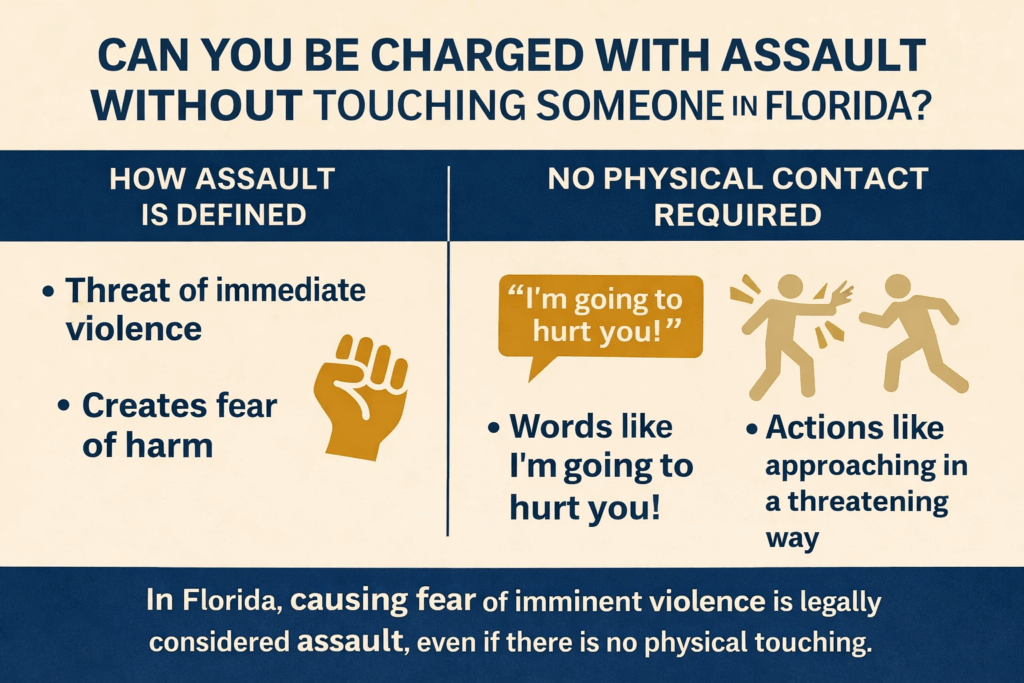
Yes — you can be charged with assault even if you never touched anyone.
In fact, Florida assault law is built entirely around threats and fear, not physical contact.
Here’s how Florida defines assault, when no-touch cases are charged, and where prosecutors often overreach.
For a full explanation of how assault charges work in Florida — including penalties, defenses, and when cases escalate — see our guide to Assault Charges in Florida.
⚖️ The Short Answer
Yes. Under Florida law, assault does not require physical contact. A person may be charged based on:
an intentional threat,
an apparent ability to carry it out, and
conduct that creates a well-founded fear of imminent violence.
This is why many assault cases arise from arguments, gestures, or words alone.
📜 How Florida Law Defines Assault
Under Florida Statute § 784.011, assault occurs when a person:
Intentionally threatens another person by word or act,
Appears capable of carrying out the threat, and
Creates a reasonable fear that violence is about to occur.
🚫 Physical contact is not required.
That is the key difference between assault and battery.
❌ When No-Contact Conduct Is Not Assault
Not every argument, raised voice, or gesture qualifies as criminal assault.
Assault charges often fail when the defense shows:
✔ No Real Threat
Angry words, sarcasm, or insults — including situations involving verbal threats alone — do not meet the legal standard unless they create a real and immediate fear of violence.
✔ No Apparent Ability
If the accused could not realistically carry out the threat (due to distance, barriers, or circumstances), the charge may fail.
✔ No Well-Founded Fear
The alleged victim must have a well-founded fear of imminent violence, not a speculative or exaggerated reaction.
✔ Self-Defense or Defense of Others
Threats made to prevent imminent harm may be legally justified.
🚨 Common Situations Where Assault Is Charged Without Touching
Florida assault arrests frequently arise from situations like:
Verbal threats during heated arguments — including threats made over text or social media — are often evaluated differently depending on immediacy and ability.
Raising fists or advancing aggressively
Threatening gestures without contact
Road-rage confrontations
Domestic disputes involving intimidation
Brandishing an object without using it
In many cases, arrests are made based solely on one person’s perception.
🔍 What Prosecutors Must Prove
To convict someone of assault, the State must prove all three elements beyond a reasonable doubt:
Intentional threat (words or actions)
Apparent ability to carry out the threat
Well-founded fear of imminent violence
If any element is missing, the charge cannot stand.
⚖️ Penalties for Assault in Florida
Simple assault is a second-degree misdemeanor, punishable by:
Up to 60 days in jail
Up to 6 months of probation
Up to a $500 fine
Assault can become aggravated assault — a felony — if:
a deadly weapon is involved, or
the threat occurs during the commission of another felony
⚠️ What If the Alleged Victim Overreacted?
This is one of the most common issues in assault cases.
Florida law requires fear that is:
real, and
reasonable under the circumstances.
If the alleged victim misinterpreted words, exaggerated fear, or reacted emotionally rather than reasonably, the case may be weak.
🛡️ How Assault Charges Are Defended
Effective defenses often focus on:
Lack of intent to threaten
No reasonable fear of imminent harm
No apparent ability to carry out the threat
Self-defense or defense of others
Inconsistent statements or missing video evidence
Many no-contact assault cases are reduced or dismissed when these elements are challenged early.
📍 Facing an Assault Charge in Florida?
Being charged with assault does not mean you are guilty — especially when no physical contact occurred.
📞 Call (954) 270-0769 or request a confidential consultation today.
❓ Frequently Asked Questions
Can you be charged with assault without touching someone in Florida?
Yes. Florida assault law does not require physical contact. A credible threat that creates fear of imminent harm can be enough.
Do words alone count as assault?
Sometimes. Words combined with circumstances showing intent and ability may qualify. Angry speech alone usually does not.
What if I was just yelling?
Yelling or arguing without a true threat and reasonable fear is typically not assault.
Is assault a felony or misdemeanor?
Simple assault is a misdemeanor. It becomes a felony if charged as aggravated assault.
Can assault charges be dismissed?
Yes. Lack of intent, lack of fear, self-defense, or weak evidence can lead to dismissal or reduction.