
Last updated March 2026
Not every threat is a crime.
Under Florida law, assault is not based on words alone—it depends on how those words or actions are perceived. One of the most important elements the State must prove is that the alleged victim experienced a well-founded fear of imminent violence.
This requirement often determines whether an arrest becomes a conviction—or whether the case falls apart.
For a broader explanation of how assault charges work, see our guide to Assault Charges in Florida.
📜 The Legal Standard Under Florida Law
Florida Statute § 784.011 defines assault as:
• an intentional and unlawful threat by word or act
• coupled with an apparent ability to carry out the threat
• that creates a well-founded fear that violence is imminent
All three elements must be proven beyond a reasonable doubt.
If the fear is not “well-founded,” the charge fails—even if the words sounded threatening.
🧠 What Does “Well-Founded Fear” Actually Mean?
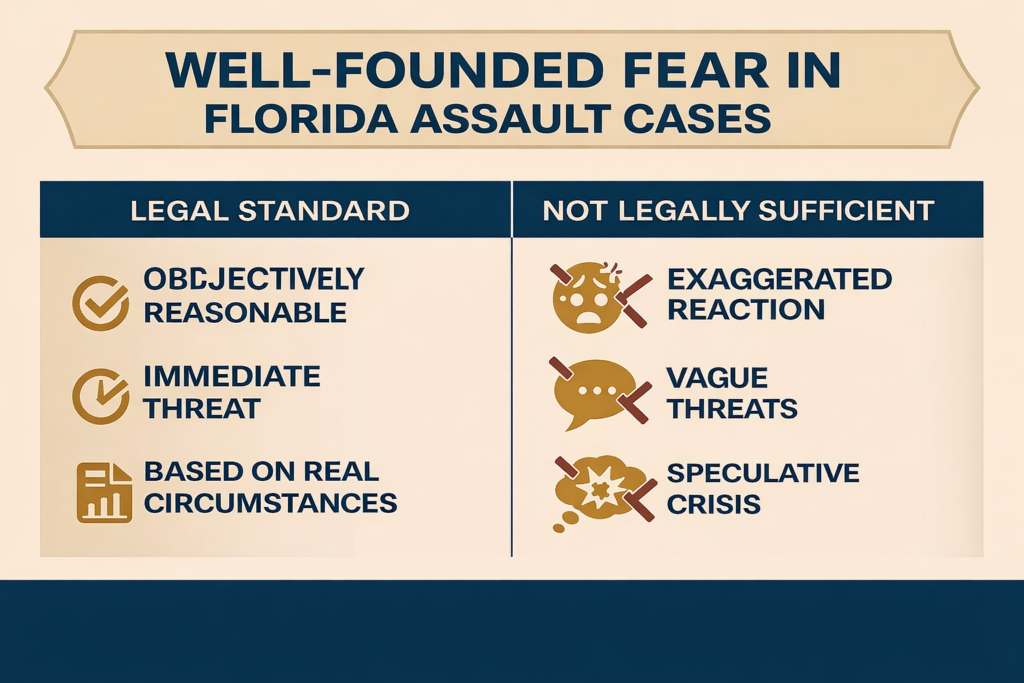
A well-founded fear is not just personal anxiety or emotional reaction.
It must be:
• Objectively reasonable – a typical person in the same situation would feel threatened
• Immediate – the threat must involve imminent, not future, harm
• Based on real circumstances – not speculation or exaggeration
This is why similar statements can lead to different outcomes depending on the context.
⏱️ Immediacy Is Critical
Florida law requires fear of imminent violence, not something that might happen later.
Examples:
“I’ll get you someday” → not imminent
“I’m going to hit you right now” while advancing → may satisfy the requirement
If there is time for reflection, delay, or distance, the “well-founded fear” element may not be met.
Situations involving verbal threats alone often turn on this issue.
🧍 Apparent Ability Still Matters
Even if words are threatening, fear is not “well-founded” unless the accused appears capable of carrying out the threat.
Courts consider:
• physical distance between the parties
• barriers or obstacles
• whether the accused was restrained or prevented from acting
• whether the accused moved toward or away from the alleged victim
For example, threats made from far away—or through threats made over text or social media—often fail to establish immediacy and ability.
🚫 When Fear Is Not Legally Sufficient
Many assault cases fail because the alleged fear does not meet the legal standard.
Common examples include:
🔹 Exaggerated Reactions
The alleged victim overreacts to angry words that do not indicate immediate harm.
🔹 Vague or Conditional Threats
Statements like “you’ll regret this” or “I’ll deal with you later” lack immediacy.
🔹 Mutual Arguments
Heated exchanges where both parties are yelling without a clear imminent threat.
🔹 Misinterpretation of Conduct
Gestures or movements that are perceived as threatening but lack intent or ability.
🔍 Evidence That Determines Fear
Because “fear” is subjective, prosecutors rely heavily on context.
Key evidence includes:
• body-worn camera footage
• 911 calls and tone of voice
• witness statements
• physical positioning and distance
• whether the accused advanced or made threatening movements
Small details often determine whether fear was reasonable—or legally insufficient.
🛡️ Defense Strategies Focus on This Element
Challenging the “well-founded fear” element is often central to the defense.
Strategies may include:
✔ showing the threat was not immediate
✔ demonstrating lack of apparent ability
✔ highlighting inconsistencies in the alleged victim’s statements
✔ presenting video that contradicts fear claims
✔ establishing mutual confrontation or escalation
If the State cannot prove fear beyond a reasonable doubt, the case cannot stand.
📍 Broward County Reality
In Broward County, many assault arrests arise from emotional, fast-moving situations:
• domestic disputes
• neighbor conflicts
• road-rage encounters
• bar or nightlife incidents
Officers often rely on initial statements made under stress—but those statements do not always reflect the legal standard required for conviction.
⚖️ Why This Element Often Decides the Case
The difference between:
a heated argument, and
a criminal assault
often comes down to whether the fear was real, reasonable, and immediate.
Without that, there is no assault under Florida law.
❓ FREQUENTLY ASKED QUESTIONS
What is “well-founded fear” in a Florida assault case?
It means the alleged victim had a reasonable and immediate fear that violence was about to occur—not just a subjective or emotional reaction.
Does fear have to be immediate?
Yes. Florida law requires fear of imminent harm. Future or conditional threats are usually not enough.
Can someone be charged if the victim was just scared?
Not necessarily. The fear must be objectively reasonable under the circumstances.
Do words alone create well-founded fear?
Sometimes, but only if they are immediate, specific, and supported by apparent ability.
Can this element be challenged in court?
Yes. Many assault cases are dismissed or reduced when the defense shows the fear was not reasonable or imminent.