
Last updated March 2026
Threats today don’t always happen face-to-face. Text messages, direct messages, and social media posts are increasingly at the center of Florida criminal cases — and many people are shocked to learn they can be arrested for assault without ever being in the same room as the alleged victim.
So when does a threatening message become a crime?
And when does it not?
Here’s how Florida law treats threats made over text or social media — and where prosecutors often overreach.
For a full explanation of assault charges, defenses, and when no-contact conduct becomes criminal, see our guide to Assault Charges in Florida.
⚖️ The Short Answer
Sometimes — but not always.
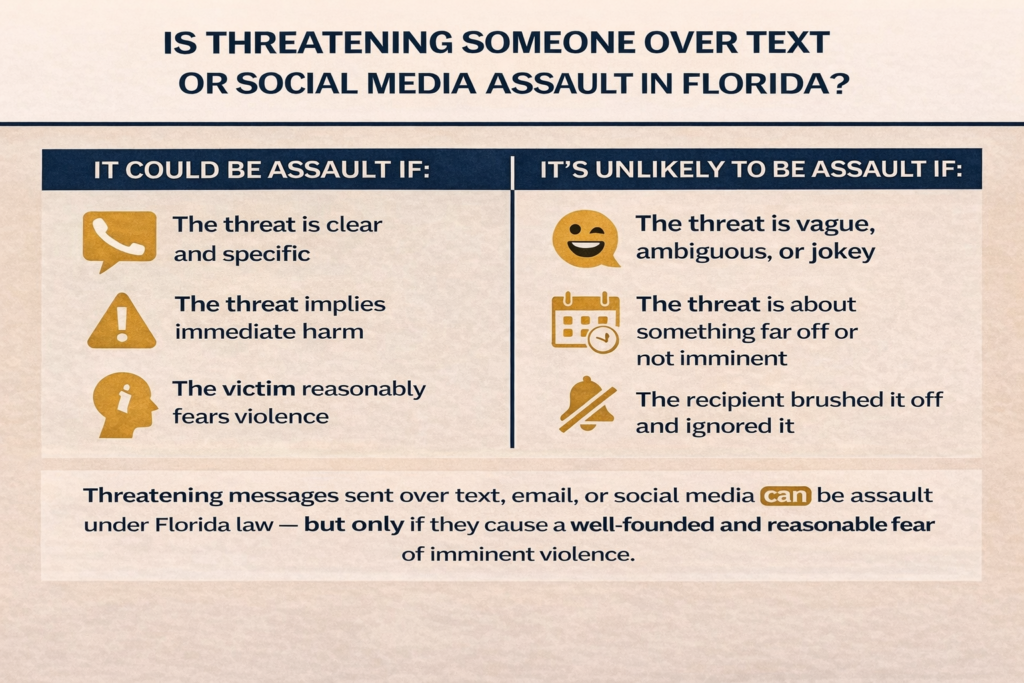
In Florida, a threatening message can support an assault charge only if it creates a well-founded fear of imminent violence and the sender appears capable of carrying out the threat.
Many threatening messages do not meet this standard, especially when the threat is vague, exaggerated, emotional, or not immediate.
📜 How Florida Defines Assault
Under Florida Statute § 784.011, assault requires proof of three elements:
An intentional threat by word or act
An apparent ability to carry out the threat
A well-founded fear that violence is imminent
🚫 Physical contact is not required — but immediacy is critical.
📱 Can a Text Message or Social Media Post Be Assault?
Yes — in limited circumstances.
A message may qualify as assault if:
the language is a clear threat of violence
the threat suggests immediate action
the sender appears capable of carrying it out
the recipient reasonably believes violence is about to occur
But many online threats fail one or more of these elements.
❌ When Online Threats Are Not Assault
Assault charges based on messages often fall apart when the defense shows:
✔ No Imminent Threat
Messages like “I’m going to ruin you” or “you’ll regret this” are usually too vague to qualify.
✔ No Apparent Ability
If the sender is far away, blocked, or clearly unable to act immediately, the “apparent ability” element may fail.
✔ No Reasonable Fear
Fear must be objectively reasonable, not based on speculation, exaggeration, or past arguments.
✔ Emotional or Hyperbolic Speech
Angry messages sent during breakups, arguments, or online disputes — similar to situations involving verbal threats alone — are often emotional venting, not true threats.
🚨 Common Situations Leading to Charges
Threat-based assault allegations often arise from:
Heated text exchanges after breakups
Social media arguments that escalate
Messages sent during custody or family disputes
Online threats reported days or weeks later
Screenshots taken out of context
In many cases, police rely on one-sided screenshots without reviewing the full conversation.
🔍 What Prosecutors Must Prove
To convict someone of assault based on messages, the State must prove:
The message was an intentional threat of violence
The sender appeared capable of acting immediately
The recipient had a well-founded fear of imminent harm, not just a subjective reaction to the message
If any one of these elements is missing, the charge cannot stand.
⚠️ Assault vs. Other Charges
Even when a message does not qualify as assault, prosecutors may attempt to pursue other charges, such as:
written threats
harassment or stalking
cyberstalking
Each offense has different elements and defenses, and overcharging is common.
🛡️ How These Cases Are Defended
Effective defenses often focus on:
Lack of immediacy
No real threat of violence
Context missing from screenshots
No apparent ability to act
Exaggerated or unreasonable fear
Constitutional free-speech concerns
Early legal review of the entire message history — not just selected excerpts — is often decisive.
📍 Facing an Assault Allegation Based on Messages?
Threat-based assault cases frequently hinge on context, timing, and interpretation — not just words on a screen.
📞 Call (954) 270-0769 or request a confidential consultation today.
❓ Frequently Asked Questions
Is threatening someone over text assault in Florida?
Sometimes. It depends on whether the message creates a reasonable fear of imminent violence and whether the sender appears capable of acting immediately.
Do threats have to be immediate to count as assault?
Yes. Florida assault law requires fear of imminent harm. Threats about future or unspecified harm usually do not qualify.
Can old messages be used to charge assault?
Messages sent long before a report is made often undermine the immediacy requirement, which can weaken the case.
What if the message was a joke or exaggeration?
Context matters. Hyperbolic or sarcastic messages may not meet the intent or fear elements required for assault.
Can assault charges based on texts be dismissed?
Yes. Many are dismissed or reduced when intent, immediacy, or reasonable fear cannot be proven.