
Last updated March 2026
Not every heated argument is a crime.
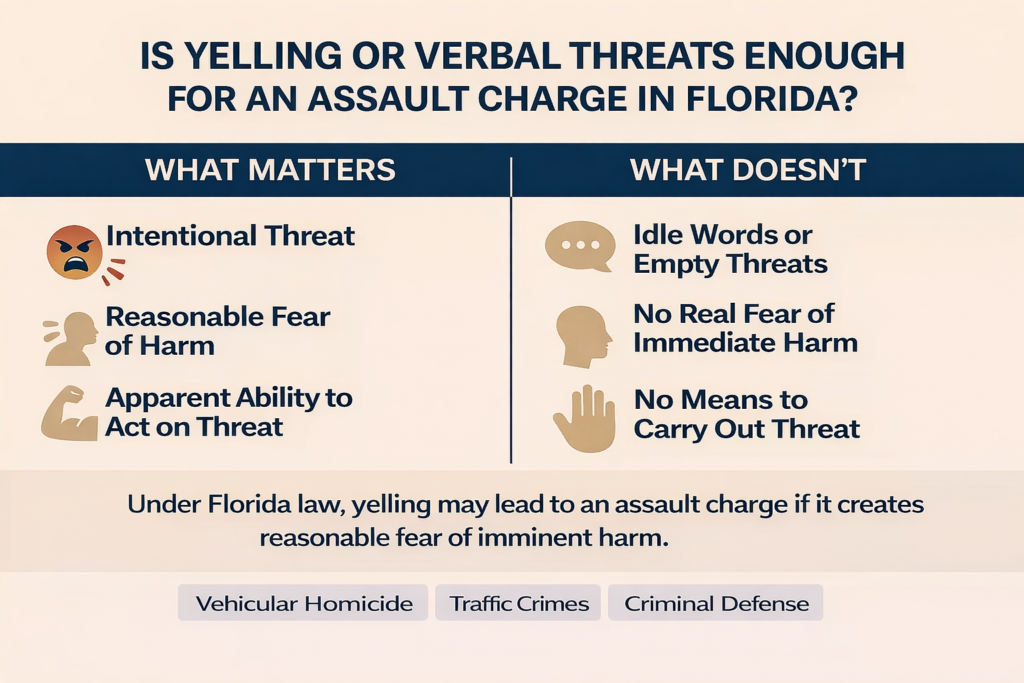
In Florida, assault does not require physical contact — but it does require more than yelling or harsh words.
The key legal question is:
Do verbal threats alone meet Florida’s definition of assault?
The answer depends on intent, immediacy, and apparent ability.
Thus in Florida, assault does not require physical contact — but it does require more than yelling or harsh words. For more detail, see our post Assault Without Physical Contact is treated under Florida law.
For a full breakdown of how Florida defines assault and aggravated assault, see our guide to Assault Charges in Florida.
⚖️ The Legal Definition of Assault in Florida
Under Florida Statute § 784.011, assault occurs when a person:
1️⃣ Intentionally and unlawfully threatens, by word or act, to do violence
2️⃣ Has the apparent ability to carry out the threat
3️⃣ Creates a well-founded fear in the other person that violence is imminent
There are three critical components:
Intentional threat
Apparent ability
Imminent fear
Yelling alone does not automatically satisfy these elements.
🔥 Are Words Alone Enough?
Sometimes yes — but often no.
Florida courts recognize that words alone can support an assault charge if they create a reasonable fear of immediate harm.
However, the threat must be:
Specific
Immediate
Coupled with apparent ability
Capable of creating reasonable fear
For example:
“I’m going to kill you someday” → likely not imminent
“I’m going to hit you right now” while advancing → potentially assault
Context controls.
🗣️ What About Saying “I’ll Kill You”?
Not every statement like “I’ll kill you” qualifies as assault under Florida law.
Courts look at:
• Whether the threat was immediate or about the future
• Whether the person had the apparent ability to carry it out
• The tone and context in which the statement was made
• Whether the speaker advanced or took action consistent with the threat
For example:
“I’ll kill you one day” → likely not imminent
“I’ll kill you right now” while advancing → may support an assault charge
The same words can be treated very differently depending on the surrounding circumstances.
🎯 The “Imminent” Requirement
This is where many assault cases rise or fall.
The fear must be of immediate violence, not:
Future harm
Conditional threats
Angry exaggeration
Idle insults
Statements like:
“You’ll regret this.”
“I’m going to get you.”
Often lack the immediacy required for assault.
The State must prove the alleged victim had a Well-Founded Fear of Imminent Violence, not just a subjective reaction.
🎭 Tone, Context, and Surrounding Circumstances
Courts do not evaluate words in isolation.
They consider:
• Tone of voice (angry, joking, sarcastic)
• Physical movement (advancing, retreating, stationary)
• Distance between the parties
• Whether the situation was escalating or de-escalating
• Prior interactions between the individuals
A statement made during a heated argument may be interpreted differently than the same words spoken calmly while moving toward someone.
This is why video evidence and witness testimony often play a critical role in assault cases.
🧠 Apparent Ability Matters
Even threatening words may not qualify if:
The accused was physically restrained
There was significant distance
A barrier separated the parties
The accused had no realistic ability to carry out the threat
Apparent ability is judged objectively.
If a reasonable person would not believe harm was imminent, the assault element may fail.
🚫 When Yelling Is Not Assault
Common scenarios that may not meet the legal threshold:
🔹 Heated Arguments
Shouting during an argument, without advancing or threatening immediate harm.
🔹 Online or Text Messages
Threats Made Over Text or Social Media may lack immediacy because the person does not have the present ability to act.
🔹 Conditional Statements
“If you touch me, I’ll hit you” may not be unlawful if defensive.
🔹 Mutual Confrontation
If both parties are yelling and no immediate threat exists, assault may not be proven.
⚖️ When Verbal Threats Can Become Aggravated Assault
If a verbal threat is combined with:
Display of a firearm
Brandishing a weapon
Use of a vehicle as a weapon
Intent to commit another felony
The charge may escalate to aggravated assault.
For more on felony assault exposure, see aggravated assault in Florida.
🔍 Evidence That Decides These Cases
Because assault does not require contact, these cases often hinge on:
• Body-worn camera footage
• 911 recordings
• Tone of voice
• Distance between parties
• Witness statements
• Physical positioning
• Whether the accused advanced or moved aggressively
Small details determine whether a threat was legally imminent or just angry speech.
🛡️ Common Defense Strategies
Effective defenses may include:
✔ Lack of intent
✔ No imminent threat
✔ No apparent ability
✔ Words taken out of context
✔ Mutual confrontation
✔ Self-defense
✔ Credibility issues
Many assault cases collapse when the State cannot prove imminence beyond a reasonable doubt.
📍 Broward County Reality
In Broward County, assault arrests frequently arise from:
Domestic disputes
Roadside confrontations
Bar altercations
Neighbor disputes
Workplace conflicts
Officers often rely on initial statements made during emotionally charged moments.
But emotional reactions are not the legal standard.
⚖️ Can Assault Charges Be Reduced or Dismissed?
Yes.
If the defense demonstrates:
No true imminent threat
No apparent ability
Exaggerated fear
Inconsistent statements
Video contradicts the allegation
Charges may be dismissed or reduced.
The distinction between angry speech and criminal assault is often clearer under careful legal analysis.
📞 Charged With Assault in Florida?
If you were arrested after a verbal confrontation, the legal standard may be higher than the arrest report suggests.
Not every raised voice or heated statement qualifies as assault.
Call Michael White, P.A. at (954) 270-0769 for a confidential consultation.