
Last updated February 2026
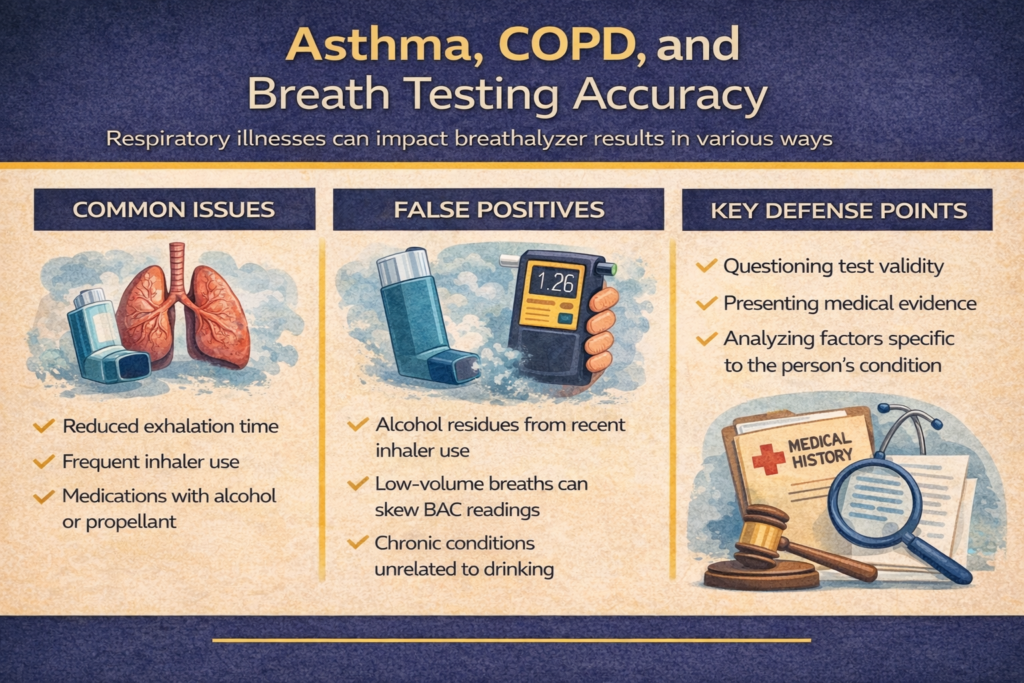
Breathalyzer results are often treated as decisive evidence in Florida DUI cases. But breath testing assumes something that isn’t true for many drivers: that everyone exhales air the same way.
If you have asthma, COPD, emphysema, or another chronic respiratory condition, a breath test may not accurately reflect your true blood-alcohol level — and in some cases, it may produce artificially high or misleading results.
This page explains how respiratory conditions affect breath testing, why inhalers and breathing limitations matter, and how these issues are used to challenge DUI evidence in Florida courts.
🫁 Why Breath Testing Depends on Lung Function
Florida breath tests are designed to analyze deep lung (alveolar) air, which is assumed to correlate with blood-alcohol concentration (BAC).
These assumptions are central to how chemical evidence is evaluated in Florida DUI cases, particularly when breath testing is used to estimate blood-alcohol concentration. To reach that air, a driver must:
Exhale continuously
Maintain sufficient breath volume
Provide a steady airflow until the machine accepts the sample
Respiratory conditions interfere with these assumptions.
Asthma, COPD, and similar conditions often limit:
Exhalation time
Breath volume
Airflow consistency
When the breath sample is incomplete or altered, the test may capture residual or upper-airway alcohol vapors instead of true alveolar air.
💨 How Asthma and COPD Can Skew Breath Test Results
⏱️ Reduced Exhalation Time
Many people with asthma or COPD cannot exhale long enough to meet the machine’s ideal sampling profile. Short or interrupted breaths can distort results.
📉 Low-Volume Breath Samples
Breathalyzers assume a standard breath volume. Chronic lung disease can reduce lung capacity, forcing the machine to extrapolate or accept marginal samples.
🌬️ Irregular Airflow
Wheezing, coughing, or airway constriction can interfere with airflow stability, increasing variability between samples.
These factors can produce inconsistent, inflated, or unreliable readings, even when alcohol consumption was modest or nonexistent.
💊 Inhalers, Medications, and Alcohol Residue
Many asthma and COPD patients rely on inhalers or nebulizers, some of which introduce additional complications:
🚑 Alcohol-Based Propellants
Certain inhalers and oral sprays contain alcohol-based ingredients that can temporarily elevate breath alcohol readings.
⏳ Timing Issues
If an inhaler is used shortly before testing, residual vapors may remain in the mouth or upper airway.
⚠️ Observation Period Failures
Florida requires a pre-test observation period to reduce contamination. Breathing treatments, coughing, or oral medication use during that time can undermine compliance.
Importantly, these effects are unrelated to drinking — yet they may still influence the test result.
⚖️ Why These Issues Matter in Florida DUI Cases
Florida law allows breath test results to be admitted only if testing procedures are followed and the result is reliable.
In cases involving asthma or COPD, defense counsel may challenge:
Whether the test truly measured deep lung air
Whether the driver could physically comply with testing requirements
Whether inhaler use contaminated the sample
Whether the officer properly accounted for medical limitations
When breath testing assumptions break down, the scientific reliability of the result becomes questionable.
🛡️ Common Defense Strategies in Respiratory-Related DUI Cases
In DUI cases involving asthma or COPD, defense attorneys often focus on:
🧪 Test Validity
Was the breath sample physiologically reliable given the driver’s condition?
🩺 Medical Documentation
Do medical records confirm chronic respiratory disease, inhaler prescriptions, or recent treatment?
⏱️ Observation Period Compliance
Did coughing, inhaler use, or breathing difficulty occur during the observation window?
📊 Result Consistency
Were breath samples inconsistent, marginal, or barely accepted by the machine?
👨⚕️ Expert Testimony
Medical or toxicology experts can explain why lung disease undermines breath-testing assumptions.
When these issues are established, breath test evidence may be suppressed, discredited, or given little weight.
🚔 Breath Testing Is Evidence — Not Automatic Proof
A breath test result is not a conviction. It is evidence that must be reliable, lawfully obtained, and scientifically valid.
Respiratory conditions like asthma and COPD expose a fundamental weakness in breath testing: the test assumes healthy lungs. When that assumption is false, so is the certainty of the result.
📍 Charged With DUI and Have Asthma or COPD?
If you were arrested for DUI and suffer from asthma, COPD, or another breathing condition, your medical history may be critical to your defense.
Early legal review allows your attorney to:
Preserve medical evidence
Challenge test reliability
Identify procedural violations
Expose weaknesses before prosecutors lock in their theory
❓ Frequently Asked Questions
Can asthma cause a false high breath test result?
Yes. Reduced breath volume, short exhalation, and inhaler use can interfere with breathalyzer accuracy.
Do inhalers contain alcohol?
Some do. Alcohol-based propellants or oral sprays can introduce residual vapors shortly before testing.
Does COPD affect breathalyzer accuracy?
Yes. COPD alters airflow and lung capacity, which can undermine the assumptions breath testing relies on.
Will police account for my breathing condition automatically?
Not always. Officers often lack medical training and may not adjust testing procedures accordingly.
Can breath test results be thrown out because of asthma or COPD?
Possibly. If the condition undermines test reliability or procedures were not followed, the results may be suppressed or discredited.