
Last updated February 2026
Bounced a check and worried you’ll be arrested? You’re not alone. In Florida, writing a bad check can be a crime—and depending on the amount, it could be a misdemeanor or a felony.
Bad check charges fall under Florida’s broader theft and fraud laws. To understand how these cases are prosecuted and defended statewide, see our guide to theft and fraud charges in Florida.
Here’s how Florida law handles worthless checks, and what you can do if you’re facing charges or received a bad check complaint.
⚖️ Florida’s Worthless Check Law
Under Florida law, it’s a crime to issue a check knowing that:
You don’t have sufficient funds in the account, or
You have no account at all with the bank listed on the check
The law applies to both paper checks and electronic checks used for payment.
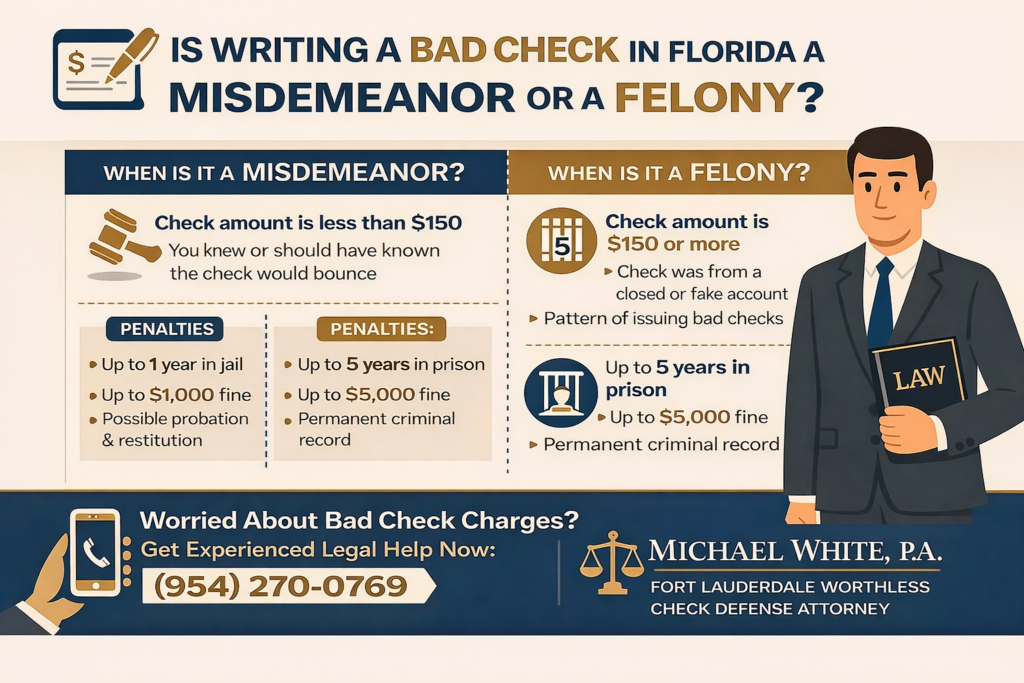
🧠 When Is It a Misdemeanor?
You may be charged with a first-degree misdemeanor if the check amount is:
Less than $150, and
You knew or should have known the check would bounce
Penalties:
Up to 1 year in jail
Up to $1,000 fine
Possible probation, restitution, and court fees
🚨 When Is It a Felony?
A bounced check becomes a third-degree felony if:
The check is for $150 or more, OR
The check was drawn from a closed or fake account, OR
There’s a pattern of issuing bad checks
Penalties:
Up to 5 years in prison
Up to $5,000 fine
Restitution to the victim
Permanent criminal record
In many cases, prosecutors treat felony worthless check allegations as part of Florida’s broader fraud and theft laws — especially when deception or repeated conduct is alleged.
⚠️ Why Bad Check Cases Escalate Quickly in Florida
Worthless check cases often begin as civil disputes but can turn criminal fast. Once a statutory demand letter is ignored or a pattern of bad checks is alleged, prosecutors may treat the case as fraud rather than a simple payment issue.
What started as a bounced check can quickly become a criminal record problem — especially if law enforcement believes there was intent to defraud.
💥 Common Defenses to Bad Check Charges
At Michael White, P.A., we’ve defended clients accused of writing bad checks—often resolving the case without a conviction.
Possible defenses include:
Lack of intent to defraud
Bank error or processing delay
Postdated checks (not subject to prosecution)
Payment stopped due to billing dispute
Restitution paid before charges were filed
🧾 Statutory Notice Before Criminal Charges
Florida law generally requires the recipient of a bad check to send a written demand giving you 15 days to pay the amount owed (plus fees) before criminal charges are pursued.
Ignoring that notice is one of the fastest ways a bad check matter turns into a criminal case.
👨⚖️ Fort Lauderdale Fraud & Worthless Check Defense Lawyer
Even an honest mistake with a check can escalate into criminal charges. At Michael White, P.A., we help clients resolve check-related offenses through negotiation, diversion, or defense in court.
We aim to protect your record, minimize fines, and keep you out of jail.
🔍 More Answers About Bad Check Charges in Florida
❓ Is a bounced check automatically a crime in Florida?
No. Prosecutors must prove you knew the account lacked funds and intended to defraud.
❓ Can I go to jail for writing a $75 bad check?
Yes. If the check bounces and isn’t resolved, it can lead to a first-degree misdemeanor charge.
❓ What if I already paid the money back?
That may help avoid charges—or lead to case dismissal. But it’s not automatic.
❓ Is it a felony if the account was closed?
Yes. Writing a check from a closed or fake account is a third-degree felony.
❓ What if I didn’t mean for the check to bounce?
Intent is critical. Your attorney may argue lack of fraud or resolve the case through restitution.