
Last updated March 2026
Yes — property damage charges can be dropped in Florida, but it depends on the facts, the evidence, and whether prosecutors can actually prove criminal mischief beyond a reasonable doubt.
Many people are charged with property damage after arguments, misunderstandings, or emotionally charged situations. In these cases, the difference between a conviction and a dismissal often comes down to intent, proof of damage, and how the case is handled early.
This page explains when property damage charges are commonly dropped, reduced, or dismissed — and why these cases are often overcharged.
For a complete explanation of Florida’s criminal mischief law, including misdemeanor vs felony thresholds, see Criminal Mischief (Vandalism) in Florida.
⚖️ What Are Property Damage Charges in Florida?
In Florida, property damage is usually charged as criminal mischief. Prosecutors must prove that the accused:
-
Willfully and maliciously damaged property
-
That belonged to someone else (or was jointly owned)
-
And that the damage was not accidental or legally justified
If the State cannot prove any one of these elements, the charge may be dropped or reduced.
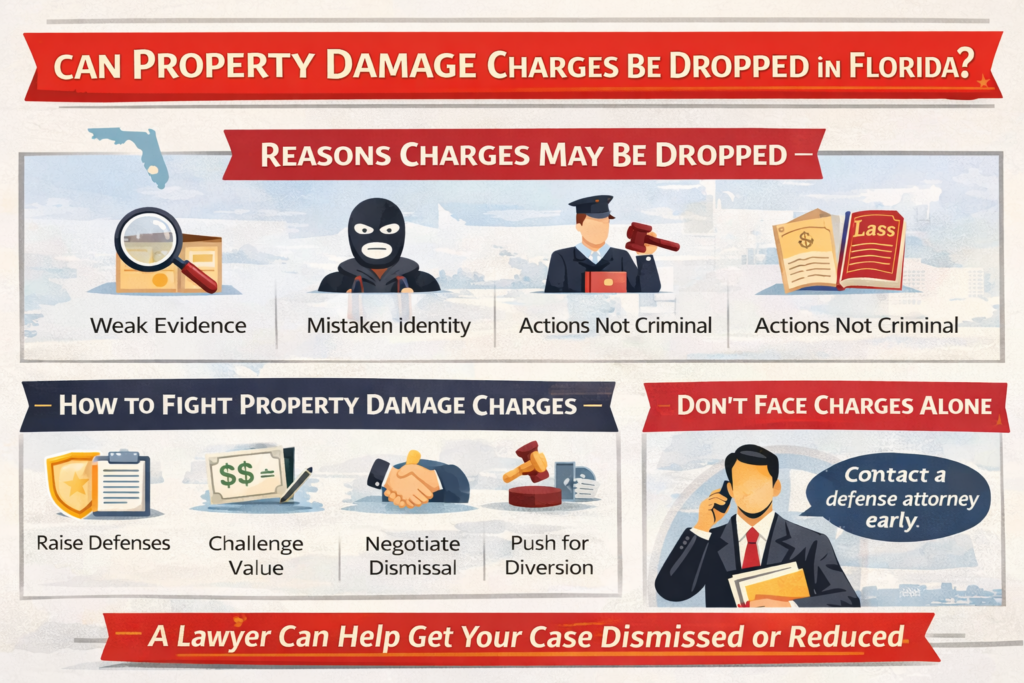
✅ Common Reasons Property Damage Charges Are Dropped
1️⃣ Lack of Intent
Accidents are not crimes.
If the damage occurred during:
-
an accident
-
a misunderstanding
-
reckless but unintentional conduct
the “willful and malicious” element may be missing. Many property damage cases fail right here.
2️⃣ Weak or Inconclusive Evidence
Property damage cases often rely on:
-
assumptions
-
circumstantial timing
-
unverified accusations
Common problems include:
-
no eyewitnesses
-
poor-quality video footage
-
no physical evidence tying the accused to the damage
When proof is weak, prosecutors frequently decline to file or later dismiss charges.
3️⃣ Mistaken Identity
These cases often occur:
-
at night
-
during disputes
-
when multiple people were present
If the State cannot reliably identify who caused the damage, the charge may not survive.
4️⃣ Ownership or Permission Disputes
Many cases involve:
-
shared residences
-
jointly owned vehicles
-
family or relationship conflicts
If you reasonably believed the property was yours — or had permission — criminal mischief may not apply.
5️⃣ Damage Value Cannot Be Proven
Whether a charge is a misdemeanor or felony often depends on the alleged cost of damage.
Charges are commonly reduced or dropped when:
-
repair estimates are inflated
-
cosmetic damage is overstated
-
pre-existing damage is blamed on the accused
-
multiple items are improperly bundled together
Challenging valuation is one of the most effective ways to defeat felony exposure.
In lower-value cases, charges are often treated as misdemeanors — see how minor property damage cases are handled in Florida.
6️⃣ Civil Resolution or Diversion
In appropriate cases — especially for first-time offenders — prosecutors may agree to:
-
restitution without a conviction
-
pretrial diversion
-
dismissal after conditions are met
These outcomes often depend on early legal intervention.
🧠 What Prosecutors Still Must Prove
Even when damage is obvious, prosecutors must still prove:
-
intent at the time of the act
-
that the damage was criminal, not justified
-
that the accused caused the damage
-
that the alleged value is accurate
If those elements are shaky, the case becomes vulnerable. This is especially true in cases relying on unclear footage — see how video evidence can be challenged in criminal mischief cases.
🧯 Situations Where Charges Are Commonly Overcharged
Property damage arrests often arise from:
-
domestic disputes
-
neighbor conflicts
-
breakups or evictions
-
emotionally charged arguments
In these situations, allegations are frequently exaggerated — and charges are filed before all facts are known.
These patterns are especially common in relationship-based cases — see criminal mischief allegations arising from domestic disputes.
🧭 What to Do If You’re Charged With Property Damage
If you’re facing a property damage allegation:
-
Do not admit fault in texts, messages, or conversations
-
Preserve evidence (photos, videos, timestamps, witnesses)
-
Do not agree to damage amounts without verification
-
Avoid contact that could escalate allegations
Early mistakes often make these cases harder to resolve.
⚠️ Property Damage Charges Don’t Always Stick
Just because someone accuses you of damaging property does not mean the case will hold up.
Many property damage cases in Florida are:
-
reduced
-
dismissed
-
resolved without convictions
when intent, proof, or valuation is challenged correctly.
If you’ve been accused of property damage in Florida, early decisions matter. These cases often turn on intent, evidence, and damage valuation — and mistakes made early can make dismissal harder.
Speaking with a defense lawyer before making statements or agreeing to repair costs can help protect your record and your options.