
Last updated March 2026
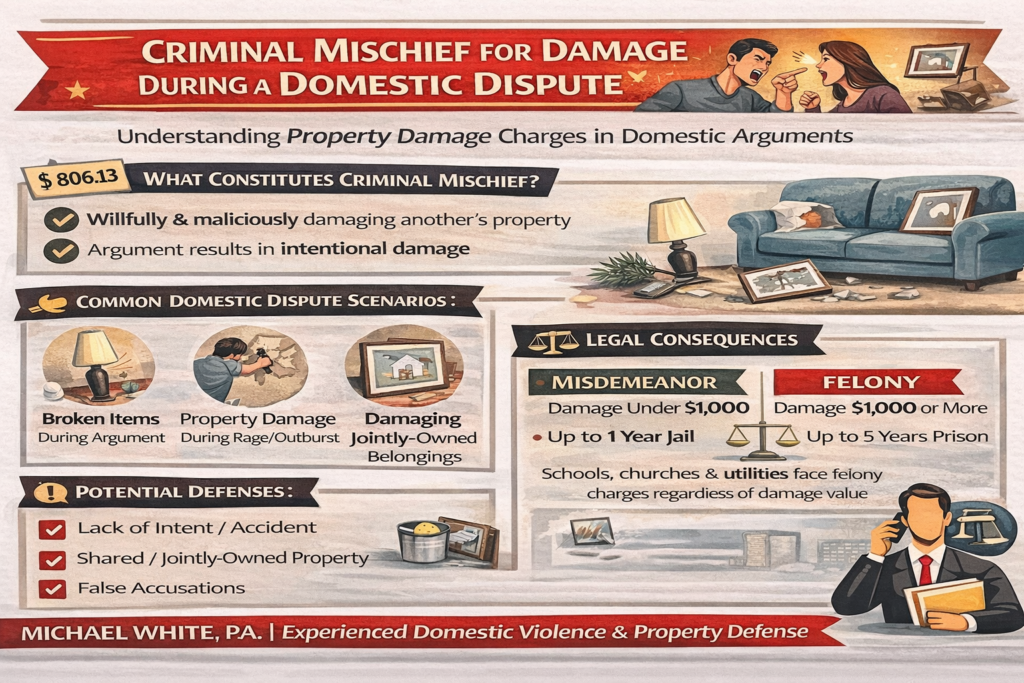
Property damage allegations often arise out of arguments between spouses, partners, roommates, or family members. In Florida, those situations can lead to criminal mischief charges — even when the dispute is personal and no one is physically injured.
For a broader overview of how these cases are charged, see Criminal Mischief in Florida.
When Does Property Damage Become Criminal Mischief?
Not every heated argument leads to criminal charges. To prove criminal mischief, the State must show:
- intentional conduct
- damage to property
- property belonging to another person
The key issue is often ownership. In domestic situations, that question is not always straightforward.
What If the Property Is Shared?
This is one of the most important issues in domestic-related criminal mischief cases.
Situations may involve:
- jointly owned property
- shared living spaces
- items purchased during a relationship
- unclear ownership between parties
If the property belongs to both individuals, or if there is a legitimate dispute over ownership, that may affect whether a crime occurred at all.
Common Scenarios That Lead to Charges
Criminal mischief charges in domestic situations often involve:
- breaking household items during an argument
- damaging phones, televisions, or personal belongings
- punching walls or doors
- throwing objects that cause property damage
- damaging a partner’s vehicle
Even though these events happen in emotional or chaotic circumstances, they can still be prosecuted as criminal offenses.
For vehicle-related situations, see Keying a Car in Florida.
Why These Cases Are Often More Complex
Domestic-related property damage cases are rarely straightforward. They often involve:
- conflicting stories
- emotional dynamics
- incomplete investigations
- assumptions by responding officers
- pressure to make an arrest
Law enforcement is often called after the fact, meaning officers must rely on statements rather than direct observation.
The Role of Damage and Valuation
As with all criminal mischief cases, the amount of damage matters.
In domestic disputes, damage claims may be:
- exaggerated
- estimated without documentation
- influenced by the underlying conflict
Even relatively minor damage can lead to charges depending on how the situation is presented.
For lower-value allegations, see Criminal Mischief Under $200 in Florida.
Common Defenses in Domestic Property Damage Cases
Lack of Intent
Arguments can escalate quickly. Not all damage is intentional or malicious. Accidental or reactive conduct may not meet the legal standard for criminal mischief.
Ownership Disputes
If the property is jointly owned or disputed, that may undermine the State’s case.
Consent or Implied Permission
In some relationships, there may be a history of shared use or authority over property that complicates the analysis.
Credibility Issues
Domestic cases often come down to one person’s word against another. Inconsistencies, bias, or exaggeration may become critical issues.
Can These Charges Be Dropped?
Yes — domestic-related criminal mischief cases are often resolved without a conviction, especially where:
- ownership is unclear
- intent is disputed
- damage is minimal
- both parties share responsibility
Possible outcomes may include dismissal, diversion, or negotiated resolutions involving restitution.
For more on repayment issues, see Restitution in Florida Criminal Mischief Cases.
Fort Lauderdale Criminal Mischief Defense Attorney
Domestic dispute cases involving property damage require careful handling. These cases often involve legal, factual, and emotional layers that can significantly affect how charges are filed and resolved.
At Michael White, P.A., we focus on:
- analyzing ownership issues
- challenging intent
- addressing credibility concerns
- positioning cases for dismissal or reduction
Early intervention can be especially important in domestic-related cases to prevent escalation and long-term consequences.
FAQs
Can I be charged for breaking something in my own house in Florida?
It depends on ownership. If the property belongs to another person — even within a shared home — criminal charges may still apply.
What if we both own the property?
Joint ownership can be a defense or complicating factor, depending on the circumstances.
Is property damage during an argument automatically a crime?
No. The State must still prove intentional and malicious damage to another person’s property.
Do these cases always involve domestic violence charges?
Not necessarily. Property damage alone may be charged as criminal mischief, though it can arise in domestic-related situations.