
Last updated March 2026
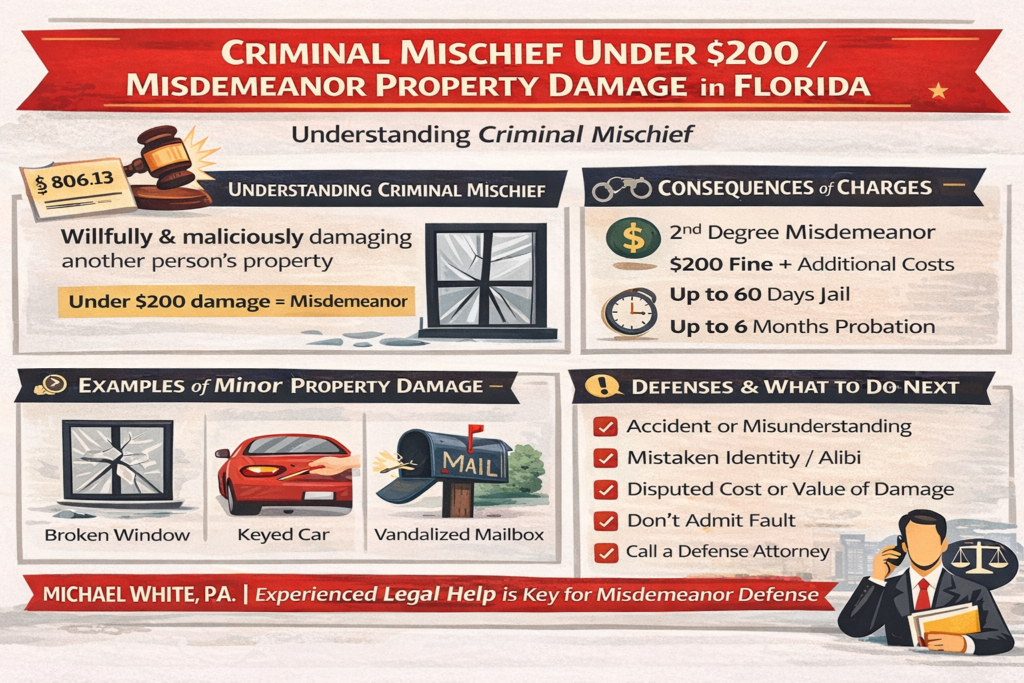
Not every property damage case in Florida is charged as a felony. When the alleged damage is relatively minor, the offense may be filed as a lower-level misdemeanor criminal mischief case. Even so, a misdemeanor conviction can still leave you with a criminal record, court costs, restitution, probation, or even jail exposure.
For a broader overview of the offense itself, see our guide to Criminal Mischief in Florida.
What Is Criminal Mischief in Florida?
Under Florida law, criminal mischief generally means willfully and maliciously injuring or damaging another person’s real or personal property. The issue is not just whether something was broken or damaged. The State must prove the damage was done intentionally and maliciously, not by accident, carelessness, or misunderstanding.
In smaller-dollar cases, prosecutors often rely on witness statements, photographs, repair estimates, and assumptions about what happened during an argument or confrontation. That is one reason these cases are often more defensible than they first appear.
When Is Criminal Mischief a Misdemeanor?
Where the value of the alleged damage is modest, the charge may be treated as misdemeanor criminal mischief rather than a felony. The charging level depends heavily on the damage amount claimed by law enforcement or the complaining witness.
These cases often arise from allegations involving:
- a broken household item
- damage to a window or mirror
- dents or scratches to a vehicle
- damage to a mailbox, fence, or small fixture
- graffiti or other minor defacement
If the accusation involves a broken window, you may also want to review Is Breaking a Window a Crime in Florida?, since intent and surrounding circumstances often determine whether the conduct is actually criminal.
What Are the Penalties?
A misdemeanor criminal mischief charge may still carry serious consequences, including:
- a criminal conviction
- probation
- court costs
- restitution
- possible jail exposure
- difficulty with employment or background checks
In many of these cases, the financial consequences matter just as much as the formal charge. A person may face not only the criminal case, but also an order to repay the alleged victim for repair or replacement costs.
If restitution is part of the case, see Restitution in Florida Criminal Mischief Cases for a closer look at how courts handle repayment issues.
Common Defenses in Low-Dollar Property Damage Cases
The strongest defense depends on the facts, but several issues appear repeatedly in misdemeanor criminal mischief cases.
Lack of Intent
The State must prove that the damage was willful and malicious. That can be difficult where the event happened during a chaotic argument, a misunderstanding, or an accident. Not every broken item is the result of criminal intent.
Disputed Damage Amount
In some cases, the alleged value of the damage is inflated. Repair estimates may be exaggerated, unsupported, or based on replacement instead of actual damage. That matters because valuation can affect both the charge and the amount of restitution sought.
Ownership or Consent Issues
Some cases involve shared property, disputed ownership, or implied permission to use or alter an item. These issues often arise in roommate situations, family disputes, and domestic relationships.
Mistaken Identity
Police do not always witness the event. They may arrive afterward and rely on one-sided accusations. If multiple people were present, or if the evidence is incomplete, identity may be a real defense.
Why These Cases Should Not Be Minimized
People sometimes assume that a low-dollar criminal mischief charge is “just a minor case.” That is often a mistake. Even a misdemeanor can affect professional licenses, job opportunities, immigration issues, and future plea negotiations if another case ever arises.
And in some situations, a low-dollar case can become more complicated when the allegation grows out of a domestic argument or relationship dispute. If that is the context, see Criminal Mischief for Damage During a Domestic Dispute.
Can a Misdemeanor Criminal Mischief Case Be Resolved Without a Conviction?
Often, yes. Depending on the facts, the person’s prior record, and the strength of the evidence, possible outcomes may include:
- dismissal
- diversion
- negotiated reduction
- restitution-based resolution
- withhold of adjudication in appropriate cases
The earlier the case is addressed, the more options there may be for avoiding a permanent conviction.
Fort Lauderdale Criminal Mischief Defense Attorney
At Michael White, P.A., we defend clients charged with criminal mischief and other property offenses throughout Fort Lauderdale and South Florida. In these cases, early defense work often focuses on intent, valuation, restitution exposure, and whether the evidence actually proves a crime occurred at all.
A misdemeanor property damage case may look small on paper, but the consequences can still be significant. A careful review of the facts can make the difference between a lasting record and a much better outcome.
FAQs
Is criminal mischief under $200 a misdemeanor in Florida?
Yes. Lower-dollar property damage allegations are often charged as misdemeanor criminal mischief, though the exact charging decision depends on the alleged facts and damage amount.
Can I go to jail for misdemeanor criminal mischief in Florida?
Yes. Even a misdemeanor criminal mischief charge can carry jail exposure, along with probation, court costs, and restitution.
What if the damage was accidental?
Accidental damage is not the same as willful and malicious damage. Lack of intent is often one of the strongest defenses in criminal mischief cases.
Do I have to pay restitution in a misdemeanor property damage case?
Possibly. Courts often address repair or replacement costs in criminal mischief cases, especially if the case is resolved through plea negotiations or probation.