
Last updated March 2026
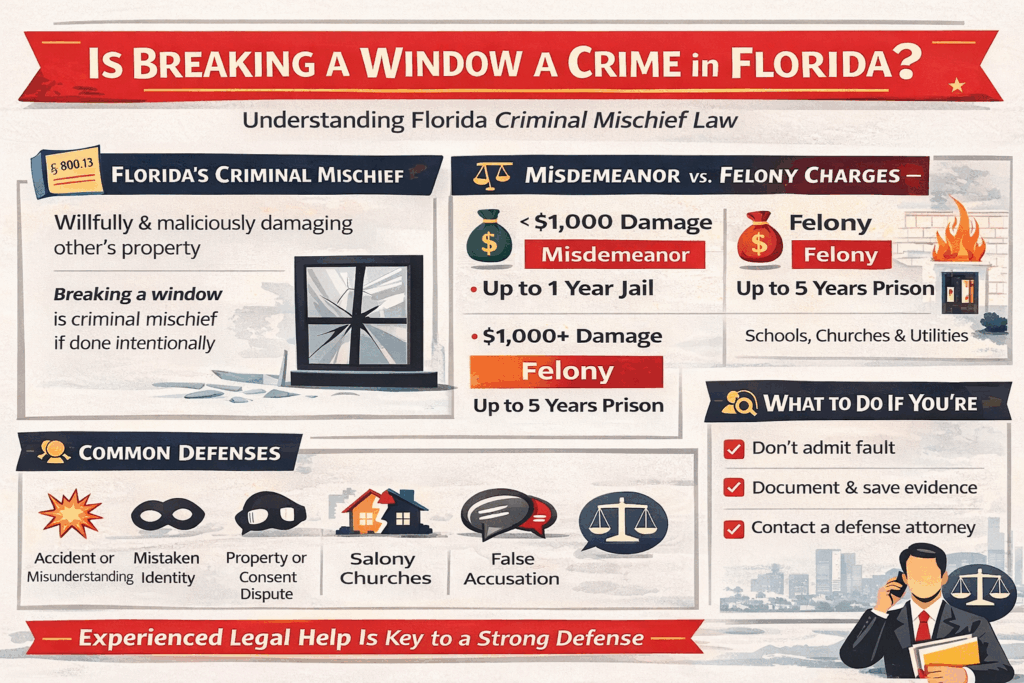
Breaking a window doesn’t always feel criminal — especially if it’s done during an emergency, a heated moment, or on property you believe is your own. But under Florida law, breaking a window can absolutely lead to criminal charges depending on intent, ownership, and circumstances.
This page explains when breaking a window is treated as a crime, when it may be legally justified, and why these cases often turn on fine factual details. For a full breakdown of Florida’s criminal mischief law, including misdemeanor vs felony thresholds, see Criminal Mischief (Vandalism) in Florida.
⚖️ When Breaking a Window Can Be a Crime
In Florida, breaking a window is most commonly charged as criminal mischief, but other charges may apply depending on what happens next.
Breaking a window can lead to:
-
Criminal mischief (vandalism) if property is willfully and maliciously damaged
-
Burglary if the broken window is part of an unlawful entry into a structure or vehicle
-
Attempted theft if prosecutors allege intent to steal
-
Domestic-violence-related charges when damage occurs during an interpersonal dispute
Importantly, you do not need to steal anything or even enter the property for criminal mischief charges to apply.
🧠 What the State Must Prove
To convict someone of criminal mischief for breaking a window, prosecutors generally must prove:
-
The damage was willful and malicious
-
The property belonged to someone else (or was jointly owned)
-
The damage was not accidental or legally justified
Many cases fail when the State cannot prove intent or when the circumstances show a reasonable explanation.
💰 Why the Amount of Damage Matters
In criminal mischief cases, the alleged value of the damage often determines whether the charge is a misdemeanor or a felony.
In practice, this leads to frequent disputes over:
-
inflated repair estimates
-
cosmetic vs structural damage
-
pre-existing damage
-
bundling multiple items to reach felony thresholds
These valuation disputes are often the key to reducing or dismissing charges. In lower-value cases, the charge may remain a misdemeanor — see When Criminal Mischief is Treated as a Minor Property Damage Offense.
🧯 When Breaking a Window May Be Legally Justified
Florida law recognizes that not all property damage is criminal. Breaking a window may be legally justified in situations such as:
-
Medical or safety emergencies
(e.g., breaking a car window to rescue a child or animal) -
Self-defense or defense of others
(e.g., escaping immediate danger) -
Necessity
(when damage is required to prevent greater harm)
These defenses depend heavily on the facts and must be raised properly through counsel.
❗ Breaking Your Own Window Can Still Be a Crime
This surprises many people.
You may still face charges even if the window is “yours” when:
-
the property is shared or jointly owned
-
the damage occurs during a domestic dispute
-
the conduct creates danger or public disruption
Florida courts have allowed criminal mischief charges in cases involving shared residences, vehicles, or emotionally charged incidents. These issues frequently arise in relationship-related cases — see how property damage is treated during domestic disputes.
🧭 How These Cases Are Commonly Charged
In South Florida, broken-window cases often arise from:
-
arguments between partners or family members
-
neighbor disputes
-
misunderstandings about ownership or permission
-
emergency situations that are later questioned
When prosecutors believe the broken window was part of an unlawful entry, they may attempt to elevate the case to burglary.