
Last updated February 2026
Being arrested in Florida is stressful enough — but many people are shocked to learn that even when the State Attorney never files charges, the arrest can still appear on background checks for years.
If your case was marked “no file,” “no action,” or “never filed,” you may still need to take formal steps to clear your record.
The good news:
Yes, arrests that were never filed can often be sealed or expunged — but only if you do it correctly.
This page explains what “never filed” really means, when sealing or expungement is available, and why timing matters.
⚖️ What Does “Never Filed” Mean in Florida?
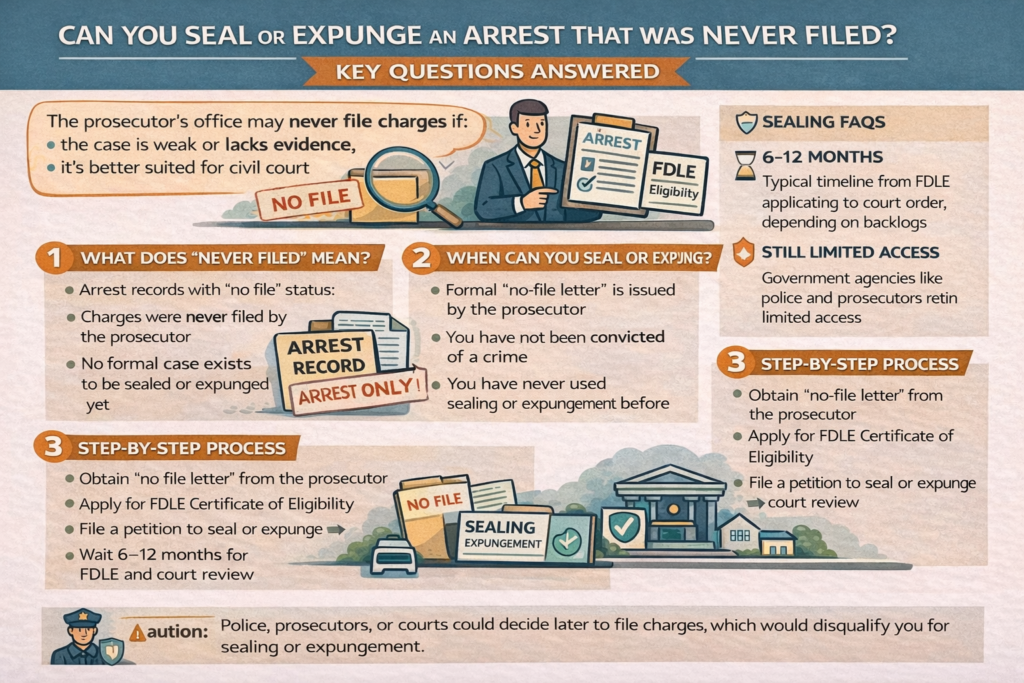
When an arrest is marked as “never filed”, it means the prosecutor reviewed the case and chose not to file formal charges.
This can happen for many reasons, including:
insufficient evidence,
witness credibility issues,
legal defects in the arrest,
constitutional problems with the stop or search,
or a determination that prosecution is not in the public interest.
Importantly, a “no file” decision is not the same as a dismissal, because no case was ever opened in court.
But the arrest itself still exists.
🚨 Why a “No File” Arrest Still Shows Up
Even without charges, a Florida arrest typically remains:
visible in law-enforcement databases,
accessible to background check companies,
searchable by employers, landlords, and licensing boards,
and reportable on applications unless it is sealed or expunged.
In other words, nothing is automatically cleared just because charges were never filed.
✅ When Can You Seal or Expunge an Arrest That Was Never Filed?
You may be eligible to seal or expunge a “no file” arrest if all of the following are true:
✔ The prosecutor formally declined to file charges
✔ You were never adjudicated guilty of any offense in the case
✔ You have not already used your one lifetime sealing or expungement
✔ The offense is not statutorily disqualified
✔ No charges were later filed arising from the same arrest
In many situations, expungement is available for no-file cases — which is the strongest form of relief because it destroys the record rather than merely hiding it.
For a broader overview of Florida’s record-clearing framework, see our
Sealing & Expungement in Florida guide.
❌ When a “No File” Arrest Is NOT Eligible
Even without charges, sealing or expungement may be unavailable if:
charges were later filed after the initial no-file decision,
the arrest involved a disqualifying offense,
you previously sealed or expunged another record,
or the arrest was part of a larger incident that resulted in a conviction.
This is especially common when:
multiple arrests arise from a single incident, or
companion charges were filed later.
Each arrest must be evaluated independently.
🔁 Sealing vs. Expungement for No-File Arrests
Both options may be available, but they are not the same.
Expungement destroys the arrest record held by most agencies and provides the cleanest result.
Sealing hides the arrest from public view but allows limited government access.
Which option applies depends on eligibility and strategy.
To understand the difference, see Sealing vs. Expunging Criminal Records in Florida.
📋 How the Process Works
Clearing a no-file arrest is not automatic. It typically requires:
Obtaining proof that the case was never filed (often a “no file” letter)
Applying for a Certificate of Eligibility with FDLE
Submitting fingerprints and certified arrest documentation
Filing a petition to seal or expunge in court
Waiting for FDLE and judicial review
The full process usually takes 6–12 months, depending on agency backlogs.
⚠️ Important Timing Warning
A no-file decision does not always mean the case is permanently over.
In limited circumstances, prosecutors may later:
reopen an investigation, or
file charges before the statute of limitations expires.
If charges are filed later, you may lose eligibility for sealing or expungement.
This is why record-clearing decisions should be made carefully and strategically.
🧠 Why These Cases Are Often Mishandled
Many people are incorrectly told:
“You don’t need to do anything — it was never filed,” or
“Clerks will remove it automatically.”
That’s rarely true.
Common problems include:
incomplete arrest dispositions,
background check databases not updating,
FDLE applications being rejected for missing documentation,
or people accidentally using their one lifetime expungement on the wrong case.
👨⚖️ Help Clearing a No-File Arrest in Florida
At Michael White, P.A., we help clients:
confirm no-file status,
determine sealing vs. expungement eligibility,
prepare FDLE applications correctly,
file petitions courts are willing to grant,
and ensure records are actually removed from databases.
This is especially important when employment, licensing, immigration, or housing is at stake.
❓ Frequently Asked Questions
Can an arrest that was never filed be expunged in Florida?
Often yes. Many no-file arrests qualify for expungement if eligibility requirements are met.
Do I need to wait a certain amount of time?
Not always, but timing can matter depending on the case and whether charges could still be filed.
Will a no-file arrest show up on background checks?
Yes — unless it is sealed or expunged.
Is sealing or expungement automatic if charges were never filed?
No. You must apply and receive a court order.
Can I do this myself?
You can, but errors frequently result in delays or permanent loss of eligibility.
📞 Ready to Clear a No-File Arrest?
An arrest that was never filed does not have to follow you forever — but it won’t disappear on its own.
If you want to find out whether your arrest qualifies for sealing or expungement, and how to do it the right way, contact Michael White, P.A. today for a confidential consultation.