
Last updated March 2026
When Fatal Truck Crashes Become Criminal Investigations
Fatal crashes involving large trucks, delivery vehicles, or other commercial vehicles often trigger intensive investigations by law enforcement and traffic homicide units. Because commercial vehicles are larger, heavier, and subject to additional safety regulations, investigators frequently examine these crashes closely to determine whether criminal charges are appropriate.
When a death occurs in a commercial vehicle accident, prosecutors may consider charges such as vehicular homicide, manslaughter, or other homicide charges depending on the circumstances.
However, determining whether a fatal crash involving a commercial vehicle rises to the level of a criminal offense requires careful analysis of the evidence, driver behavior, vehicle condition, and crash reconstruction findings.
For a broader overview of how these cases are prosecuted under Florida law, see our guide to Vehicular Homicide in Florida, which explains the elements prosecutors must prove in fatal crash prosecutions.
Why Commercial Vehicle Crashes Receive Greater Scrutiny
Commercial vehicles often weigh 20 to 30 times more than passenger vehicles, which means collisions involving trucks frequently result in severe injuries or fatalities.
Because of this risk, commercial drivers must comply with strict federal and state safety regulations.
When a fatal crash occurs, investigators may examine whether the commercial driver complied with:
• driver fatigue rules
• vehicle inspection requirements
• cargo safety regulations
• licensing and training standards
If investigators believe a commercial driver operated a vehicle in a reckless manner likely to cause death or great bodily harm, prosecutors may consider vehicular homicide charges under Florida Statutes.
Real-World Example: When Truck Drivers Face Criminal Charges After Fatal Crashes
Although most commercial vehicle accidents are investigated as traffic incidents, there are situations where prosecutors pursue criminal charges against truck drivers.
For example, in a widely reported Florida case, truck driver Harjinder Singh was charged after a fatal crash involving a commercial vehicle on a South Florida roadway. Prosecutors alleged that unsafe driving behavior contributed to the collision that resulted in a death.
Cases like this illustrate how commercial vehicle crashes can escalate from a traffic investigation to a Traffic Homicide Investigation when authorities believe reckless driving may have contributed to a fatal outcome.
However, as in any vehicular homicide case, prosecutors must still prove recklessness and causation beyond a reasonable doubt.
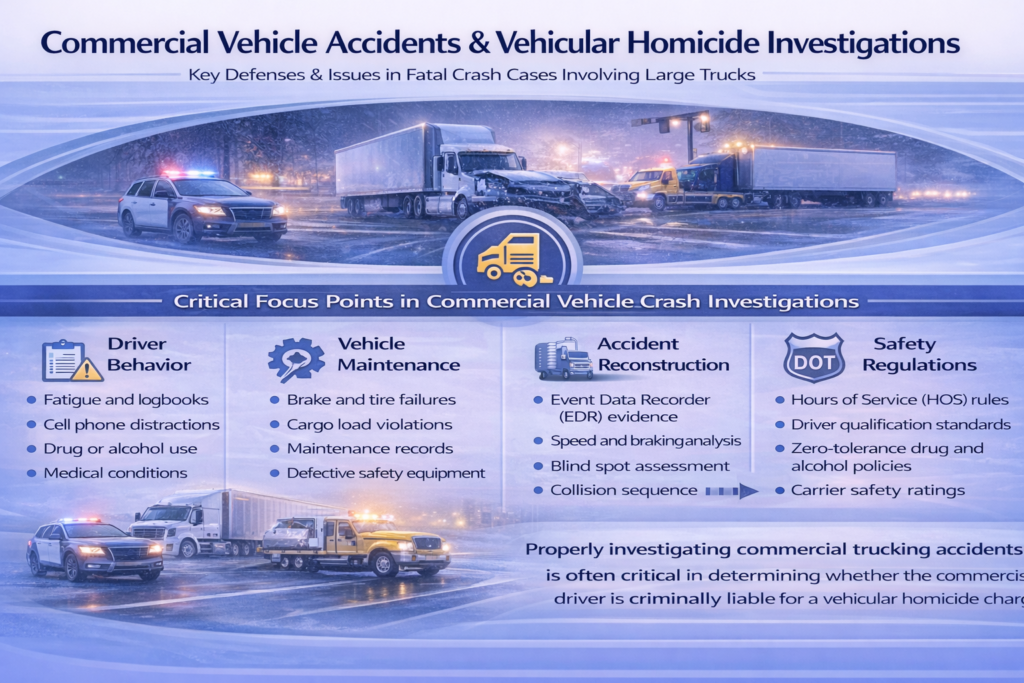
Key Factors Investigated in Fatal Commercial Vehicle Crashes
Commercial vehicle accidents involve unique investigative issues that do not typically arise in ordinary passenger vehicle crashes.
Investigators often examine four major areas.
Driver Behavior
The conduct of the commercial driver is often the first issue investigators analyze.
Authorities may review whether the driver:
• exceeded safe speeds
• drove while fatigued
• used a cellphone while operating the vehicle
• ignored traffic signals or safety warnings
• operated the vehicle under the influence of alcohol or drugs
Fatigue is a particularly important issue in commercial vehicle cases because long driving hours can impair reaction time and judgment.
Hours-of-Service and Logbook Compliance
Commercial drivers must comply with federal Hours-of-Service (HOS) regulations that limit how long a driver may operate a vehicle without rest.
Investigators may examine:
• electronic logbook records
• driver schedules
• delivery deadlines
• GPS data showing driving time
If investigators believe a driver exceeded legal driving limits or falsified records, that evidence may become part of a criminal investigation.
Vehicle Maintenance and Equipment
Commercial vehicles must undergo regular inspection and maintenance to ensure they remain safe for highway operation.
Investigators may review whether the truck or commercial vehicle had:
• brake failures
• worn tires
• defective steering components
• improperly secured cargo
• missing or malfunctioning safety equipment
Maintenance records may become critical evidence in determining whether the crash resulted from mechanical issues rather than reckless driving.
Accident Reconstruction and Vehicle Data
Commercial vehicle crashes frequently involve complex Crash Reconstruction analysis.
Investigators may analyze:
• vehicle speed before impact
• braking distances
• debris patterns
• collision angles
• driver reaction times
Commercial trucks also frequently contain sophisticated onboard recording systems that capture operational data.
These systems may provide Event Data Recorder Evidence, commonly known as vehicle “black box” data.
We explain how this data is analyzed — and sometimes challenged — in our guide on Whether Black Bbox Evidence Can Be Wrong in Vehicular Homicide Cases.
Causation in Commercial Vehicle Homicide Cases
Even when a commercial vehicle is involved in a fatal crash, prosecutors must still prove that the driver’s conduct caused the death.
This is known as Causation in Criminal Law, and it is often one of the most contested issues in vehicular homicide cases.
Factors that may complicate causation include:
• actions of other drivers
• sudden roadway hazards
• mechanical failures
• weather conditions
• unavoidable traffic situations
When another factor becomes the true cause of the fatal crash, the prosecution may struggle to prove criminal liability.
These issues are examined further in our article on Challenging Causation in Vehicular Homicide Cases.
Multiple Parties May Be Involved in Commercial Vehicle Investigations
Commercial vehicle crashes can involve multiple parties beyond the driver.
Investigators may examine whether responsibility lies with:
• the commercial driver
• the trucking company
• maintenance contractors
• cargo loading companies
• vehicle manufacturers
Determining responsibility often requires a detailed investigation into vehicle operation, company safety practices, and crash reconstruction evidence.
Why These Cases Often Require Expert Analysis
Fatal crashes involving commercial vehicles frequently require multiple experts to analyze the evidence.
These experts may include:
• accident reconstruction specialists
• mechanical engineers
• commercial vehicle safety experts
• forensic analysts reviewing Crash Data Retrieval
Because of the complexity of these investigations, early review of evidence can play an important role in how prosecutors evaluate the case.
Speak With a Florida Vehicular Homicide Defense Attorney
Fatal crashes involving commercial vehicles frequently require multiple experts to analyze the evidence.
These experts may include:
• accident reconstruction specialists
• mechanical engineers
• commercial vehicle safety experts
• forensic analysts reviewing Crash Data Retrieval
Because of the complexity of these investigations, early review of evidence can play an important role in how prosecutors evaluate the case.
FAQs
Can a commercial truck driver be charged with vehicular homicide in Florida?
Yes. If investigators believe a commercial driver operated a vehicle in a reckless manner that caused a fatal crash, prosecutors may file vehicular homicide charges under Florida law.
What evidence is used in fatal commercial vehicle crash investigations?
Investigators often review crash reconstruction evidence, driver logbooks, vehicle maintenance records, event data recorder information, and witness statements.
Do trucking regulations affect criminal investigations after a fatal crash?
Yes. Investigators may examine whether the driver or trucking company violated federal safety regulations such as hours-of-service limits or vehicle inspection requirements.
Can mechanical failure prevent vehicular homicide charges?
Yes. If a crash resulted from brake failure, tire defects, or other mechanical problems rather than reckless driving, prosecutors may have difficulty proving criminal liability.