
Last updated March 2026
⚖️ When Consent Becomes the Central Issue
In many sexual battery cases, the core issue is not whether contact occurred — but whether it was consensual.
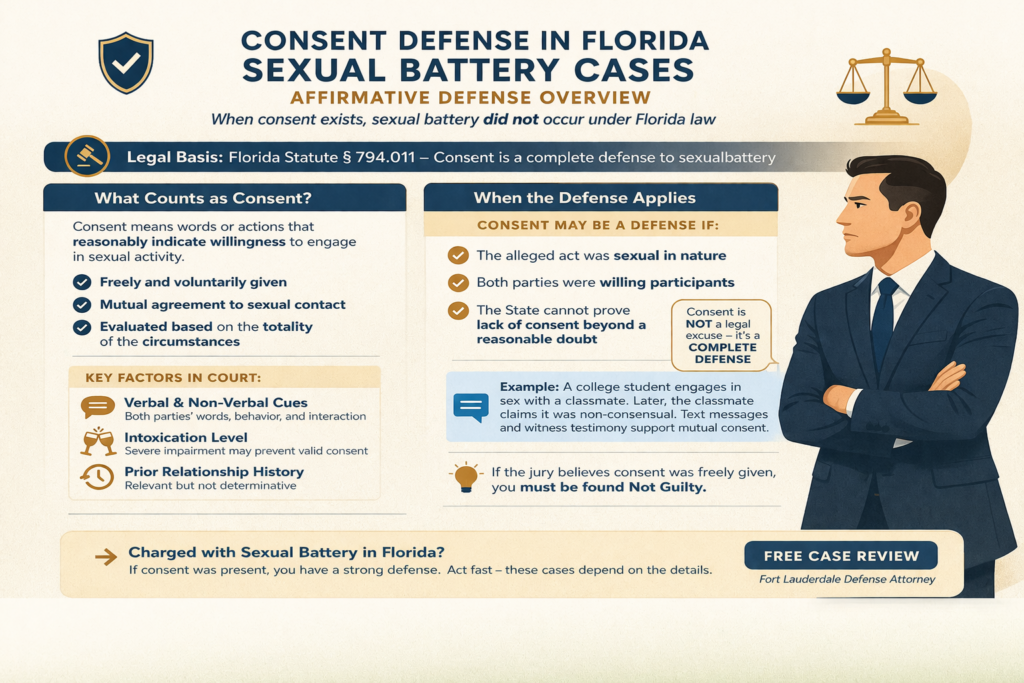
Florida law defines sexual battery as non-consensual sexual activity. That means when consent is present, the legal foundation of the charge can collapse.
But in practice, consent is rarely straightforward. These cases often involve conflicting accounts, limited physical evidence, and credibility disputes, making the defense highly fact-specific.
For a broader overview of how sexual battery charges are prosecuted and defended, see our guide to Sexual Battery Charges in Florida.
❗ How Florida Law Defines Consent
Under Florida law, consent generally means intelligent, knowing, and voluntary agreement.
However, the law also recognizes situations where consent may not legally exist, including:
- When a person is physically helpless or incapacitated
- When coercion, threats, or force are alleged
- When the alleged victim is under a certain age
In cases involving minors, consent may be legally limited depending on age and circumstances. For a broader breakdown of how consent is evaluated, see our guide to Sexual Battery Involving Minors Ages 12–17 in Florida.
This means that even if someone appears to agree, prosecutors may still argue that legal consent was not possible under the circumstances.
🧠 How Consent Is Evaluated in Real Cases
Consent is rarely determined by a single piece of evidence.
Instead, courts and juries evaluate:
- Statements from both parties
- Text messages, social media, or digital communication
- Behavior before, during, and after the alleged incident
- Witness testimony or surrounding context
In many cases, there is no clear physical evidence proving or disproving consent. As a result, these cases often turn on credibility and consistency.
For a deeper look at how evidence is analyzed, see our guide on DNA Evidence in Sexual Battery Cases in Florida.
⚠️ Common Challenges in Consent-Based Defenses
Even when consent is a valid defense, proving it can be difficult.
Common issues include:
Conflicting Testimony
Both parties may provide completely different accounts of the same event.
Lack of Physical Evidence
The absence of injuries or forensic evidence does not automatically prove consent — but it can be a critical factor in the defense.
Delayed Reporting
When allegations are reported later, it can complicate how evidence is interpreted and how credibility is evaluated. Learn more about how timing affects these cases in our guide to Delayed Reporting in Sexual Battery Cases in Florida.
Misinterpretation of Communication
Messages or interactions may be taken out of context or interpreted differently by investigators.
🔍 Consent vs. False Allegations
Not all cases involving disputed consent are fabricated — but some are.
In certain situations, allegations arise from:
- Regret or misunderstanding
- Relationship conflicts
- External pressure or influence
Distinguishing between a lack of consent and a false allegation is often one of the most important aspects of the defense. These cases frequently require a detailed analysis of statements, timelines, and inconsistencies.
⛓️ What Happens If Consent Is Not Accepted?
If a jury rejects a consent defense, the consequences can be severe.
Depending on the allegations, a conviction may lead to:
- Long-term or life imprisonment
- Mandatory sentencing structures
- Lifetime sex offender registration
Because of these stakes, consent defenses must be carefully developed and supported by evidence — not simply asserted.
🛡️ Building a Strong Consent Defense
A successful defense often involves:
- Early investigation of all available evidence
- Preservation of digital communications
- Identification of inconsistencies in statements
- Strategic use of forensic and contextual evidence
The earlier a defense strategy is developed, the greater the opportunity to shape how the case is charged and prosecuted.
📞 Facing a Sexual Battery Allegation?
If your case involves questions of consent, what happens early can determine everything that follows.
A proactive defense can make the difference between a case moving forward — or falling apart.
❓ FREQUENTLY ASKED QUESTIONS ABOUT CONSENT DEFENSE
❓ Can consent be a defense to sexual battery in Florida?
Yes. If the sexual activity was consensual, it may serve as a complete defense. However, consent must be legally valid under Florida law and is often heavily disputed.
❓ How do prosecutors try to disprove consent?
Prosecutors may rely on statements, physical evidence, digital communications, and surrounding circumstances to argue that consent did not exist or was not legally valid.
❓ Does lack of physical evidence help the defense?
It can. While not determinative, the absence of injuries or forensic evidence may support a consent-based defense, depending on the overall facts of the case.