
Last updated March 2026
⚖️ When Allegations Are Reported Later
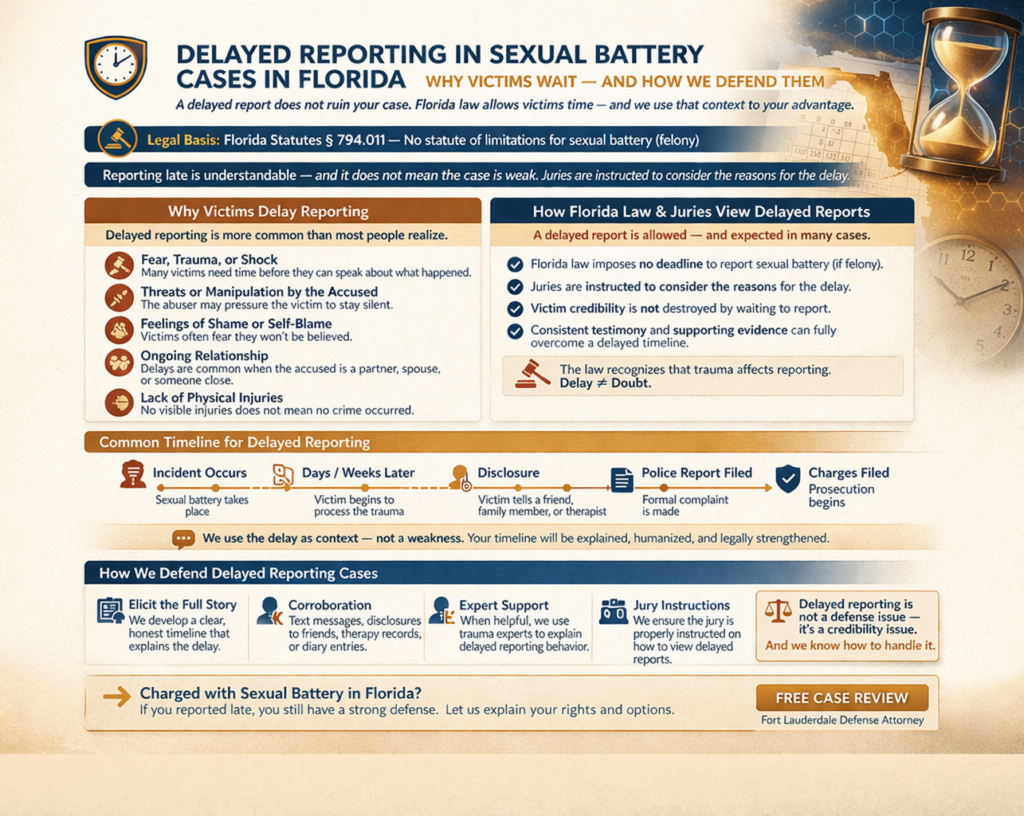
Not all sexual battery allegations are reported immediately.
In some cases, a report may come days, weeks, months, or even years after the alleged incident. This is known as delayed reporting, and it can significantly affect how a case is investigated and defended.
Timing alone does not determine whether an allegation is true or false — but it does impact evidence, memory, and credibility, which are central to any criminal case.
For a broader overview of how sexual battery charges are prosecuted and defended, see our guide to Sexual Battery Charges in Florida.
❗ Why Allegations May Be Reported Late
There are many reasons why someone may delay reporting an allegation.
These may include:
- Fear of consequences or retaliation
- Emotional or psychological factors
- Uncertainty about how to report
- Influence from others
- Delayed interpretation of events
Each case is different, and courts do not assume that a delay automatically undermines an allegation.
Even when an allegation is reported much later, the case may still proceed if it falls within Florida’s legal time limits. To understand how long prosecutors have to file charges, see our guide to the Statute of Limitations for Sexual Battery in Florida.
🧠 How Delayed Reporting Affects Evidence
When a report is delayed, certain types of evidence may no longer be available.
This can include:
- Physical or forensic evidence
- Surveillance footage
- Witness recollection
- Digital data that may have been deleted or lost
As a result, cases involving delayed reporting often rely more heavily on statements and credibility rather than objective evidence.
For a closer look at how forensic evidence is used, see our guide on DNA Evidence in Florida Sexual Battery Cases.
⚠️ The Role of Memory and Inconsistencies
Over time, memory can change.
This does not automatically mean a person is being untruthful — but it does mean that:
- Details may shift or become unclear
- Statements may evolve
- Inconsistencies may develop
These issues are often central to how delayed reporting cases are evaluated in court.
🔍 Delayed Reporting and Credibility
Because physical evidence may be limited, delayed reporting cases frequently turn on credibility.
Key questions often include:
- Are the statements consistent over time?
- Do the statements align with available evidence?
- Is there corroboration from other sources?
- Are there factors that may influence the allegation?
In some cases, delayed reporting overlaps with concerns about false allegations or misinterpretation of events. Learn more in our guide to False Allegations of Sexual Battery in Florida.
🔗 Delayed Reporting vs. Consent Disputes
Some delayed reporting cases are actually consent disputes, where both parties agree contact occurred but disagree about whether it was consensual.
In these situations, timing can complicate how the case is interpreted.
For a deeper understanding of how consent is evaluated, see our guide to Consent Defense in Florida Sexual Battery Cases.
⛓️ What Happens When a Case Proceeds Without Early Evidence
Even without immediate reporting, cases can still move forward.
If prosecutors believe the allegation is credible, charges may be filed based primarily on statements and available context.
If a jury ultimately believes the accusation, the consequences can be severe, including:
- Long-term or life imprisonment
- Mandatory sentencing structures
- Lifetime sex offender registration
🛡️ Defense Strategies in Delayed Reporting Cases
Delayed reporting changes how a case must be defended.
Effective strategies often include:
Reconstructing the Timeline
- Identifying gaps in the sequence of events
- Comparing statements to available records
Preserving and Analyzing Digital Evidence
- Text messages
- Social media
- Location data
Examining Inconsistencies
- Changes in statements over time
- Conflicts with objective evidence
Investigating Context
- Relationship dynamics
- External influences
- Motive or misunderstanding
In many cases, the defense focuses on whether the delay has affected the reliability of the allegation.
📞 Facing a Delayed Allegation?
If you are accused of sexual battery based on a delayed report, the absence of early evidence does not mean the case cannot be challenged.
These cases often depend on credibility, context, and careful analysis of what can — and cannot — be proven after time has passed.
❓ FREQUENTLY ASKED QUESTIONS ABOUT DELAYED REPORTING
❓ Does delayed reporting mean an allegation is false?
No. Delay alone does not determine truth or falsity. Each case must be evaluated based on all available evidence and context.
❓ Can someone still be charged if a report is made much later?
Yes. Charges may still be filed if the statute of limitations has not expired and prosecutors believe there is sufficient evidence.
❓ How does delayed reporting affect a defense?
It can limit available evidence, create inconsistencies in statements, and shift the focus of the case toward credibility and context.