
Last updated March 2026
Few domestic violence charges in Florida escalate a case as quickly as domestic violence by strangulation. Prosecutors treat these cases as inherently dangerous because strangulation can cause serious injury or death even when visible injuries appear minimal.
In Florida, strangulation in a domestic relationship is charged as a third-degree felony, exposing a defendant to prison, probation, and long-term collateral consequences.
If you or someone you care about has been arrested for strangulation in Fort Lauderdale or Broward County, it is critical to understand how the law works and what defenses may apply.
If you are facing domestic violence charges in South Florida, start by reviewing our guide to working with a Fort Lauderdale Domestic Violence Defense Lawyer to understand the legal process and immediate steps to protect your rights.
What Is Domestic Violence by Strangulation in Florida?
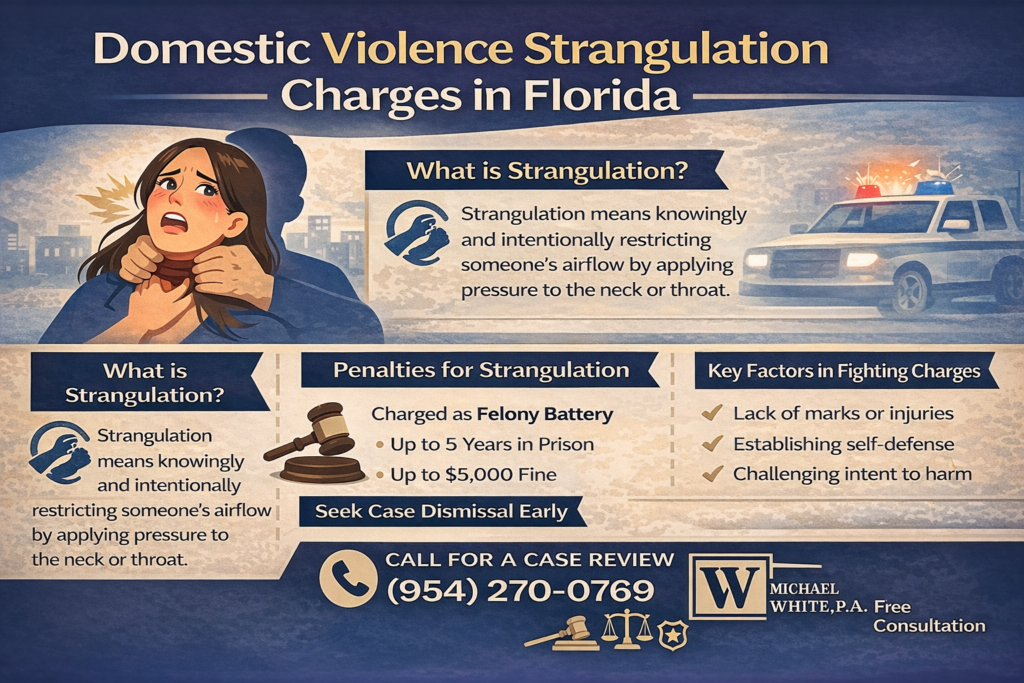
Domestic violence by strangulation is defined under Florida Statute 784.041.
The law makes it a felony when a person:
Knowingly and intentionally impedes the normal breathing or circulation of blood
By applying pressure to the throat or neck
Or by blocking the nose or mouth
Against a family or household member
The key elements prosecutors must prove are intent, impeding breathing or circulation, and the existence of a domestic relationship.
Unlike other violent crimes, the statute does not require visible injury. A person can face a felony charge even when the alleged victim shows little or no physical marks.
Why Strangulation Charges Are Treated So Seriously
Prosecutors and law enforcement consider strangulation one of the most dangerous forms of domestic violence because it can lead to rapid unconsciousness, internal injury, or delayed medical complications.
As a result, these cases often receive heightened attention from domestic violence units within the State Attorney’s Office.
Even when injuries appear minor, officers frequently make arrests based on allegations of restricted breathing or statements made during a 911 call.
Penalties for Domestic Violence Strangulation
Domestic violence by strangulation is classified as a third-degree felony in Florida.
Potential penalties include:
Up to 5 years in prison
Up to 5 years of felony probation
Up to $5,000 in fines
A conviction may also result in:
A permanent felony record
Loss of firearm rights under federal law
Mandatory batterers’ intervention program participation
Immigration consequences for non-citizens
Evidence Prosecutors Often Use in Strangulation Cases
Strangulation allegations are frequently supported by indirect evidence rather than obvious physical injury.
Common forms of evidence include:
911 recordings describing breathing restriction
Body-worn camera footage
Photographs of redness or bruising
Medical records
Statements from the alleged victim
Text messages or social media messages
Common Defenses to Domestic Violence Strangulation
Every case turns on its specific facts. However, several defenses frequently arise in strangulation prosecutions.
Lack of Intent
The statute requires intentional conduct. Accidental contact or defensive movements may not satisfy this element.
Self-Defense
If a person used force to protect themselves during a confrontation, self-defense may apply.
Florida law also allows immunity from prosecution when justified force is used. Learn more in our guide to Stand Your Ground in a Florida Domestic Violence Case.
Lack of Medical Evidence
Because strangulation can occur without visible injury, prosecutors sometimes rely heavily on statements rather than objective proof.
The absence of medical findings can weaken the State’s case.
False or Exaggerated Allegations
Domestic disputes often arise during emotionally charged situations such as breakups or custody conflicts. In some cases, allegations are exaggerated or misinterpreted.
Bond and Release Conditions in Strangulation Cases
Because strangulation is charged as a felony, defendants are typically held until first appearance before a judge.
Judges often impose strict release conditions, including:
No contact orders
GPS monitoring
Travel restrictions
Substance testing
Because strangulation is charged as a felony, defendants are often held in custody until a judge determines release conditions. You can learn how this process works in Bond in Domestic Violence Cases in Florida.
Can Domestic Violence Strangulation Charges Be Dropped?
Like other domestic violence offenses, strangulation charges cannot be “dropped” by the alleged victim alone.
Once an arrest occurs, the State Attorney controls whether the case proceeds.
However, charges may still be dismissed or reduced when evidence is weak or contradictory.
Speak With a Fort Lauderdale Domestic Violence Defense Lawyer
A strangulation charge can dramatically change the direction of a domestic violence case because it converts a misdemeanor battery into a felony prosecution.
Early defense investigation is critical. Evidence such as body-cam video, medical records, and witness statements can determine whether the case proceeds or collapses.
If you were arrested for domestic violence strangulation in Fort Lauderdale, Hollywood, or anywhere in Broward County, speak with an experienced defense lawyer as soon as possible.
Michael White, P.A. is a former Broward prosecutor who understands how domestic violence cases are built — and how they can be challenged.
Call (954) 270-0769 for a confidential consultation.